East Africa Map: Countries, Great Rift Valley & Natural Wonders
Where Is East Africa?
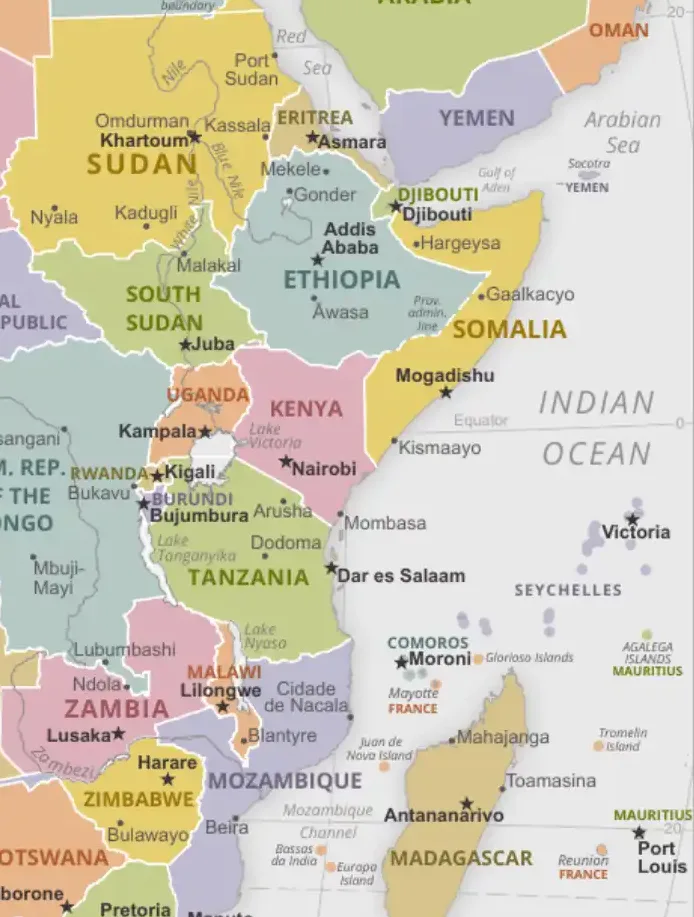
East Africa is the eastern side of the African continent, running from Eritrea and Djibouti on the Red Sea south to Tanzania, with Madagascar and the smaller Indian Ocean islands offshore. The map on this page shows the 13 countries most often called East Africa: Ethiopia, Tanzania, Kenya, Uganda, Rwanda, Burundi, Somalia, Eritrea, Djibouti, Madagascar, Mauritius, Seychelles and Comoros. The region contains the Great Rift Valley, Africa's highest mountain (Kilimanjaro), Lake Victoria and the source of the White Nile.
Country counts vary by definition: this map covers the 13 countries most often called East Africa, while the UN grouping used in our East Africa region guide has 18, adding South Sudan, Malawi, Mozambique, Zambia and Zimbabwe.
Last updated: September 2026
Use the buttons above the interactive map to show all 13 countries, only the mainland or island states, the countries crossed by the Rift Valley, or the main national parks. Click a marker for the capital and population.
The 13 Countries of East Africa
Populations below are approximate 2024 UN estimates. Nine countries are on the mainland; four are island states in the Indian Ocean.
🇪🇹 Ethiopia
Capital: Addis Ababa
Population: about 130 million
Area: 1,104,300 km²
Languages: Amharic, Oromo, Tigrinya
Africa's second most populous country and, apart from the Italian occupation of 1936–41, never colonised. Home to the African Union headquarters, the rock-hewn churches of Lalibela and Lake Tana, source of the Blue Nile. Landlocked since Eritrea's independence in 1993.
Key Features: Lucy fossil discovery site, Simien Mountains, Ethiopian coffee origin, unique calendar system
🇹🇿 Tanzania
Capital: Dodoma (official); Dar es Salaam is the largest city
Population: about 68 million
Area: 947,303 km²
Languages: Swahili, English
Home to Mount Kilimanjaro (Africa's highest peak), Serengeti National Park, Ngorongoro Crater, and the spice island of Zanzibar. Also home to the Great Migration and Olduvai Gorge, a key early-human fossil site.
Key Features: Great Migration, Kilimanjaro, Zanzibar Stone Town, wildlife diversity, Swahili culture
🇰🇪 Kenya
Capital: Nairobi
Population: about 56 million
Area: 580,367 km²
Languages: Swahili, English
East Africa's largest economy and main business hub. The Rift Valley crosses the country from north to south; it also borders Lake Victoria and the Indian Ocean. Known for the Maasai Mara, tea exports and mobile money (M-Pesa).
Key Features: Maasai Mara Reserve, Great Rift Valley lakes, Samburu culture, tech innovation hub
🇺🇬 Uganda
Capital: Kampala
Population: about 50 million
Area: 241,038 km²
Languages: English, Swahili
Landlocked "Pearl of Africa", with mountain gorillas in Bwindi, the White Nile leaving Lake Victoria at Jinja, and the glaciated Rwenzori Mountains on the DR Congo border.
Key Features: Mountain gorillas, Nile source, Rwenzori Mountains, crater lakes, diverse ecosystems
🇲🇬 Madagascar
Capital: Antananarivo
Population: about 31 million
Area: 587,041 km²
Languages: Malagasy, French
The world's fourth-largest island, about 400 km off Mozambique across the Mozambique Channel. Long isolation means roughly 90% of its wildlife, including all lemurs, is found nowhere else.
Key Features: Lemurs, baobab trees, unique biodiversity, Avenue of the Baobabs, endemic species
🇸🇴 Somalia
Capital: Mogadishu
Population: about 19 million
Area: 637,657 km²
Languages: Somali, Arabic
Occupies the tip of the Horn of Africa and has the longest mainland coastline in Africa (about 3,300 km) on the Gulf of Aden and Indian Ocean. Pastoralism, especially camel herding, is central to the economy.
Key Features: Longest African coastline, nomadic culture, ancient trade routes, strategic location
🇷🇼 Rwanda
Capital: Kigali
Population: about 14 million
Area: 26,338 km²
Languages: Kinyarwanda, French, English
Small, landlocked and densely populated "Land of a Thousand Hills", just south of the Equator. Known for mountain gorillas in Volcanoes National Park, Lake Kivu and its recovery since the 1994 genocide.
Key Features: Mountain gorillas, Lake Kivu, Nyungwe Forest, Kigali
🇧🇮 Burundi
Capital: Gitega (political); Bujumbura is the economic centre
Population: about 14 million
Area: 27,834 km²
Languages: Kirundi, French
Small, landlocked Great Lakes country on the northeastern shore of Lake Tanganyika, the world's second-deepest lake. Known for its royal drumming tradition (UNESCO-listed).
Key Features: Lake Tanganyika, traditional drumming, dense population, mountainous terrain
🇪🇷 Eritrea
Capital: Asmara
Population: about 3.5 million
Area: 117,600 km²
Languages: Tigrinya, Arabic, English
Red Sea country, independent from Ethiopia since 1993. Asmara's Italian-era modernist architecture is a UNESCO World Heritage Site; the northern Danakil Depression lies in the southeast.
Key Features: Italian colonial architecture, Red Sea coast, diverse ethnic groups, Danakil Depression
🇲🇺 Mauritius
Capital: Port Louis
Population: about 1.3 million
Area: 2,040 km²
Languages: English, French, Mauritian Creole
Volcanic island about 2,000 km off the African coast, east of Madagascar. One of Africa's highest-income countries, with an economy built on tourism, financial services and, historically, sugar.
Key Features: Luxury tourism, coral reefs, multicultural society, economic success, beaches
🇩🇯 Djibouti
Capital: Djibouti City
Population: about 1.2 million
Area: 23,200 km²
Languages: Arabic, French
Small country on the Bab-el-Mandeb strait between the Red Sea and Gulf of Aden. Handles most of Ethiopia's trade and hosts several foreign military bases. Lake Assal, at 155 m below sea level, is Africa's lowest point.
Key Features: Lake Assal, Bab-el-Mandeb strait, port of Djibouti, Afar Triangle
🇰🇲 Comoros
Capital: Moroni
Population: about 0.9 million
Area: 2,235 km²
Languages: Arabic, French, Comorian
Three volcanic islands (Grande Comore, Mohéli, Anjouan) at the northern end of the Mozambique Channel. A major ylang-ylang and vanilla producer; Mount Karthala is one of the world's largest active volcanoes.
Key Features: Ylang-ylang production, volcanic islands, Islamic culture, marine biodiversity
🇸🇨 Seychelles
Capital: Victoria
Population: about 130,000
Area: 459 km²
Languages: English, French, Seychellois Creole
Africa's smallest country by area and population: 115 granite and coral islands northeast of Madagascar. Aldabra atoll holds one of the world's largest giant tortoise populations.
Key Features: Aldabra atoll, Vallée de Mai, giant tortoises, beaches
The Great Rift Valley: East Africa's Defining Feature
The Great Rift Valley system is East Africa's most distinctive geographical feature, stretching over 6,000 kilometers from Lebanon to Mozambique. In East Africa, this massive geological formation creates dramatic landscapes, deep lakes, and volcanic activity that defines the region's character.
Eastern Rift Valley
The Eastern branch of the Rift Valley runs through Ethiopia, Kenya, and Tanzania, creating a series of lakes, volcanoes, and escarpments that form some of Africa's most spectacular scenery:
- Ethiopia: Features the Danakil Depression (one of Earth's lowest and hottest places), volcanic activity, and highland plateaus
- Kenya: Home to Lakes Nakuru, Naivasha, and Bogoria, plus the dramatic Rift Valley escarpment visible from Nairobi
- Tanzania: Contains Lake Natron, Lake Manyara and the volcanic Ngorongoro highlands
Western Rift Valley
The Western branch (Albertine Rift) holds a chain of long, deep lakes. Lake Victoria, Africa's largest lake, sits in the shallow basin between the two branches rather than in either rift.
- Lake Albert and Lake Edward: On the Uganda–DR Congo border
- Lake Tanganyika: World's second-deepest lake (shared by Tanzania, Burundi, and Democratic Republic of Congo)
- Lake Kivu: High-altitude lake between Rwanda and Democratic Republic of Congo
Geological Significance
The Rift Valley represents an active continental splitting process, where the African continent is slowly separating into two parts. This geological activity creates:
- Volcanic mountains including Mount Kilimanjaro, Mount Kenya and the Virunga volcanoes; the non-volcanic Rwenzori range was uplifted by rifting
- Hot springs and geothermal activity used for energy production
- Unique ecosystems supporting diverse wildlife and endemic species
- Rich fossil deposits revealing human evolutionary history
Wildlife and Conservation: East Africa's Natural Heritage
East Africa hosts some of the world's most famous wildlife concentrations and conservation success stories. The region's diverse ecosystems support an incredible array of species, from the Big Five to endemic primates and unique island fauna.
Major National Parks and Reserves
Tanzania
- Serengeti National Park: Famous for the Great Migration of 2 million wildebeest, zebras, and gazelles
- Ngorongoro Conservation Area: UNESCO World Heritage site featuring the world's largest intact volcanic caldera
- Nyerere National Park (formerly Selous Game Reserve): One of Africa's largest protected areas
- Tarangire National Park: Known for large elephant herds and distinctive baobab trees
Kenya
- Maasai Mara National Reserve: Northern extension of Serengeti ecosystem, famous for wildlife density
- Amboseli National Park: Best views of Mount Kilimanjaro with large elephant populations
- Tsavo East and West: Combined form one of the world's largest protected areas
- Samburu National Reserve: Home to unique northern species including Grevy's zebra and reticulated giraffe
Uganda
- Bwindi Impenetrable National Park: Mountain gorilla habitat and UNESCO World Heritage site
- Queen Elizabeth National Park: Features tree-climbing lions and diverse ecosystems
- Murchison Falls National Park: Where the Nile River creates spectacular waterfalls
Rwanda
- Volcanoes National Park: Mountain gorilla conservation success story
- Nyungwe Forest National Park: Montane rainforest with primates and canopy walks
Conservation Success Stories
East Africa leads in wildlife conservation innovations:
- Mountain Gorilla Recovery: Numbers rose from about 620 in 1989 to over 1,000 in the most recent census
- Community Conservation: Local communities benefit from tourism revenue, creating incentives for protection
- Anti-Poaching Efforts: Technology and international cooperation reducing elephant and rhino poaching
- Marine Conservation: Indian Ocean coral reef protection and sustainable fishing practices
Cultural Diversity and Heritage
East Africa represents extraordinary cultural diversity, with over 400 distinct ethnic groups speaking hundreds of languages. This cultural richness reflects thousands of years of migration, trade, and cultural exchange.
Major Cultural Groups
Bantu Peoples
The largest language family in East Africa, including:
- Kikuyu (Kenya): Largest ethnic group in Kenya, traditional farmers and traders
- Chagga (Tanzania): Mount Kilimanjaro slopes inhabitants known for coffee cultivation
- Baganda (Uganda): Dominant group in Uganda with ancient kingdom traditions
- Hutu and Tutsi (Rwanda/Burundi): Historically interrelated groups with complex social structures
Nilotic Peoples
Pastoralist groups primarily in northern regions:
- Maasai (Kenya/Tanzania): Famous warriors and cattle herders maintaining traditional lifestyle
- Turkana (Kenya): Nomadic pastoralists in arid northern regions
- Dinka and Nuer (South Sudan/Ethiopia): Tall cattle-herding peoples of the Nile basin
Cushitic Peoples
Primarily in the Horn of Africa:
- Oromo (Ethiopia): Ethiopia's largest ethnic group with ancient democratic traditions
- Somali: Nomadic pastoralists across Somalia, Ethiopia, Kenya, and Djibouti
- Afar: Desert nomads in the Danakil Depression region
Languages
East Africa's linguistic landscape includes:
- Swahili: Regional lingua franca spoken by an estimated 100 million or more people; a Bantu language with many Arabic loanwords
- Amharic: Official language of Ethiopia, using unique Ge'ez script
- English: Official language in Kenya, Uganda, Tanzania, and several other countries
- French: Official in Rwanda, Burundi, Djibouti, Madagascar, Comoros and Seychelles
- Arabic: Important in Somalia, Djibouti, and Comoros
Religious Traditions
- Christianity: Dominant in Kenya, Uganda, Tanzania, Rwanda, Burundi, and Ethiopia
- Islam: Majority in Somalia, Djibouti, and Comoros; significant minorities elsewhere
- Traditional Religions: Still practiced alongside major religions, varying by ethnic group
- Ethiopian Orthodox: Ancient Christian tradition unique to Ethiopia and Eritrea
Economic Landscapes and Opportunities
East Africa represents one of Africa's most dynamic economic regions, with diverse economies ranging from traditional agriculture to modern services and emerging technology sectors.
Major Economic Sectors
Agriculture and Natural Resources
- Coffee: Ethiopia (origin of coffee), Kenya, Uganda, Rwanda, and Burundi are major producers
- Tea: Kenya is one of the world's largest black tea exporters
- Tourism: Wildlife safaris, cultural tourism, and beach destinations generate billions annually
- Horticulture: Kenya exports flowers, vegetables, and fruits to Europe and Middle East
- Fisheries: Lake Victoria, Indian Ocean, and other water bodies support significant fishing industries
Emerging Industries
- Technology: Kenya's "Silicon Savannah" leads in mobile money innovation (M-Pesa) and fintech
- Manufacturing: Growing textile, food processing, and light manufacturing sectors
- Financial Services: Regional banking hubs in Nairobi and emerging markets
- Energy: Geothermal (Kenya), hydroelectric (Ethiopia, Uganda), and renewable energy development
Regional Integration
The East African Community (EAC) has eight members: Kenya, Tanzania, Uganda, Rwanda, Burundi, South Sudan, the DR Congo (joined 2022) and Somalia (joined 2024).
- Common Market: Free movement of goods, services, capital, and people
- Single Currency Goal: A long-term plan for monetary union, whose target date has been pushed back several times
- Infrastructure Projects: Cross-border roads, railways, and energy connections
- Political Federation: Long-term goal of political integration
Climate and Geography
East Africa's diverse geography creates multiple climate zones, from equatorial rainforests to arid deserts, high mountain peaks to tropical islands, supporting varied ecosystems and agricultural systems.
Climate Zones
Tropical Highland Climate
Found in elevated areas (1,500+ meters above sea level):
- Ethiopian Highlands: Cool temperatures, distinct wet and dry seasons
- Kenyan Highlands: Ideal for tea, coffee, and flower cultivation
- Rwandan Hills: Moderate temperatures year-round, excellent for agriculture
- Mount Kilimanjaro Region: Multiple climate zones from tropical to alpine
Equatorial Climate
Near the equator with consistent temperatures and rainfall:
- Uganda: Reliable rainfall supporting diverse agriculture
- Western Kenya: Lake Victoria region with high humidity
- Lake Victoria basin: Rain in most months, supporting dense farming
Savanna Climate
Characterized by distinct wet and dry seasons:
- Serengeti Ecosystem: Supports massive wildlife migrations
- Maasai Steppe: Traditional pastoralist areas
- Southern Kenya/Tanzania: Mixed farming and ranching regions
Arid and Semi-Arid
Limited rainfall supporting specialized ecosystems:
- Northern Kenya: Pastoralist regions with drought-resistant livestock
- Somalia: Desert and semi-desert supporting nomadic cultures
- Danakil Depression: One of Earth's hottest and driest places
Tropical Marine Climate
Island nations with oceanic influences:
- Zanzibar: Tropical with monsoon influences
- Mauritius: Warm temperatures moderated by ocean breezes
- Seychelles: Consistent tropical warmth with seasonal rainfall
- Comoros: Tropical with volcanic influences
Seasonal Patterns
East Africa experiences complex seasonal patterns influenced by monsoons and altitude:
- Long Rains: March-May, crucial for agriculture
- Dry Season: June-October, optimal for wildlife viewing
- Short Rains: November-December, variable intensity
- Dry Season: January-February, warmest period
Travel and Tourism Guide
East Africa offers world-class travel experiences, from wildlife safaris to cultural immersion, beach holidays to mountain adventures. Each country provides unique attractions and experiences for every type of traveler.
Must-See Destinations
Wildlife and Nature
- Serengeti-Maasai Mara Ecosystem: Greatest wildlife spectacle on Earth
- Ngorongoro Crater: Intact volcanic caldera with incredible wildlife density
- Mount Kilimanjaro: Africa's highest peak and popular trekking destination
- Bwindi Impenetrable Forest: Mountain gorilla trekking experience
- Volcanoes National Park: Golden monkey and gorilla encounters
Cultural Heritage
- Stone Town, Zanzibar: UNESCO World Heritage Swahili cultural center
- Lalibela, Ethiopia: Rock-hewn churches and Orthodox Christian pilgrimage site
- Maasai Villages: Traditional warrior culture experiences
- Asmara, Eritrea: Preserved Italian Art Deco architecture
Beach and Islands
- Zanzibar Archipelago: Beaches, spice tours, and historic Stone Town
- Mauritius: Luxury resorts, coral reefs, and water sports
- Seychelles: Exclusive island paradise with unique granite formations
- Kenyan Coast: Diani Beach, Malindi, and coastal cultural sites
Travel Seasons
- Dry Season (June-October): Best for wildlife viewing, clear skies
- Migration Season (July-September): Optimal time for Serengeti-Maasai Mara crossing
- Shoulder Seasons (November-December, March-May): Fewer crowds, varied weather
- Calving Season (January-March): Serengeti births, excellent predator activity
Travel Tips
- Visas: Many countries offer e-visas or visa-on-arrival for tourists
- Health: Yellow fever vaccination is required or recommended for several countries (check each one); malaria precautions are advised in most lowland areas
- Currency: Most countries have separate currencies; USD widely accepted in tourism sector
- Language: English and Swahili widely spoken; French in some countries
- Transportation: Domestic flights connect major destinations; road conditions vary
Historical Significance
East Africa holds profound historical importance as the "Cradle of Humanity," the crossroads of ancient trade routes, and the birthplace of human civilization. Archaeological discoveries in the region have revolutionized our understanding of human evolution and early societies.
Human Evolution
- Olduvai Gorge, Tanzania: "Cradle of Mankind" where Louis and Mary Leakey discovered early human fossils
- Lucy Discovery, Ethiopia: 3.2 million-year-old Australopithecus afarensis fossil
- Laetoli Footprints: about 3.5 million-year-old hominin tracks preserved in volcanic ash
- Turkana Boy, Kenya: Nearly complete Homo erectus skeleton from 1.6 million years ago
Ancient Civilizations
- Kingdom of Aksum (Ethiopia): Ancient trading empire controlling Red Sea trade routes
- Swahili City-States: Medieval trading centers along the East African coast
- Kingdom of Buganda (Uganda): Sophisticated pre-colonial state with complex political systems
Trade and Cultural Exchange
- Indian Ocean Trade: Ancient connections with Arabia, Persia, India, and China
- Arab Influence: Islamic culture, architecture, and language (especially Swahili)
- Portuguese Period: Early European contact and colonial influence
- Omani Empire: Significant Arab presence, especially in Zanzibar
Using Our Interactive Map
Map Features
- All Countries View: Complete overview of all 13 East African nations
- Mainland Countries: Focus on continental nations excluding island states
- Island Nations: Explore Indian Ocean island countries and their unique characteristics
- Great Rift Valley: Highlight countries along this geological wonder
- Wildlife Parks: Locate major national parks and conservation areas
Click any country marker to see its capital, population, whether it is a mainland or island state and whether the Rift Valley crosses it. Park markers (lion icons) appear under "Wildlife Parks". For full profiles, open the country pages linked in the list above.
Related Maps
See also the Horn of Africa map, where the Great Rift Valley is, where Mount Kilimanjaro is, where Rwanda is and the neighbouring Central Africa and Southern Africa maps.
Frequently Asked Questions
Which countries are in East Africa?
This map uses the common 13-country definition: Ethiopia, Tanzania, Kenya, Uganda, Rwanda, Burundi, Somalia, Eritrea and Djibouti on the mainland, plus the island states of Madagascar, Mauritius, Seychelles and Comoros. The UN geoscheme counts 18 by adding South Sudan, Malawi, Mozambique, Zambia and Zimbabwe.
What is the largest country in East Africa?
Ethiopia is the largest by both area (about 1.1 million km²) and population (about 130 million). Tanzania is second by area and population.
What is the East African Community?
The East African Community (EAC) is a regional bloc of eight member states promoting economic and political integration: Kenya, Tanzania, Uganda, Rwanda, Burundi, South Sudan, the Democratic Republic of the Congo and Somalia.
What languages are spoken in East Africa?
Swahili is the most widely spoken regional language and is an official language of Kenya, Tanzania, Uganda and the EAC. English, Arabic, Amharic, French and dozens of indigenous languages are also widely used.
When is the best time to visit East Africa?
The long dry season from June to October is best for safaris. The Great Migration usually reaches Kenya's Maasai Mara between July and September, while calving in the southern Serengeti peaks around January to March.
Is the Great Rift Valley in East Africa?
Yes. The East African Rift runs from the Afar Triangle in Ethiopia southward through Kenya, Uganda, Tanzania, Malawi and Mozambique, splitting into the Eastern and Western Rifts that frame Lake Victoria.