Horn of Africa Map
Where Is the Horn of Africa?
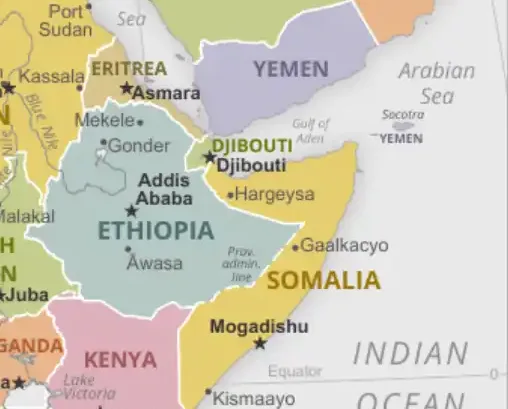
The Horn of Africa is the peninsula on the far eastern tip of Africa that juts into the Arabian Sea, with the Gulf of Aden to the north and the Indian Ocean to the east. It is made up of four countries: Ethiopia, Somalia, Eritrea and Djibouti. Together they cover about 1.9 million km² and are home to roughly 155 million people, most of them in Ethiopia. Across the narrow Bab-el-Mandeb strait lies Yemen on the Arabian Peninsula.
Last updated: September 2026
On a map, look for the "horn" shape pointing east between roughly 0° and 18° N. Ethiopia fills the highland interior and has been landlocked since Eritrea became independent in 1993; Eritrea and Djibouti hold the Red Sea coast; Somalia wraps around the tip, including Cape Guardafui (Ras Asir), the easternmost point of mainland Africa. The self-declared Republic of Somaliland in the north-west of Somalia runs its own affairs but is not internationally recognised as a state. Some broader definitions of the "Greater Horn" also include Kenya, Sudan, South Sudan and Uganda. The Horn is usually treated as part of East Africa – see also our East Africa map. Click the markers on the interactive map above for each country's key facts.
The Four Countries of the Horn of Africa
The Horn of Africa encompasses four sovereign nations, each with distinct histories, cultures, and geographical features, yet united by their shared location on this strategic peninsula.
🇪🇹 Ethiopia
Capital: Addis Ababa
Population: about 130 million (2024)
Area: 1,104,300 km²
Languages: Amharic (official), Oromo, Tigrinya, Somali, others
Africa's second-most populous country and, with Liberia, one of only two African countries never colonised (apart from Italy's occupation of 1936–1941). Known as the birthplace of coffee, home to ancient Orthodox Christian traditions, and featuring the source of the Blue Nile. Addis Ababa serves as the diplomatic capital of Africa, hosting the African Union headquarters.
Key Features: Never colonized, ancient Christian heritage, coffee origins, African Union headquarters, Lucy fossil discoveries
🇸🇴 Somalia
Capital: Mogadishu
Population: about 19 million (2024)
Area: 637,657 km²
Languages: Somali, Arabic
Strategically located at the tip of the Horn with the longest coastline of mainland Africa (about 3,300 km), featuring extensive Indian Ocean shores. Known for ancient trading civilization, nomadic pastoral culture, and significant maritime heritage. The Somali people extend across the Horn region, with significant populations in neighboring countries, creating cultural continuity across borders.
Key Features: Longest mainland African coastline, ancient trading heritage, nomadic traditions, strategic maritime location, cultural diaspora
🇪🇷 Eritrea
Capital: Asmara
Population: about 3.5 million (estimate)
Area: 117,600 km²
Languages: Tigrinya, Arabic, English (working languages), Tigre and others
Gained independence from Ethiopia in 1993, becoming Africa's newest state at the time (South Sudan followed in 2011). Features a long Red Sea coastline, Italian colonial architecture in Asmara (UNESCO World Heritage site), and diverse landscapes from coastal deserts to highland plateaus. Known for cycling culture and unique architectural heritage.
Key Features: Africa's former newest state, Red Sea coast, UNESCO World Heritage capital, Italian architecture, cycling culture
🇩🇯 Djibouti
Capital: Djibouti City
Population: about 1.2 million (2024)
Area: 23,200 km²
Languages: French, Arabic, Afar, Somali
Smallest Horn of Africa country but highly strategic, on the African side of the Bab-el-Mandeb strait at the entrance to the Red Sea. Hosts several foreign military bases and handles most of landlocked Ethiopia's trade, linked by the Addis Ababa–Djibouti railway. Lake Assal, about 155 m below sea level, is the lowest point in Africa and one of the saltiest lakes on Earth.
Key Features: Strategic strait control, international military bases, Ethiopia's main port, unique geology, Lake Assal
Geographic Features and Significance
The Horn of Africa's distinctive geography has shaped its history, culture, and strategic importance throughout human civilization.
Physical Geography
The Peninsula Formation
- Shape: Horn-shaped peninsula pointing east into the Arabian Sea, ending at Cape Guardafui
- Area: About 1.9 million km² for the four countries
- Tectonics: The Afar Triangle is where the Red Sea, Gulf of Aden and East African rifts meet; the Somali Plate is slowly pulling away from the Nubian (African) Plate
- Elevation: From about 155 m below sea level (Lake Assal) to 4,550 m at Ras Dashen in Ethiopia's Simien Mountains
Major Water Bodies
- Red Sea: North-eastern coast of Eritrea and Djibouti, connecting to the Mediterranean via the Suez Canal
- Gulf of Aden: Northern coast of Somalia and Djibouti, linking the Red Sea to the Arabian Sea
- Indian Ocean: Eastern and southern coast of Somalia
- Bab-el-Mandeb Strait: Critical chokepoint between Red Sea and Gulf of Aden
Diverse Landscapes
- Ethiopian Highlands: Africa's largest continuous mountain area above 1,500m
- Great Rift Valley: Dramatic geological feature running through the region
- Danakil Desert: One of Earth's hottest and lowest places
- Coastal Plains: Extensive lowlands along Red Sea and Indian Ocean
Climate Zones
- Highland Climate: Temperate conditions in Ethiopian plateau areas
- Arid Desert: Hot, dry conditions in lowland areas
- Semi-Arid: Transitional zones supporting pastoral activities
- Coastal Tropical: Hot, humid conditions along coastlines
Strategic Importance and Maritime Significance
The Horn of Africa's location makes it one of the world's most strategically important regions for global trade, military operations, and geopolitical influence.
Global Trade Routes
Suez Canal Connection
- Trade Volume: Roughly 12% of world trade used the Red Sea–Suez route before Houthi attacks on shipping from late 2023 diverted many vessels around the Cape of Good Hope
- Oil Transport: Major route for Middle Eastern oil to Europe and Americas
- Container Ships: Primary route between Asia and Europe
- Economic Impact: Billions in daily trade value transit the region
Critical Chokepoints
- Bab-el-Mandeb Strait: About 29 km wide at its narrowest point
- Strategic Control: Yemen and Djibouti control access
- Security Concerns: Piracy and regional conflicts affect shipping
- Alternative Routes: The only sea alternative between Europe and Asia is the much longer voyage around southern Africa
Military and Security Presence
International Military Bases
- Djibouti: Hosts bases from US, France, China, Japan, and others
- Somalia: International peacekeeping and anti-piracy operations
- Strategic Value: Control of Red Sea and Indian Ocean access
Regional Security Challenges
- Piracy: Somali waters historically affected by maritime piracy
- Terrorism: Regional groups pose security threats
- Border Disputes: Ongoing territorial and boundary issues
- Refugee Movements: Large displaced populations from regional conflicts
Ancient Civilizations and Historical Heritage
The Horn of Africa has been home to some of humanity's oldest civilizations, serving as a crossroads between African, Arabian, and Mediterranean cultures for thousands of years.
Prehistoric Significance
Human Evolution
- Lucy (Australopithecus): 3.2 million-year-old fossil found in Ethiopia
- Ardipithecus: Earlier hominid species discovered in Ethiopian Rift Valley
- Stone Tools: Some of world's oldest stone tool discoveries
- Archaeological Sites: Numerous sites documenting human evolution
Ancient Kingdoms and Empires
Kingdom of Aksum (1st-8th century CE)
- Location: Northern Ethiopia and Eritrea
- Trade Power: Major trading empire connecting Africa, Arabia, and Rome
- Christianity: One of world's earliest Christian kingdoms
- Legacy: Giant stelae (obelisks) at Aksum, its own coinage and the Ge'ez script
Land of Punt
- Egyptian Records: Trading partner mentioned in ancient Egyptian texts
- Location: Likely covered parts of present-day Somalia and Ethiopia
- Trade Goods: Gold, ebony, wild animals, incense
- Cultural Exchange: Early example of Africa-Mediterranean trade
Somali City-States
- Mogadishu: Major medieval trading city
- Berbera: Important Gulf of Aden port
- Zeila: Historical trading center
- Islamic Culture: Spread of Islam through trade connections
Religious and Cultural Heritage
- Ethiopian Orthodox Christianity: Ancient Christian traditions and rock churches
- Islam: Early Islamic settlements and cultural influence
- Traditional Beliefs: Indigenous spiritual practices and customs
- Cultural Fusion: Unique blend of African, Arabian, and Mediterranean influences
Cultural Diversity and People
The Horn of Africa showcases remarkable cultural and linguistic diversity, with numerous ethnic groups, languages, and traditions creating a rich tapestry of human heritage.
Major Ethnic Groups
Ethiopian Peoples
- Oromo: Largest ethnic group, primarily in central and southern Ethiopia
- Amhara: Highland people, traditional political influence
- Tigray: Northern Ethiopia, related to Eritrean Tigrinya
- Sidama: Southern peoples with distinct cultural traditions
- Afar: Desert nomads in eastern lowlands
Somali Peoples
- Distribution: Somalia, eastern Ethiopia, northern Kenya, Djibouti
- Clans: Complex clan-based social organization
- Pastoralism: Traditional nomadic livestock herding
- Unity: Shared language, religion, and cultural practices
Other Regional Groups
- Tigrinya (Eritrea): Highland people with ancient cultural heritage
- Rashaida: Arab nomadic people in coastal areas
- Kunama: Agricultural people in Eritrea-Ethiopia border
- Issa and Afar (Djibouti): Nomadic peoples in Djibouti
Languages
- Cushitic Languages: Oromo, Somali, Afar (largest family)
- Semitic Languages: Amharic, Tigrinya, Arabic
- Nilo-Saharan: Various languages in border regions
- Official Languages: Amharic, Somali, Arabic, French, English
Traditional Lifestyles
- Highland Agriculture: Terraced farming, coffee cultivation
- Pastoral Nomadism: Cattle, goat, and camel herding
- Coastal Trading: Maritime commerce and fishing
- Urban Centers: Ancient cities with modern development
Economic Development and Resources
Despite challenges, the Horn of Africa possesses significant economic potential through its strategic location, natural resources, and human capital.
Economic Sectors
Agriculture and Livestock
- Coffee: Ethiopia is the birthplace and major exporter of coffee
- Livestock: Large populations of cattle, goats, sheep, and camels
- Cereals: Sorghum, maize, wheat in highland areas
- Pastoralism: Traditional livestock systems supporting millions
Natural Resources
- Energy: Geothermal, hydroelectric, and solar potential
- Minerals: Salt (Djibouti), gold, potash
- Oil and Gas: Exploration activities in Somalia and Ethiopia
- Water: Blue Nile source, various rivers and lakes
Services and Trade
- Port Services: Djibouti as regional hub for landlocked countries
- Airlines: Ethiopian Airlines as major African carrier
- Telecommunications: Growing mobile and internet services
- Banking: Developing financial services sector
Development Challenges
- Infrastructure: Need for improved transportation and utilities
- Climate: Drought and climate variability affecting agriculture
- Conflict: Regional instability affecting development
- Poverty: High poverty rates despite economic potential
Economic Opportunities
- Regional Integration: IGAD promoting economic cooperation
- Infrastructure Development: Chinese and other international investment
- Renewable Energy: Vast potential for clean energy development
- Agriculture Modernization: Improving productivity and value chains
Modern Geopolitics and Regional Relations
The Horn of Africa remains a focal point of international attention due to its strategic location and regional dynamics.
Regional Organizations
IGAD (Intergovernmental Authority on Development)
- Members: Djibouti, Eritrea, Ethiopia, Somalia, plus Kenya, Sudan, South Sudan, Uganda
- Focus: Economic integration, peace and security, drought management
- Achievements: Conflict mediation, infrastructure projects
- Challenges: Member country disputes, limited resources
International Engagement
Global Powers
- United States: Military base in Djibouti, counterterrorism focus
- China: Belt and Road Initiative projects, infrastructure investment
- European Union: Development aid, migration management
- Gulf States: Investment, religious and cultural ties
Regional Issues
- Ethiopia-Eritrea Relations: 1998–2000 border war, a 2018 peace deal, and renewed tension since the end of the Tigray war (2020–2022)
- Somalia Stabilization: International peacekeeping efforts
- Nile Waters: Dispute with Egypt and Sudan over Ethiopia's Grand Ethiopian Renaissance Dam on the Blue Nile
- Refugee Crisis: Large displaced populations requiring international support
Climate and Environmental Features
The Horn of Africa experiences diverse climatic conditions that have shaped human settlement patterns, economic activities, and environmental challenges.
Climate Patterns
Rainfall Seasons
- Belg Rains (February-May): Small rainy season in Ethiopia
- Kiremt Rains (June-September): Main rainy season in Ethiopian highlands
- Gu Rains (April-June): Main rainy season in Somalia
- Deyr Rains (October-December): Secondary rainy season in Somalia
Climate Variability
- El Niño/La Niña: Pacific weather patterns affecting regional rainfall
- Indian Ocean Dipole: Ocean temperatures influencing precipitation
- Drought Cycles: Periodic severe droughts affecting the region
- Climate Change: Increasing temperature and rainfall variability
Environmental Challenges
- Desertification: Expanding arid areas threatening agriculture
- Deforestation: Loss of forest cover for fuel and agriculture
- Water Scarcity: Limited freshwater resources in arid regions
- Soil Degradation: Erosion and nutrient loss in agricultural areas
Conservation Efforts
- National Parks: Protected areas for wildlife and ecosystems
- Community Conservation: Local involvement in environmental protection
- Reforestation: Tree planting and forest restoration programs
- Sustainable Agriculture: Promoting climate-adapted farming practices
Using Our Interactive Map
The buttons above the map filter the four countries:
Map Features
- All Countries View: Complete overview of all four Horn of Africa nations
- Coastal Countries: Focus on nations with Red Sea and Indian Ocean access
- Landlocked Countries: Ethiopia, the most populous landlocked country in the world
- Ancient Civilizations: Ethiopia, Eritrea and Somalia (Aksum, Punt and the Somali city-states)
- Strategic Ports: Countries central to Red Sea and Gulf of Aden shipping and Ethiopia's trade corridors
Country Information
Click on any country marker to access:
- Basic facts: capital, population, area, languages
- A short description of the country's significance
Related Maps
See the East Africa map for Kenya, Tanzania and their neighbours, the Great Rift Valley map for the Afar rift, and the Nile River map for the Blue Nile, which rises at Lake Tana in Ethiopia. Capitals: Addis Ababa, Mogadishu, Asmara, Djibouti City.
Frequently Asked Questions
Which countries make up the Horn of Africa?
The Horn of Africa consists of four countries: Ethiopia, Somalia, Eritrea and Djibouti. Broader definitions of the "Greater Horn" also include Kenya, Sudan, South Sudan and Uganda.
Why is it called the Horn of Africa?
The region is named for its horn-shaped peninsula, which points east into the Arabian Sea between the Gulf of Aden and the Indian Ocean. The shape is easy to spot on any map of north-east Africa.
What is the largest country in the Horn of Africa?
Ethiopia is the largest by both area (about 1.1 million km²) and population (about 130 million). Somalia is second by area, and Djibouti is the smallest.
Why is the Horn of Africa strategically important?
It borders the Bab-el-Mandeb strait, the southern entrance to the Red Sea and the Suez Canal route between Europe and Asia. Djibouti hosts military bases of several foreign powers because of this position.
Was Ethiopia ever colonised?
Ethiopia was never colonised in the usual sense. It defeated Italy at Adwa in 1896 and was occupied by Italy only from 1936 to 1941.
What languages are spoken in the Horn of Africa?
Major languages include Oromo and Amharic (Ethiopia), Somali (Somalia, Djibouti and eastern Ethiopia), Tigrinya (Eritrea and northern Ethiopia), Afar, and Arabic. French is an official language in Djibouti.