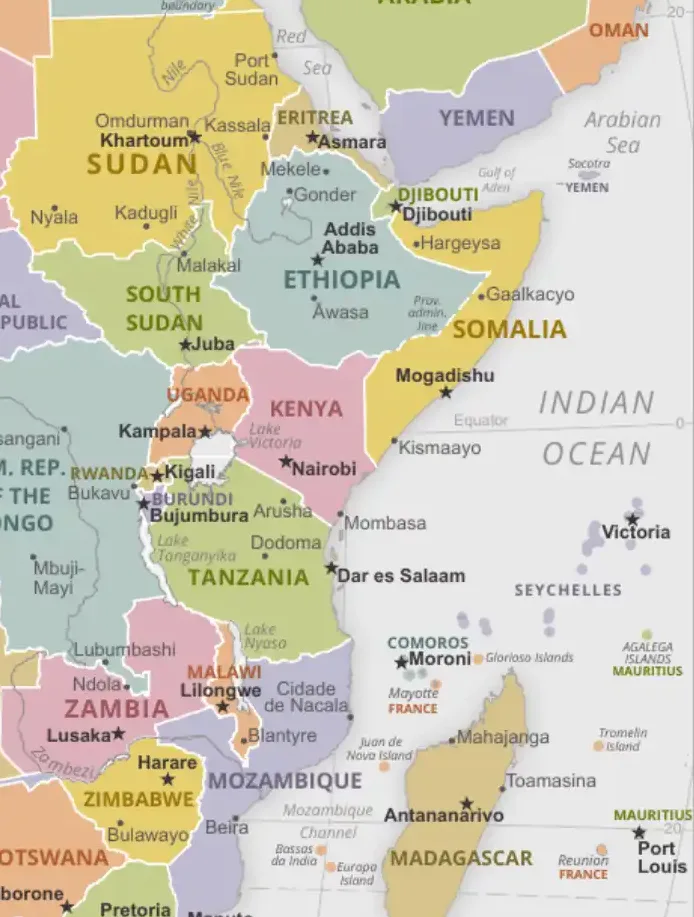
About East Africa
Geography & Climate
East Africa is defined by dramatic geographical features including:
- Great Rift Valley: A massive geological fault system stretching from Ethiopia to Mozambique
- Mount Kilimanjaro: Africa's highest peak at 5,895 meters in Tanzania
- Lake Victoria: Africa's largest lake, shared by Kenya, Tanzania, and Uganda
- Indian Ocean Coastline: Pristine beaches and historic Swahili trading ports
- Horn of Africa: The easternmost projection of the African continent
Culture & Languages
East Africa is incredibly diverse with Swahili serving as a lingua franca across much of the region. English is widely spoken due to British colonial history, while Amharic dominates in Ethiopia. The region features a unique blend of African, Arab, and Asian influences, particularly along the coast.
History
East Africa holds profound historical significance:
- Cradle of Humanity: Sites such as Olduvai Gorge (Tanzania) and the Afar region (Ethiopia) have yielded key early human fossils, including "Lucy"
- Ancient Kingdoms: Kingdom of Aksum in Ethiopia, one of the great civilizations of the ancient world
- Swahili Coast: Historic trading civilization connecting Africa, Arabia, and Asia
- Colonial Period: British, German, Italian, French, Belgian and Portuguese rule in different areas. Ethiopia was never colonised, apart from the Italian occupation of 1936–1941
- Independence: Most countries became independent in the 1960s; Mozambique followed in 1975, Seychelles in 1976, Djibouti in 1977, Zimbabwe in 1980, Eritrea in 1993 and South Sudan in 2011
Wildlife & Safari Tourism
East Africa is world-renowned for its wildlife and national parks:
- Serengeti National Park (Tanzania): Home to the Great Migration of wildebeest
- Masai Mara (Kenya): Famous for big game viewing and Maasai culture
- Ngorongoro Crater (Tanzania): One of the world's largest unbroken volcanic calderas
- Bwindi Impenetrable Forest (Uganda): Mountain gorilla habitat
- Volcanoes National Park (Rwanda): Mountain gorillas on the Virunga volcanoes, next to Virunga National Park in DR Congo (Africa's oldest national park)
Economy
The region's economy is driven by:
- Agriculture: Coffee, tea, flowers, and horticultural products
- Tourism: Wildlife safaris, beach resorts, and cultural heritage sites
- Port Services: Mombasa, Dar es Salaam, and Djibouti serve as regional trade hubs
- Technology: Kenya's "Silicon Savannah" and mobile money innovation (M-Pesa)
- EAC Integration: The East African Community promotes regional economic cooperation
Major Cities
- Nairobi, Kenya: Regional economic and diplomatic hub (about 4.4 million at the 2019 census)
- Dar es Salaam, Tanzania: Major port and commercial center
- Addis Ababa, Ethiopia: African Union headquarters and diplomatic capital
- Kampala, Uganda: Commercial and cultural center
- Kigali, Rwanda: One of Africa's cleanest and most organized cities
- Mogadishu, Somalia: Historic port city and capital
Island Nations
East Africa includes several stunning island nations in the Indian Ocean:
- Madagascar: The world's fourth-largest island with unique biodiversity
- Mauritius: Tropical paradise and financial services hub
- Seychelles: Luxury tourism destination with pristine beaches
- Comoros: Volcanic islands with rich Arab-African culture
Southern Members of the UN Grouping
The UN counts Malawi, Mozambique, Zambia and Zimbabwe as part of East Africa, although many people think of them as southern African countries (they are all members of SADC). Eight countries in this grouping are landlocked: Burundi, Ethiopia, Malawi, Rwanda, South Sudan, Uganda, Zambia and Zimbabwe.
The Horn of Africa
The northeastern part of East Africa, known as the Horn of Africa, includes Somalia, Ethiopia, Eritrea, and Djibouti. This strategic region controls access to the Red Sea and has been a crossroads of civilizations for millennia.
East African Community (EAC)
The EAC is a regional intergovernmental organization with eight members: Kenya, Tanzania, Uganda, Rwanda, Burundi, South Sudan, DR Congo (joined 2022) and Somalia (joined 2024). Its headquarters are in Arusha, Tanzania. It aims to widen and deepen economic, political, social, and cultural integration to improve the quality of life for East Africans.