West Africa: Countries, Capitals & Key Facts

🌴 West Africa Region

West Africa has 16 countries (UN grouping), from Mauritania and Senegal on the Atlantic to Niger and Nigeria in the east. About 456 million people live here (2024), just over half of them in Nigeria. The region runs from the Sahara and Sahel in the north to the tropical forests of the Gulf of Guinea coast.

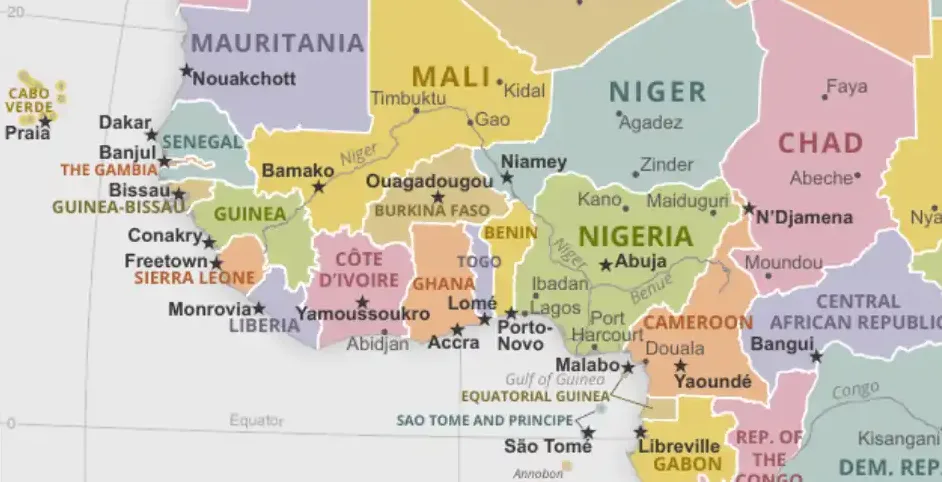
Map of West Africa showing its countries and capitals
Countries and capitals of West Africa.

Last updated: September 2026

16
Countries
~456M
Population
6.1M
km² Area
French, English
Main Languages

Interactive Map of West Africa

Countries in West Africa

🇧🇯

Benin

Capital: Porto-Novo
Population: 14.5M
Area: 114,763 km²
Currency: CFA Franc
Phone Code: +229
View Country Details →
🇧🇫

Burkina Faso

Capital: Ouagadougou
Population: 23.5M
Area: 272,967 km²
Currency: CFA Franc
Phone Code: +226
View Country Details →
🇨🇻

Cabo Verde

Capital: Praia
Population: 0.5M
Area: 4,033 km²
Currency: Cape Verdean Escudo
Phone Code: +238
View Country Details →
🇨🇮

Côte d'Ivoire

Capital: Yamoussoukro
Population: 31.9M
Area: 322,463 km²
Currency: CFA Franc
Phone Code: +225
View Country Details →
🇬🇲

Gambia

Capital: Banjul
Population: 2.8M
Area: 10,689 km²
Currency: Gambian Dalasi
Phone Code: +220
View Country Details →
🇬🇭

Ghana

Capital: Accra
Population: 34.4M
Area: 238,535 km²
Currency: Ghanaian Cedi
Phone Code: +233
View Country Details →
🇬🇳

Guinea

Capital: Conakry
Population: 14.8M
Area: 245,857 km²
Currency: Guinean Franc
Phone Code: +224
View Country Details →
🇬🇼

Guinea-Bissau

Capital: Bissau
Population: 2.2M
Area: 36,125 km²
Currency: CFA Franc
Phone Code: +245
View Country Details →
🇱🇷

Liberia

Capital: Monrovia
Population: 5.6M
Area: 111,369 km²
Currency: Liberian Dollar
Phone Code: +231
View Country Details →
🇲🇱

Mali

Capital: Bamako
Population: 24.5M
Area: 1,240,192 km²
Currency: CFA Franc
Phone Code: +223
View Country Details →
🇲🇷

Mauritania

Capital: Nouakchott
Population: 5.2M
Area: 1,030,700 km²
Currency: Mauritanian Ouguiya
Phone Code: +222
View Country Details →
🇳🇪

Niger

Capital: Niamey
Population: 27.0M
Area: 1,267,000 km²
Currency: CFA Franc
Phone Code: +227
View Country Details →
🇳🇬

Nigeria

Capital: Abuja
Population: 232.7M
Area: 923,768 km²
Currency: Nigerian Naira
Phone Code: +234
View Country Details →
🇸🇳

Senegal

Capital: Dakar
Population: 18.5M
Area: 196,722 km²
Currency: CFA Franc
Phone Code: +221
View Country Details →
🇸🇱

Sierra Leone

Capital: Freetown
Population: 8.6M
Area: 71,740 km²
Currency: Sierra Leonean Leone
Phone Code: +232
View Country Details →
🇹🇬

Togo

Capital: Lomé
Population: 9.5M
Area: 56,785 km²
Currency: CFA Franc
Phone Code: +228
View Country Details →

Population: 2024 estimates from the UN World Population Prospects 2024, rounded to 0.1 million. Area: total area including inland water.

About West Africa

Geography & Climate

West Africa features diverse landscapes ranging from coastal tropical forests to the arid Sahel. The region is characterized by:

  • The Niger River: West Africa's major waterway, flowing through Guinea, Mali, Niger, and Nigeria
  • Atlantic Coastline: Stretching from Mauritania to Nigeria with major ports
  • Sahel Region: Semi-arid transition zone in the north (Mauritania, Mali, Niger, Burkina Faso)
  • Tropical Forests: Dense rainforests in coastal Guinea, Sierra Leone, Liberia, and southern Nigeria
  • Guinea Highlands: Uplands spanning Guinea, Sierra Leone, Liberia and Côte d'Ivoire, where the Niger rises; the Senegal and Gambia rivers rise in the nearby Fouta Djallon
  • Landlocked countries: Mali, Burkina Faso and Niger have no coastline (see landlocked countries in Africa)

Culture & Languages

West Africa is incredibly diverse with hundreds of ethnic groups and languages. Major languages include Hausa, Yoruba, Igbo, Fulani, Wolof, and Akan. Colonial languages French and English serve as official languages in most countries. The region is known for its rich musical traditions, including Afrobeat, Highlife, and Mbalax.

History

West Africa has a rich pre-colonial and colonial history:

  • Ancient Empires: Ghana Empire, Mali Empire (with legendary Timbuktu), Songhai Empire
  • Trading Kingdoms: Powerful states built on gold, salt, and trans-Saharan trade
  • Slave Trade Era: Major departure point for the Atlantic slave trade (15th-19th centuries)
  • Colonial Period: Mostly divided between France and Britain from the 1880s; Portugal held Guinea-Bissau and Cabo Verde, and Germany held Togoland until the First World War. Liberia was never colonised
  • Independence: Ghana was first in 1957 and Guinea followed in 1958; most French colonies and Nigeria became independent in 1960, while Guinea-Bissau (1973–74) and Cabo Verde (1975) were last
  • Modern Era: Regional integration through ECOWAS (Economic Community of West African States)

Economy

West Africa's economy is driven by:

  • Oil & Gas: Nigeria is one of Africa's largest oil producers and has the continent's largest proven gas reserves; Ghana, Côte d'Ivoire, Senegal and Niger also produce oil
  • Agriculture: Cocoa (Côte d'Ivoire, Ghana), cashews, cotton, palm oil
  • Mining: Gold (Ghana, Mali), diamonds (Sierra Leone), bauxite (Guinea)
  • Services: Banking, telecommunications, and tech hubs (Lagos, Accra)
  • ECOWAS: Regional economic bloc promoting trade and integration

Major Cities

  • Lagos, Nigeria: Nigeria's largest city and commercial hub, and one of Africa's largest urban areas (metro estimates range from about 15 to over 20 million)
  • Abidjan, Côte d'Ivoire: Economic capital and major port
  • Accra, Ghana: Capital and growing tech hub
  • Dakar, Senegal: Westernmost capital on the African mainland (Praia in Cabo Verde lies further west)
  • Abuja, Nigeria: Purpose-built capital city
  • Bamako, Mali: Capital on the Niger River

Demographics

With about 456 million people (2024), West Africa is Africa's second most populous region after East Africa in the UN grouping. Nigeria alone has about 233 million, just over half of the total. The population is very young (median age under 20 in most countries) and growing quickly.

UNESCO World Heritage Sites

West Africa contains numerous UNESCO sites including:

  • Timbuktu (Mali)
  • Old Towns of Djenné, including the Great Mosque (Mali)
  • Asante Traditional Buildings (Ghana)
  • Island of Gorée (Senegal) - former slave trading post
  • Historic Centre of Porto-Novo (Benin)
  • Sukur Cultural Landscape (Nigeria)

ECOWAS (Economic Community of West African States)

Founded in 1975 by the Treaty of Lagos, ECOWAS promotes economic integration, peace and security. It now has 12 member states: Burkina Faso, Mali and Niger formally left in January 2025 and formed the Alliance of Sahel States (AES), and Mauritania left in 2000. Key initiatives include:

  • Free movement of people and goods
  • Common external tariff
  • Plans for a common currency (the Eco), repeatedly postponed
  • Joint peacekeeping operations

Frequently Asked Questions

How many countries are in West Africa?

The UN grouping used on this page counts 16 countries: Benin, Burkina Faso, Cabo Verde, Côte d'Ivoire, The Gambia, Ghana, Guinea, Guinea-Bissau, Liberia, Mali, Mauritania, Niger, Nigeria, Senegal, Sierra Leone and Togo. Some sources place Mauritania in North Africa instead.

What is the largest country in West Africa?

By area, Niger is the largest (about 1,267,000 km²), just ahead of Mali and Mauritania. By population, Nigeria is by far the largest, with about 233 million people in 2024, making it Africa's most populous country.

What is the smallest country in West Africa?

Cabo Verde, an island nation in the Atlantic, is the smallest by both area (4,033 km²) and population (about 0.5 million). On the mainland, The Gambia is the smallest country (10,689 km²).

What languages are spoken in West Africa?

French is the main official or working language in eight countries (Benin, Burkina Faso, Côte d'Ivoire, Guinea, Mali, Niger, Senegal and Togo), English in five (Nigeria, Ghana, Liberia, Sierra Leone and The Gambia) and Portuguese in two (Cabo Verde and Guinea-Bissau). Mauritania's official language is Arabic. Widely spoken African languages include Hausa, Yoruba, Igbo, Fula, Wolof, Mandinka and Akan.

Which countries left ECOWAS?

Burkina Faso, Mali and Niger formally withdrew from ECOWAS in January 2025 and formed the Alliance of Sahel States. Mauritania left earlier, in 2000. ECOWAS now has 12 members.

Explore Other African Regions