West Africa Map: The 16 Countries, Capitals and Geography
Where Is West Africa?
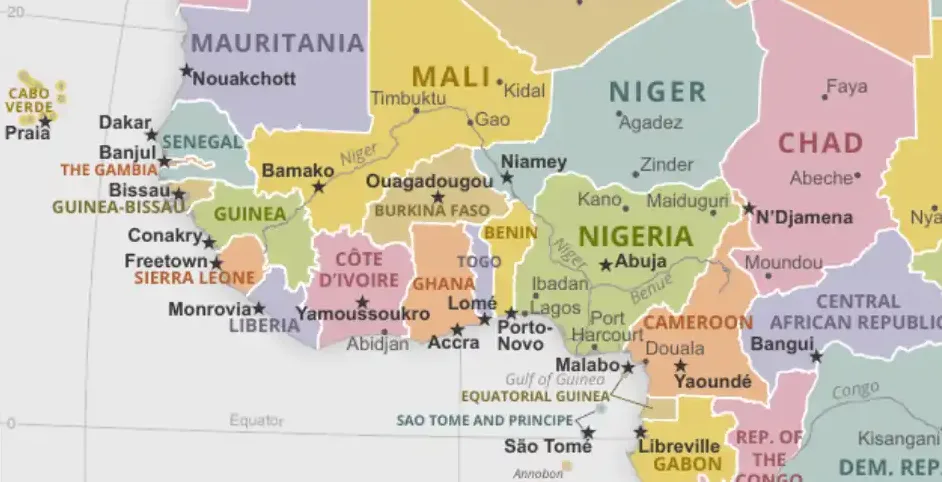
West Africa is the western bulge of the continent: the land south of the Sahara and west of Cameroon and Chad, bordered by the Atlantic Ocean to the west and the Gulf of Guinea to the south. Under the UN definition it has 16 countries: Benin, Burkina Faso, Cabo Verde (Cape Verde), Côte d'Ivoire, Gambia, Ghana, Guinea, Guinea-Bissau, Liberia, Mali, Mauritania, Niger, Nigeria, Senegal, Sierra Leone and Togo. With over 440 million people, about half of them in Nigeria, it is one of Africa's two most populous regions (with East Africa).
For each country’s capital, population and economy, see our West Africa region guide.
Last updated: September 2026
Niger and Mali are the largest countries by area; Gambia is the smallest on the mainland, and Cabo Verde is an island chain about 570 km off Senegal. Three countries are landlocked: Mali, Burkina Faso and Niger. Use the buttons above the map to filter coastal, landlocked and Sahel countries or show the main cities.
The 16 Countries of West Africa
Populations are approximate 2024 UN estimates.
🇳🇬 Nigeria
Capital: Abuja
Population: about 230 million
Area: 923,768 km²
Languages: English, Hausa, Yoruba, Igbo
Africa's most populous country and one of its largest economies, known as the "Giant of Africa". Africa's biggest oil producer alongside Angola and Libya, with large gas reserves, a strong fintech sector and the Nollywood film industry. Lagos is the commercial centre; Abuja has been the capital since 1991.
Key Features: Niger Delta, Lagos, Nollywood, oil and gas, over 250 ethnic groups
🇬🇭 Ghana
Capital: Accra
Population: about 34 million
Area: 238,533 km²
Languages: English, Akan, Ewe, Ga
Formerly the Gold Coast, Ghana became the first sub-Saharan colony to win independence (1957). It is Africa's largest gold producer and the world's second-largest cocoa producer, with offshore oil since 2010 and a record of peaceful changes of government.
Key Features: Stable democracy, cocoa production, gold mining, historical sites, tourism
🇸🇳 Senegal
Capital: Dakar
Population: about 1about 9.5 million
Area: 196,722 km²
Languages: French, Wolof
Home to Cap-Vert near Dakar, the westernmost point of mainland Africa. Known for its democratic record, mbalax music, fishing and phosphates; offshore oil production began in 2024 and gas production (shared with Mauritania) followed.
Key Features: Westernmost Africa, vibrant culture, music industry, strategic location, stable democracy
🇲🇱 Mali
Capital: Bamako
Population: about 24 million
Area: 1,240,192 km²
Languages: French, Bambara
Landlocked country that was the centre of the medieval Mali and Songhai empires, with Timbuktu and Djenné. One of Africa's leading gold and cotton producers. The Niger River's inland delta supports farming, while the north is Saharan and has been affected by armed conflict since 2012.
Key Features: Ancient empires, Timbuktu, gold mining, Niger River, traditional music
🇧🇫 Burkina Faso
Capital: Ouagadougou
Population: about 23.5 million
Area: 274,200 km²
Languages: French, Mooré, Dioula
Landlocked Sahel country whose name means "land of upright people". Gold is the main export, followed by cotton. Ouagadougou hosts FESPACO, Africa's largest film festival. Much of the north and east has been hit by jihadist violence since 2015.
Key Features: Cotton production, FESPACO film festival, gold mining, traditional crafts, cultural identity
🇨🇮 Côte d'Ivoire
Capital: Yamoussoukro (official); Abidjan is the economic capital
Population: about 31 million
Area: 322,463 km²
Languages: French
The world's largest cocoa producer (roughly 40% of global supply) and, with Ghana, the region's largest economy after Nigeria. Coastal lagoons in the south give way to savanna in the north; Abidjan is one of the region's biggest ports and business centres.
Key Features: World's largest cocoa producer, economic powerhouse, cultural diversity, modern infrastructure
🇳🇪 Niger
Capital: Niamey
Population: about 27 million
Area: 1,267,000 km²
Languages: French, Hausa
West Africa's largest country by area, landlocked and about 80% desert. A significant uranium producer. Most people live in the south, along the Niger River (which flows past Niamey) and near the Nigerian border.
Key Features: Uranium mining, Niger River, Sahel ecosystems, traditional pastoralism, strategic location
🇬🇳 Guinea
Capital: Conakry
Population: about 14.5 million
Area: 245,857 km²
Languages: French, Fulani, Mandingo
Atlantic coast country with the world's largest bauxite reserves, plus the huge Simandou iron ore deposit. Its highlands, the Fouta Djallon and Guinea Highlands, are the source of the Niger, Senegal and Gambia rivers, earning it the name "water tower of West Africa".
Key Features: Bauxite reserves, mineral wealth, Fouta Djallon highlands, river sources, cultural diversity
🇧🇯 Benin
Capital: Porto-Novo (official); Cotonou is the seat of government
Population: about 14.5 million
Area: 112,622 km²
Languages: French, Fon, Yoruba
Narrow country between Togo and Nigeria, once the Kingdom of Dahomey, whose port of Ouidah was a major slave-trade centre. Cotton is the main export, and Benin is the birthplace of Vodun, marked by a national holiday each January.
Key Features: Historical Dahomey kingdom, Vodun traditions, cultural heritage, palm oil, narrow coastline
🇹🇬 Togo
Capital: Lomé
Population: about 9.5 million
Area: 56,785 km²
Languages: French, Ewe, Kabiyé
A narrow strip about 50 km wide at the coast, stretching some 550 km inland from the Gulf of Guinea. Phosphates are a key export, and the deep-water port of Lomé is a major transit hub for landlocked Sahel countries.
Key Features: Phosphate mining, strategic location, regional trade hub, diverse landscapes, logistics center
🇸🇱 Sierra Leone
Capital: Freetown
Population: about 8.6 million
Area: 71,740 km²
Languages: English, Krio
Atlantic coast country whose capital, Freetown, was founded in 1792 as a settlement for freed slaves. Known for diamonds, iron ore and beaches on the Freetown Peninsula; its civil war ended in 2002. The leone was redenominated in 2022 (1,000 old leones = 1 new leone).
Key Features: Diamond mining, historical significance, beautiful beaches, rainforests, post-conflict recovery
🇱🇷 Liberia
Capital: Monrovia
Population: about 5.6 million
Area: 111,369 km²
Languages: English
Africa's oldest republic: settled from 1822 by freed African Americans and independent since 1847. Known for rubber, iron ore and one of the world's largest ship registries. Much of the country is covered by the Upper Guinean rainforest.
Key Features: Oldest African republic, American heritage, rubber production, maritime registration, rainforests
🇲🇷 Mauritania
Capital: Nouakchott
Population: about 5 million
Area: 1,030,700 km²
Languages: Arabic
Saharan country bridging North and West Africa; the UN places it in West Africa, but it belongs to the Arab Maghreb Union and is often grouped with North Africa. Iron ore, fish and, since 2025, offshore gas (shared with Senegal) are the main exports.
Key Features: Saharan landscapes, iron ore mining, nomadic culture, ancient trade routes, fishing industry
🇬🇲 Gambia
Capital: Banjul
Population: about 2.8 million
Area: 11,295 km²
Languages: English
Africa's smallest mainland country, completely surrounded by Senegal except for Atlantic coastline. Follows the Gambia River's course, creating unique geography. Known for groundnuts (peanuts), beach tourism and birdwatching. The river is the country's main artery for farming and transport.
Key Features: Smallest mainland country, Gambia River, groundnuts, birdwatching, beaches
🇬🇼 Guinea-Bissau
Capital: Bissau
Population: about 2.2 million
Area: 36,125 km²
Languages: Portuguese, Crioulo
Small coastal nation known for cashew nut production (major world exporter), the Bijagós Islands archipelago (UNESCO Biosphere Reserve), and complex river systems. Rich biodiversity with mangrove forests, diverse wildlife, and traditional fishing communities.
Key Features: Cashew nut exports, Bijagós Islands, mangrove ecosystems, biodiversity, traditional fishing
🇨🇻 Cabo Verde (Cape Verde)
Capital: Praia
Population: about 0.5 million
Area: 4,033 km²
Languages: Portuguese, Cape Verdean Creole
Atlantic island nation about 570 km west of Senegal, made up of 10 volcanic islands (9 inhabited). Known for unique Creole culture, traditional music (morna and coladeira), tourism industry, and maritime heritage. Successful economic diversification from agriculture to services and remittances.
Key Features: Volcanic islands, Creole culture, traditional music, tourism, maritime heritage
ECOWAS: Economic Integration and Cooperation
The Economic Community of West African States (ECOWAS), founded in 1975, now has 12 members. Mauritania left in 2000 (it signed an association agreement in 2017), and Mali, Burkina Faso and Niger, all under military governments, withdrew in January 2025 to form the Alliance of Sahel States (AES).
ECOWAS Achievements
- Free Movement Protocol: Citizens of member states can travel visa-free within the bloc
- Common Currency Plans: A single currency, the Eco, has been planned for years but repeatedly delayed
- Trade Integration: Reduced tariffs and improved trade facilitation
- Infrastructure Development: Cross-border roads, railways, and energy projects
- Peace and Security: Conflict prevention and peacekeeping interventions
Economic Powerhouses
West Africa's major economies drive regional growth and development:
- Nigeria: The region's largest economy by far, based on oil, gas, services and a large domestic market
- Ghana: Stable growth driven by gold, oil, and cocoa exports
- Côte d'Ivoire: Fast-growing economy of similar size to Ghana's; world's largest cocoa producer
- Senegal: Emerging economy with strong services and mining sectors
- Mali: Gold production and agricultural exports
Geography and Climate Diversity
West Africa encompasses remarkable geographical and climatic diversity, from the Atlantic coastline to the edge of the Sahara Desert, creating distinct ecological zones that support varied economic activities and lifestyles.
Major Climate Zones
Coastal/Guinea Savanna Zone
Humid tropical climate along the Atlantic coast:
- Countries: Southern Nigeria, Ghana, Côte d'Ivoire, Sierra Leone, Liberia, Guinea
- Characteristics: High rainfall (1,200-2,500mm annually), rainforests, high humidity
- Agriculture: Cocoa, oil palm, rubber, tropical fruits
- Economic Activities: Forestry, mining, port activities, tourism
Sudan Savanna Zone
Semi-humid tropical climate in central regions:
- Countries: Central Nigeria, Ghana, northern Côte d'Ivoire, southern Mali
- Characteristics: Distinct wet/dry seasons, grasslands with scattered trees
- Agriculture: Yams, millet, sorghum, livestock
- Economic Activities: Mixed farming, livestock rearing, trade
Sahel Zone
Semi-arid transitional zone between savanna and desert:
- Countries: Northern Nigeria, Niger, Mali, Burkina Faso, Senegal, Mauritania
- Characteristics: Limited rainfall (200-600mm), drought vulnerability
- Agriculture: Drought-resistant crops, nomadic pastoralism
- Challenges: Desertification, climate change impacts, food security
Sahara Desert Zone
Arid desert climate in northern regions:
- Countries: Northern Mauritania, northern Mali, northern Niger
- Characteristics: Very low rainfall (<200mm), extreme temperatures
- Activities: Oasis agriculture, mining, trans-Saharan trade
- Resources: Minerals, solar energy potential
Major Rivers and Water Resources
West Africa's river systems are crucial for agriculture, transportation, energy generation, and regional cooperation, supporting millions of people across multiple countries.
Niger River
West Africa's principal river, flowing 4,180 km through multiple countries:
- Source: Guinea Highlands, near the Sierra Leone border
- Countries: Guinea, Mali, Niger, Benin, Nigeria
- Uses: Irrigation, hydropower, transportation, fishing
- Cities: Bamako (Mali), Niamey (Niger), numerous Nigerian cities
Volta River System
Major river system in Ghana and Burkina Faso:
- Components: White Volta, Black Volta, Red Volta
- Lake Volta: World's largest artificial lake by surface area
- Akosombo Dam: Major hydroelectric power generation
- Uses: Electricity, fishing, transportation, irrigation
Senegal River
International river supporting regional cooperation:
- Countries: Guinea, Mali, Senegal, Mauritania
- OMVS: Multi-country river basin organization
- Projects: Diama and Manantali dams for irrigation and power
- Benefits: Agricultural development, flood control, energy
Gambia River
Crucial waterway for Gambia and regional trade:
- Length: 1,130 km from Guinea to Atlantic Ocean
- Importance: Defines Gambia's geography and economy
- Navigation: River transportation up to 500 km inland
- Activities: Agriculture, fishing, tourism
Cultural Heritage and Diversity
West Africa represents one of the world's most culturally rich and diverse regions, with hundreds of ethnic groups, languages, and traditions that have influenced global culture through music, art, cuisine, and spiritual practices.
Major Cultural Groups
Hausa-Fulani (Northern Nigeria, Niger)
- Hausa: Major trading people with widespread language influence
- Fulani: Traditionally nomadic pastoralists across the Sahel
- Religion: Predominantly Islamic with traditional elements
- Culture: Trading traditions, Islamic scholarship, cattle herding
Yoruba (Nigeria, Benin, Togo)
- Population: Over 40 million people
- Religion: Traditional Yoruba religion, Christianity, Islam
- Culture: Rich artistic traditions, urban civilization, complex religious systems
- Influence: Significant diaspora impact in Americas
Igbo (Nigeria)
- Location: Southeastern Nigeria
- Culture: Decentralized political systems, entrepreneurial traditions
- Religion: Traditional beliefs, Christianity
- Economy: Trade, agriculture, crafts
Akan (Ghana, Côte d'Ivoire)
- Groups: Ashanti, Fante, others
- History: Powerful kingdoms, gold trade
- Culture: Matrilineal society, traditional festivals
- Economy: Gold mining, cocoa farming, trade
Mandinka/Mandé (Mali, Guinea, Senegal)
- History: Mali Empire builders
- Culture: Islamic traditions, griots (traditional historians)
- Music: Traditional instruments (kora, balafon)
- Trade: Historical long-distance commerce
Languages
West Africa's linguistic landscape reflects its cultural diversity:
- Official Languages: English (5 countries), French (8 countries, as official or working language), Portuguese (2 countries), Arabic (1 country)
- Major Regional Languages: Hausa (70+ million speakers), Yoruba (40+ million), Fulani/Fula, Mandinka
- Lingua Francas: Hausa (Nigeria, Niger), Bambara/Dioula (Mali, Burkina Faso, Côte d'Ivoire), Wolof (Senegal, Gambia) and Nigerian Pidgin
- Total Languages: Over 500 indigenous languages
Traditional Religions and Spirituality
- Vodun (Benin, Togo): Traditional religion influencing global practices
- Yoruba Religion: Complex pantheon of orishas, global diaspora influence
- Islamic Traditions: Sufi orders, Islamic scholarship centers
- Animism: Traditional beliefs in various ethnic groups
- Syncretic Practices: Blending of traditional and introduced religions
Historical Significance
West Africa boasts a rich historical legacy featuring ancient empires, trans-Saharan trade routes, significant role in global trade, and the complex history of the trans-Atlantic slave trade that connects the region to the Americas.
Ancient Empires
Ghana Empire (c. 300–1200 CE)
- Location: Present-day Mali, Senegal, Mauritania
- Wealth: Control of gold trade between North and West Africa
- Capital: Koumbi Saleh
- Legacy: First major West African empire, trade networks
Mali Empire (c. 1235–1600 CE)
- Founder: Sundiata Keita
- Famous Ruler: Mansa Musa, whose 1324 pilgrimage to Mecca made Mali famous for its gold
- Cities: Timbuktu, Djenné (centers of learning)
- Trade: Gold, salt, trans-Saharan commerce
Songhai Empire (1464-1591 CE)
- Location: Niger River bend region
- Capital: Gao
- Achievement: Largest West African empire
- End: Moroccan invasion with firearms
Colonial Period and Independence
- European Contact: Portuguese exploration from 15th century
- Slave Trade: Massive impact on societies and demographics
- Colonial Rule: British, French, Portuguese control
- Independence: Ghana first (1957), others followed 1960s
- Post-Independence: Political challenges, economic development efforts
Trans-Atlantic Slave Trade
- Scale: Millions of people transported to Americas
- Impact: Demographic, social, economic disruption
- Resistance: Various forms of resistance and adaptation
- Legacy: African diaspora connections, cultural influences
- Memory: Historic sites, museums, commemoration
Natural Resources and Mining
West Africa is extraordinarily rich in natural resources, hosting significant deposits of oil, gas, minerals, and agricultural resources that drive economic development and attract international investment.
Oil and Gas Resources
- Nigeria: Major OPEC member, significant oil and gas reserves
- Ghana: Emerging oil producer (Jubilee, TEN fields)
- Côte d'Ivoire: Growing oil and gas production
- Mauritania: Offshore gas from the Greater Tortue Ahmeyim project, shared with Senegal
- Senegal: Oil production began in 2024 (Sangomar field)
Mineral Wealth
- Gold: Ghana (Africa's largest producer), Mali, Burkina Faso, Guinea
- Bauxite: Guinea (world's largest reserves), Ghana
- Iron Ore: Mauritania, Guinea, Liberia, Sierra Leone
- Uranium: Niger (major global supplier)
- Diamonds: Sierra Leone, Guinea, Liberia
- Phosphates: Senegal, Togo
Agricultural Resources
- Cocoa: Côte d'Ivoire (about 40% of world production), Ghana (roughly 15%)
- Coffee: Côte d'Ivoire, Guinea
- Cotton: Mali, Burkina Faso, Benin
- Cashews: Guinea-Bissau, Côte d'Ivoire
- Palm Oil: Nigeria, Benin, Sierra Leone
- Peanuts: Senegal, Gambia
Modern Challenges and Opportunities
While West Africa faces significant challenges, the region also presents enormous opportunities for sustainable development, technological innovation, and regional integration.
Major Challenges
- Climate Change: Desertification, irregular rainfall, coastal erosion
- Security: Jihadist insurgencies in the central Sahel and northeast Nigeria, piracy in the Gulf of Guinea
- Infrastructure: Limited roads, electricity, telecommunications
- Demographics: Rapid population growth, youth unemployment
- Governance: Military takeovers in Mali (2020–21), Guinea (2021), Burkina Faso (2022) and Niger (2023)
Emerging Opportunities
- Digital Economy: Mobile money, fintech, e-commerce growth
- Renewable Energy: Solar, wind, hydroelectric potential
- Agriculture: Value chain development, food processing
- Youth Dividend: Large young population for economic growth
- Regional Integration: ECOWAS common market development
Innovation Hubs
- Lagos, Nigeria: Fintech, e-commerce, digital services
- Accra, Ghana: Tech startups, mobile solutions
- Dakar, Senegal: Digital innovation, telecommunications
- Abidjan, Côte d'Ivoire: Regional business hub
Travel and Tourism
West Africa offers diverse tourism experiences, from beaches and historic sites to vibrant cultures and wildlife, attracting growing numbers of international and regional visitors.
Top Destinations
Cultural and Historical Sites
- Timbuktu, Mali: Ancient center of learning and trade
- Cape Coast, Ghana: Historic slave trade sites and castles
- Djenné, Mali: Ancient city with distinctive Sudano-Sahelian architecture
- Benin City, Nigeria: Historical Benin Bronzes and royal palaces
- Gorée Island, Senegal: UNESCO site commemorating slave trade
Natural Attractions
- Bijagós Islands, Guinea-Bissau: UNESCO Biosphere Reserve
- Pendjari National Park, Benin: Wildlife viewing
- Fouta Djallon, Guinea: Mountainous region with waterfalls
- Cape Verde Islands: Volcanic landscapes and beaches
- Kakum Canopy Walk, Ghana: Rainforest experience
Beaches and Coastal Areas
- Gold Coast, Ghana: Historic beaches and resorts
- Freetown Peninsula, Sierra Leone: Beautiful beaches
- Saly, Senegal: Resort destination
- Grand-Bassam, Côte d'Ivoire: Colonial architecture and beaches
Cultural Experiences
- Music Festivals: Traditional and modern music events
- Traditional Crafts: Textiles, wood carving, metalwork
- Culinary Tourism: Diverse regional cuisines
- Religious Sites: Islamic centers, traditional shrines
- Markets: Vibrant traditional and modern markets
Using Our Interactive Map
Map Features
- All Countries View: Complete overview of all 16 West African nations
- Coastal Countries: Focus on Atlantic Ocean nations with seaports and beaches
- Landlocked Countries: Explore inland nations and their unique characteristics
- Sahel Region: Highlight countries in the semi-arid transition zone
- Economic Centers: Major cities and economic hubs driving regional growth
Click a country marker to see its capital, approximate population and whether it is coastal, landlocked or in the Sahel. Markers are coloured green for the four largest economies, orange for Sahel countries, blue for other coastal countries and red for landlocked ones.
Related Maps
See the West Africa region guide, the neighbouring North Africa and Central Africa maps, the Sub-Saharan Africa map, and comparisons such as Ghana vs Côte d'Ivoire.
Frequently Asked Questions
How many countries are in West Africa?
West Africa contains 16 countries: Benin, Burkina Faso, Cape Verde, Côte d'Ivoire, Gambia, Ghana, Guinea, Guinea-Bissau, Liberia, Mali, Mauritania, Niger, Nigeria, Senegal, Sierra Leone and Togo.
What is the largest country in West Africa?
Niger is the largest by area (about 1.27 million km²), just ahead of Mali (1.24 million km²). Nigeria is by far the most populous, with about 230 million people.
Which West African countries are landlocked?
Three: Mali, Burkina Faso and Niger. They rely on ports such as Dakar, Abidjan, Lomé, Cotonou and Tema for overseas trade.
What languages are spoken in West Africa?
West Africa is highly multilingual. Official languages reflect colonial history — English (Nigeria, Ghana, Liberia, Sierra Leone, Gambia), French (most others), and Portuguese (Cape Verde, Guinea-Bissau). Hundreds of indigenous languages are spoken, including Yoruba, Hausa, Igbo, Fulani and Wolof.
Is ECOWAS the same as West Africa?
No. ECOWAS (Economic Community of West African States) now has 12 members. Mauritania left in 2000 and later signed an association agreement, and Mali, Burkina Faso and Niger withdrew in January 2025 to form the Alliance of Sahel States.
What is the currency of West Africa?
Eight countries (Benin, Burkina Faso, Côte d'Ivoire, Guinea-Bissau, Mali, Niger, Senegal and Togo) use the West African CFA franc (XOF), which is pegged to the euro. The others have national currencies, such as Nigeria's naira, Ghana's cedi and Sierra Leone's leone. ECOWAS has long discussed launching a common currency called the Eco.