Cape Verde: Atlantic Crossroads
Cape Verde (Cabo Verde) is an island country in the Atlantic Ocean, about 570 km off the coast of Senegal. Its ten volcanic islands cover 4,033 km², and the capital and largest city is Praia on Santiago island. It has about 525,000 people (2025 UN estimate), Portuguese is the official language, and it gained independence from Portugal on 5 July 1975.
The Republic of Cabo Verde (Cape Verde), an archipelago nation of ten volcanic islands scattered across the Atlantic Ocean, is one of Africa's most stable democracies. Located about 570 kilometres west of Senegal, these islands emerged from the ocean floor through volcanic activity, creating a unique nation that bridges Africa, Europe, and the Americas. With its distinctive Creole culture, world-renowned music traditions, and strategic location, Cape Verde has transformed from an isolated colonial outpost into a middle-income country that serves as a model for island nation development.
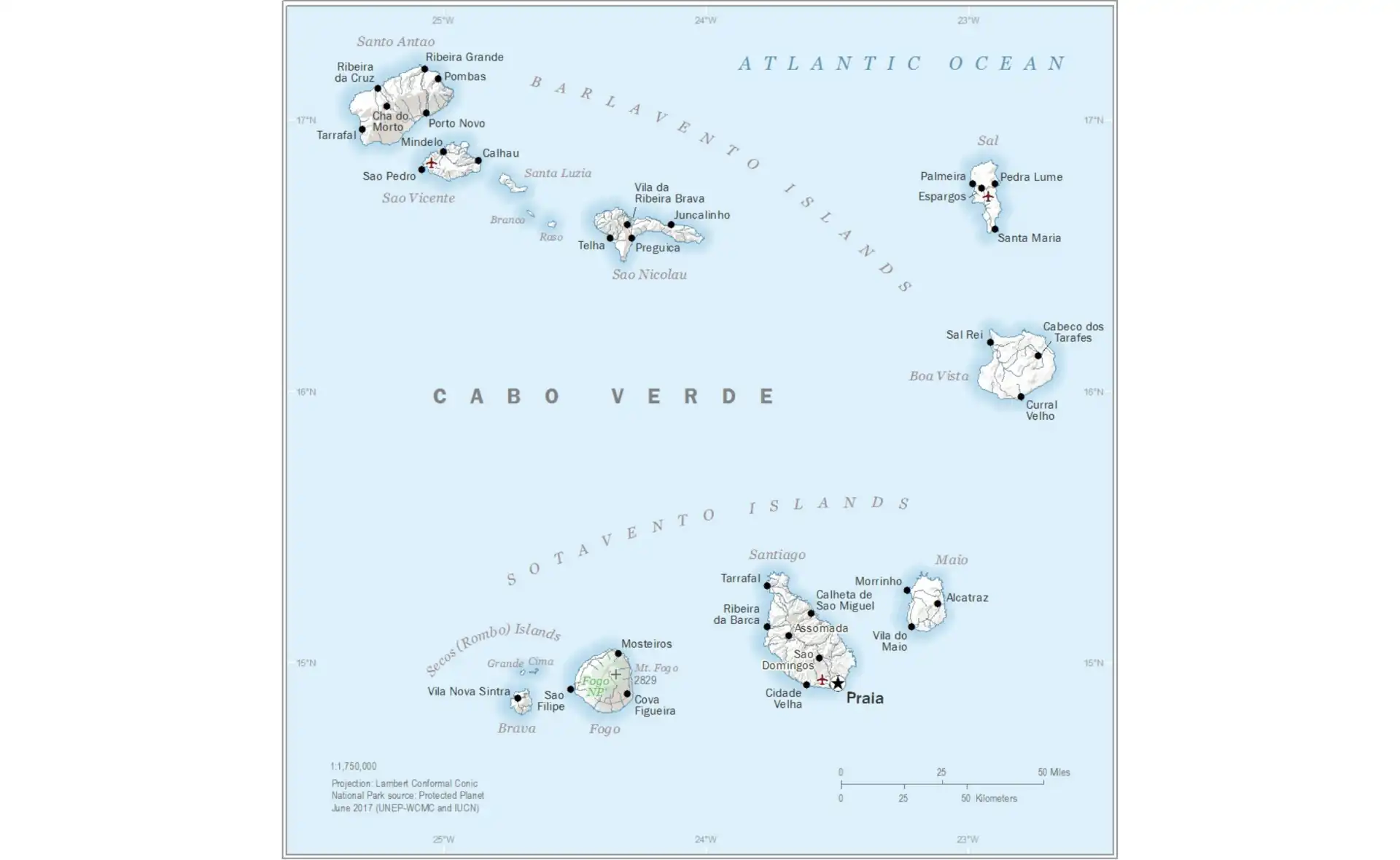
Cape Verde Facts at a Glance
| Official name | Republic of Cabo Verde |
|---|---|
| Capital | Praia, on Santiago island |
| Largest city | Praia |
| Region | West Africa |
| Population | About 525,000 (2025 UN estimate) |
| Area | 4,033 km² (1,557 sq mi) – spread over 10 volcanic islands, 9 of them inhabited |
| Coastline | Island country with about 965 km of coastline |
| Official languages | Portuguese; Cape Verdean Creole (Kriolu) is the everyday language |
| Currency | Cape Verdean escudo (CVE), pegged to the euro |
| Government | Parliamentary republic with an elected president (semi-presidential) |
| Independence | 5 July 1975, from Portugal |
| Neighbouring countries | Cape Verde is an island country with no land borders. The nearest mainland is Senegal, about 570 km to the east. |
| Administrative divisions | 22 municipalities on 9 inhabited islands (Santiago, São Vicente, Santo Antão, Sal, Boa Vista, Fogo, São Nicolau, Maio, Brava) |
| Main cities | Praia, Mindelo, Espargos, Santa Maria, Assomada |
| Highest point | Pico do Fogo, 2,829 m (9,281 ft), an active volcano |
| Rivers and lakes | No permanent rivers; fresh water comes largely from desalination and groundwater |
| Climate | Dry tropical: warm all year (about 22–28°C), little rain, falling mostly from August to October |
| Economy | Tourism (especially on Sal and Boa Vista), services, fishing and remittances from a large diaspora |
| Time zone | UTC−1 (Cape Verde Time) |
| Calling code | +238 |
Population figures are rounded 2025 estimates from the UN World Population Prospects 2024 unless stated otherwise. Facts checked September 2026.
See also: Praia city guide, countries of West Africa, island countries in Africa, Portuguese-speaking countries in Africa, African independence timeline.
Island Geography: Born from Fire
Cape Verde consists of ten main islands and several islets divided into two groups: the Barlavento (windward) islands to the north and the Sotavento (leeward) islands to the south. The total land area covers just 4,033 square kilometers, slightly larger than Rhode Island, but the islands control an extensive Exclusive Economic Zone of over 800,000 square kilometers of ocean. Each island possesses distinct characteristics shaped by volcanic origin, erosion patterns, and human habitation, creating remarkable diversity within this small nation.
The islands showcase dramatic volcanic landscapes ranging from active volcanoes to ancient eroded peaks. Fogo Island, dominated by Pico do Fogo volcano rising to 2,829 meters, remains active with its last eruption in 2014-2015. The volcano's caldera, called Chã das Caldeiras, hosts a community that persistently rebuilds after eruptions, cultivating unique wines on volcanic soils. Santo Antão presents spectacular mountainous terrain with deep valleys and knife-edge ridges, while Sal and Boa Vista feature flat, desert-like landscapes with pristine beaches formed from Saharan sand carried by trade winds.
The archipelago's position in the Atlantic trade wind belt creates distinct microclimates. Northeastern slopes receive moisture from cloud condensation, supporting agriculture, while southwestern areas remain arid. The result is a surprising range of landscapes, from the green, terraced valleys of Santo Antão to the salt pans of Sal. The surrounding ocean keeps temperatures warm and fairly even all year (about 22–28°C), and the waters around the islands are important for sea turtles, humpback whales and seabirds.
Total Islands
10 main islands
Total Area
4,033 km²
Population
About 525,000
Highest Peak
2,829 meters
From Uninhabited Islands to Creole Nation
Unlike most African territories, Cape Verde had no indigenous population when navigators sailing for Portugal reached the islands between 1456 and 1462. The archipelago's isolation in the Atlantic meant these volcanic islands remained uninhabited for millions of years after emerging from the ocean. Portuguese colonization began in 1462 on Santiago Island, establishing Ribeira Grande (now Cidade Velha) as the first European city in the tropics. This settlement became a crucial waypoint for Portuguese maritime expansion and the Atlantic slave trade.
The islands' strategic location made them an ideal stopping point for ships traveling between Europe, Africa, and the Americas. Portuguese settlers, along with enslaved Africans primarily from the Guinea coast, created a new society. The harsh environment and isolation forced adaptation and cooperation between groups, leading to extensive racial mixing and the emergence of a distinctive Creole culture. By the 16th century, a new Cape Verdean identity had formed, blending African and European elements in language, music, cuisine, and social customs.
The slave trade profoundly shaped Cape Verde's development. Ribeira Grande became a major slave depot where captives were "seasoned" before shipment to the Americas. This tragic commerce brought wealth to some while establishing patterns of inequality. When the slave trade declined, Cape Verde faced economic crisis. Recurring droughts and famines throughout the colonial period killed thousands, with particularly devastating famines in 1773-1775, 1830-1833, and 1941-1943. Portuguese colonial neglect left the islands impoverished, forcing mass emigration that created a Cape Verdean diaspora larger than the home population.
The Unique Island Characteristics
Each Cape Verdean island developed distinct characteristics based on geography, resources, and settlement patterns. Santiago, the largest and most populous island, hosts the capital Praia and more than half of the nation's population. As the first settled island, Santiago maintains the strongest African cultural influences and serves as the political and economic center. The island's varied landscape includes mountains, valleys, and beaches, supporting diverse agricultural activities and growing urban development.
The Windward Islands (Barlavento)
The northern island group showcases remarkable diversity:
- Santo Antão - Dramatic mountains and valleys, hiking paradise, traditional agriculture
- São Vicente - Cultural capital Mindelo, music and arts center, natural harbor
- São Nicolau - Agricultural traditions, historic seminary, mountainous interior
- Sal - Tourism hub, international airport, salt flats, pristine beaches
- Boa Vista - Desert landscapes, sea turtle nesting, growing tourism, sand dunes
- Santa Luzia - Uninhabited reserve, seabird colonies, pristine ecosystems
The Sotavento (leeward) islands in the south include Maio, known for its beaches and salt production; Santiago with its historical and political importance; Fogo with its active volcano and wine production; and Brava, the smallest inhabited island, famous for flowers and emigration to America. Each island maintains distinct dialects, customs, and economic specializations that contribute to national diversity.
Independence and Democratic Development
Cape Verde's path to independence intertwined with Guinea-Bissau through the African Party for the Independence of Guinea and Cape Verde (PAIGC), led by Amílcar Cabral. Unlike Guinea-Bissau's armed struggle, Cape Verde achieved independence peacefully on July 5, 1975, as Portugal's African empire collapsed. The initial plan for unity between Cape Verde and Guinea-Bissau ended with a 1980 coup in Guinea-Bissau, leading Cape Verde to chart its own course under the African Party for the Independence of Cape Verde (PAICV).
Under President Aristides Pereira and the PAICV, Cape Verde pursued socialist-oriented policies while maintaining pragmatic international relations. Despite one-party rule, the government invested heavily in education and healthcare, achieving impressive social indicators. However, economic stagnation and desire for political freedom grew through the 1980s. In 1990, responding to domestic and international pressure, Cape Verde legalised opposition parties, and in January 1991 it became one of the first African countries to move peacefully from one-party rule to multi-party democracy through elections.
The Movement for Democracy (MpD) won the 1991 elections, beginning a pattern of peaceful power transfers between MpD and PAICV that continues today. This political stability, rare in Africa, enabled consistent policy implementation and international confidence. Democratic institutions strengthened over time, with free press, independent judiciary, and active civil society. Cape Verde consistently ranks among Africa's most democratic countries, demonstrating that small island nations can achieve and maintain democratic governance despite limited resources.
Creole Culture and Identity
Cape Verdean culture represents a unique synthesis of African and European elements, creating something distinctly new. Cape Verdean Creole (Kriolu), the mother tongue of virtually all Cape Verdeans, developed from Portuguese and West African languages. While Portuguese remains the official language, Kriolu serves as the language of daily life, music, and emotional expression. Each island has its own dialect, with Santiago's Badiu and São Vicente's Crioulo serving as the main variants. An official alphabet for writing Kriolu (ALUPEC) was adopted in 2009, and there is ongoing debate about giving Kriolu official status alongside Portuguese.
Religious Syncretism
While a large majority of Cape Verdeans identify as Catholic, religious practice blends Christianity with African traditions. Tabanka festivals on Santiago combine Catholic saints with African drumming and dance. Belief in spirits and traditional healing coexists with church attendance. Protestant churches and returning emigrants introduce new religious diversity while traditional practices persist, especially in rural areas.
Cuisine Fusion
Cape Verdean cuisine reflects scarcity and creativity. Cachupa, the national dish, combines corn, beans, and whatever protein is available. Portuguese influences appear in linguiça sausage and wine-making, while African elements dominate in the use of cassava, sweet potatoes, and plantains. Seafood features prominently, with grilled lobster and tuna reflecting ocean bounty.
Social Values
Morabeza, often translated as hospitality, represents core Cape Verdean values of warmth, openness, and welcome. Despite hardships, Cape Verdeans maintain optimism and solidarity. Extended family networks provide support, while emigrant remittances sustain communities. Gender relations progressively evolve, with women increasingly prominent in business and politics.
Cape Verdean identity embraces both African roots and Atlantic orientation. Unlike some African nations struggling with ethnic divisions, Cape Verde's mixed heritage became a source of unity. The shared experience of drought, emigration, and island life created strong national identity transcending racial categories. This Creole identity influences how Cape Verdeans see themselves—as simultaneously African, European, and uniquely Cape Verdean, comfortable with multiple identities in an increasingly globalized world.
Music: The Soul of Cape Verde
Cape Verdean music gained international recognition through Cesária Évora, the "Barefoot Diva" who brought morna to world audiences. Morna, often called Cape Verde's blues, expresses sodade—a unique form of longing mixing nostalgia, love, and separation. In 2019 UNESCO added morna to its list of the Intangible Cultural Heritage of Humanity. This melancholic genre emerged in the 19th century, possibly influenced by Portuguese fado, but evolved into distinctly Cape Verdean expression. Accompanied by guitars, violin, and cavaquinho, morna captures the Cape Verdean experience of departure and distance.
Musical Genres and Traditions
Cape Verde's rich musical landscape includes:
- Morna - Slow, melancholic songs of love and longing, epitomized by Cesária Évora
- Coladeira - Upbeat dance music with African rhythms and satirical lyrics
- Funaná - Energetic accordion-based music from Santiago's interior
- Batuque - Ancient African-rooted rhythm performed by women on Santiago
- Cola San Jon - Processional music blending African drums with Portuguese traditions
Music permeates Cape Verdean life from informal gatherings to international festivals. Every island produces musicians, with Mindelo on São Vicente recognized as the cultural capital. The annual Baía das Gatas music festival attracts international audiences, while neighborhood performances maintain grassroots traditions. Contemporary Cape Verdean musicians blend traditional forms with jazz, R&B, and hip-hop, creating new sounds while honoring roots. This musical richness provides cultural export and identity anchor for Cape Verdeans worldwide.
The Diaspora Nation
Cape Verde exemplifies a transnational nation, with more Cape Verdeans living abroad than in the islands. An estimated 700,000 to 1 million Cape Verdeans reside overseas, primarily in the United States (especially Massachusetts and Rhode Island), Portugal, Netherlands, France, and African countries like Senegal and Angola. This diaspora resulted from centuries of drought-driven emigration, with major waves during famines and economic crises. Rather than brain drain, Cape Verde transformed emigration into a development resource.
Remittances from emigrants are equivalent to around a tenth of GDP, providing crucial household income and investment capital. Diaspora Cape Verdeans maintain strong homeland connections through family support, property investment, and circular migration. Many return for holidays, retirement, or business ventures, bringing skills and capital. The government actively courts diaspora engagement through dual citizenship, investment incentives, and cultural programs. Annual emigrant gatherings on each island strengthen these ties.
The diaspora profoundly influences Cape Verdean society and culture. Returned emigrants introduce new ideas, technologies, and consumption patterns. American Cape Verdeans brought English language skills and business practices, while European emigrants influenced architecture and lifestyle. This cosmopolitan exposure created openness to innovation and change. However, emigration also brings challenges—family separation, dependency on remittances, and youth focused more on leaving than local development. Balancing emigration opportunities with homeland development remains an ongoing challenge.
Economic Transformation
Cape Verde achieved remarkable economic transformation since independence, graduating from least developed country status in 2007 to lower-middle-income classification. This success story relied on political stability, good governance, and strategic use of limited resources. The economy shifted from subsistence agriculture to services, with tourism, transport, and communications driving growth. GDP per person has risen many times over since independence, though inequality and unemployment persist.
Tourism emerged as the leading economic sector, contributing roughly a quarter of GDP when indirect effects are included and employing thousands directly and indirectly. Sal and Boa Vista attract beach resort tourism, while Santo Antão and Fogo develop hiking and cultural tourism. The government promotes sustainable tourism to protect fragile island ecosystems while maximizing local benefits. However, tourism concentration on two islands and foreign ownership of large resorts limit broader economic impact. Developing linkages between tourism and local agriculture, handicrafts, and services remains a priority.
Cape Verde leverages its strategic location for transport and communications services. The ports of Praia and Mindelo handle most shipping, and international airports on Sal, Santiago (Praia), Boa Vista and São Vicente link the islands with Europe, Africa and the Americas. Submarine telecommunications cables position Cape Verde as a potential digital hub connecting Africa, Europe, and Americas. The government promotes information technology and financial services to diversify beyond tourism. Despite progress, the economy remains vulnerable to external shocks, limited water resources constrain development, and youth unemployment challenges social stability.
Environmental Challenges and Sustainability
Cape Verde faces severe environmental challenges stemming from its volcanic origin, location in the Sahel drought belt, and human pressures. The islands receive average annual rainfall of only 230mm, with some areas getting virtually no rain. Periodic droughts lasting years devastate agriculture and stress water supplies. Climate change exacerbates these challenges through rising temperatures, changing precipitation patterns, and sea level rise threatening coastal areas where most population and infrastructure concentrate.
Desertification affects all islands through centuries of overgrazing, wood cutting for fuel, and poor agricultural practices. Only 10% of land remains suitable for agriculture, forcing food imports exceeding 80% of consumption. Reforestation programs show success on some islands, but compete with land needs for housing and farming. Innovative techniques including drip irrigation, fog harvesting, and drought-resistant crops help adaptation. Renewable energy development progresses rapidly, with wind and solar projects aiming for 50% renewable electricity by 2030.
Marine resources face overfishing by foreign fleets and local fishers using unsustainable methods. Coral reefs suffer from warming waters and pollution. Plastic waste accumulates on beaches and in ocean gyres. However, Cape Verde designated large marine protected areas and develops blue economy strategies balancing conservation with sustainable use. International partnerships support climate adaptation, though small island developing state vulnerabilities require continued assistance. Success requires balancing immediate development needs with long-term sustainability.
Education and Human Development
Cape Verde prioritized education from independence, achieving nearly universal primary enrollment and literacy rates exceeding 90%. This educational investment transformed a largely illiterate colonial population into one of Africa's most educated. Secondary education expanded rapidly, while the University of Cape Verde (established 2006) provides higher education opportunities previously requiring emigration. However, education quality varies between islands, and curricula struggle to match job market needs.
Healthcare similarly improved dramatically, with life expectancy rising from under 60 years at independence to the mid-70s today. In January 2024 the World Health Organization certified Cape Verde as malaria-free, only the third country in Africa to achieve this, after Mauritius and Algeria. Infant mortality dropped through vaccination campaigns and maternal health programs. Each inhabited island has a hospital, while health centers serve remote communities. However, specialized care often requires medical evacuation to Praia or abroad.
Gender equality advanced significantly, with women comprising over 50% of university students and increasingly prominent in professional and political roles. Parliament passed progressive legislation on domestic violence and gender discrimination. However, teenage pregnancy and gender-based violence remain concerns. Young people face high unemployment despite education gains. Many see emigration as the only option, perpetuating brain drain cycles. Creating opportunities for educated youth while maintaining social cohesion challenges policymakers.
Regional and International Relations
Cape Verde pursues a foreign policy of "global insertion," leveraging multiple partnerships while maintaining independence. The country belongs to the African Union, ECOWAS, and Community of Portuguese Language Countries (CPLP), bridging African, Atlantic, and Lusophone worlds. Special partnerships with the European Union provide development assistance and market access. Relations with China grew through infrastructure investment, while traditional ties with United States (through the diaspora) and Portugal (colonial legacy) remain strong.
As a small island developing state, Cape Verde actively participates in climate change negotiations and ocean governance forums. The country advocates for special consideration of SIDS vulnerabilities while demonstrating sustainable development possibilities. Maritime security concerns, including drug trafficking and illegal fishing, require international cooperation given Cape Verde's limited naval capacity. The strategic location attracts military cooperation offers, balanced carefully to maintain sovereignty.
Regional integration through ECOWAS faces challenges given Cape Verde's isolation and different economic structure from mainland West Africa. The country imports most goods from Europe rather than African neighbors. However, Cape Verde promotes services exports and sees potential in African Continental Free Trade Area. Cultural diplomacy through music and diaspora networks provides soft power exceeding the country's small size. Success requires continued navigation between multiple identities and partnerships.
Future Prospects and Vision
Cape Verde's future depends on sustainable development balancing economic growth with environmental protection and social inclusion. The government's "Ambition 2030" strategy envisions transitioning to a developed, inclusive nation through digital transformation, sustainable tourism, and blue economy development. Achieving this requires overcoming structural constraints of small size, isolation, and climate vulnerability while building on achievements in governance, education, and stability.
Youth represent both hope and challenge, with a educated generation seeking opportunities beyond traditional sectors. Digital entrepreneurship, creative industries, and renewable energy offer potential for youth employment. However, creating sufficient quality jobs requires continued economic diversification and investment. The diaspora's second and third generations, often professionally successful but culturally distant, represent untapped resources if connections strengthen. Balancing tradition with modernity challenges all sectors.
Climate change is the greatest long-term threat: rising seas endanger coastal infrastructure, and droughts and storms may intensify. Cape Verde's experience of managing scarcity, together with its record of stable governance, gives it a strong base for adaptation.
Cape Verde: Frequently Asked Questions
What is the capital of Cape Verde?
The capital of Cape Verde is Praia, on Santiago island.
What is the population of Cape Verde?
Cape Verde has about 525,000 people (2025 UN estimate). The largest city is Praia.
How big is Cape Verde?
Cape Verde covers 4,033 km² (1,557 sq mi), spread over 10 volcanic islands, 9 of them inhabited.
What language is spoken in Cape Verde and what is its currency?
Official languages: Portuguese; Cape Verdean Creole (Kriolu) is the everyday language. Currency: Cape Verdean escudo (CVE), pegged to the euro.
Does Cape Verde have any land borders?
Cape Verde is an island country with no land borders. The nearest mainland is Senegal, about 570 km to the east.
When did Cape Verde become independent?
Cape Verde became independent on 5 July 1975 from Portugal.