Sierra Leone: From Lion Mountains to Recovery
The Republic of Sierra Leone, named by Portuguese explorers who heard the thunderous roar of storms over the coastal mountains and called them "Serra Leoa" (Lion Mountains), has emerged from a devastating civil war to become one of West Africa's most resilient nations. This country of about 8.6 million people combines stunning natural beauty—pristine beaches, lush rainforests, and abundant minerals—with a complex history shaped by the slave trade, colonialism, and conflict. Today, Sierra Leone stands as a testament to human resilience, working to transform its diamond wealth from a curse into a blessing.
Sierra Leone Key Facts
Sierra Leone is a country on the Atlantic coast of West Africa, bordered by Guinea and Liberia. Its capital and largest city is Freetown, founded in 1792 as a home for freed slaves. About 8.6 million people live in its 71,740 km². Since the civil war ended in 2002 the country has held regular elections.
| Fact | Sierra Leone |
|---|---|
| Official name | Republic of Sierra Leone |
| Capital | Freetown |
| Largest city | Freetown (about 1.2 million) |
| Population | About 8.6 million |
| Area | 71,740 km² |
| Official language | English; Krio is the national lingua franca, and Mende, Temne and Limba are the largest local languages |
| Currency | Leone (SLE); redenominated in July 2022, when 1 new leone replaced 1,000 old leones (SLL) |
| Government | Presidential republic |
| Independence | 27 April 1961, from the United Kingdom; became a republic in 1971 |
| Neighbours | Guinea, Liberia; about 400 km of Atlantic coast |
| Region | West Africa |
| Highest point | Mount Bintumani (Loma Mansa), about 1,945 m |
| Main rivers | Rokel (Seli), Sewa, Moa, Mano, Jong, Great and Little Scarcies |
| Climate | Tropical: a very wet rainy season from about May to October and a dry season from November to April |
| Economy | Mining (iron ore, diamonds, rutile, bauxite, gold), agriculture (rice, cassava, cocoa, coffee) and fishing |
| Time zone | GMT (UTC+0) |
| Calling code | +232 |
Figures are rounded. Population figures are 2024 UN estimates unless a census is cited.
Regions, Districts and Main Towns of Sierra Leone
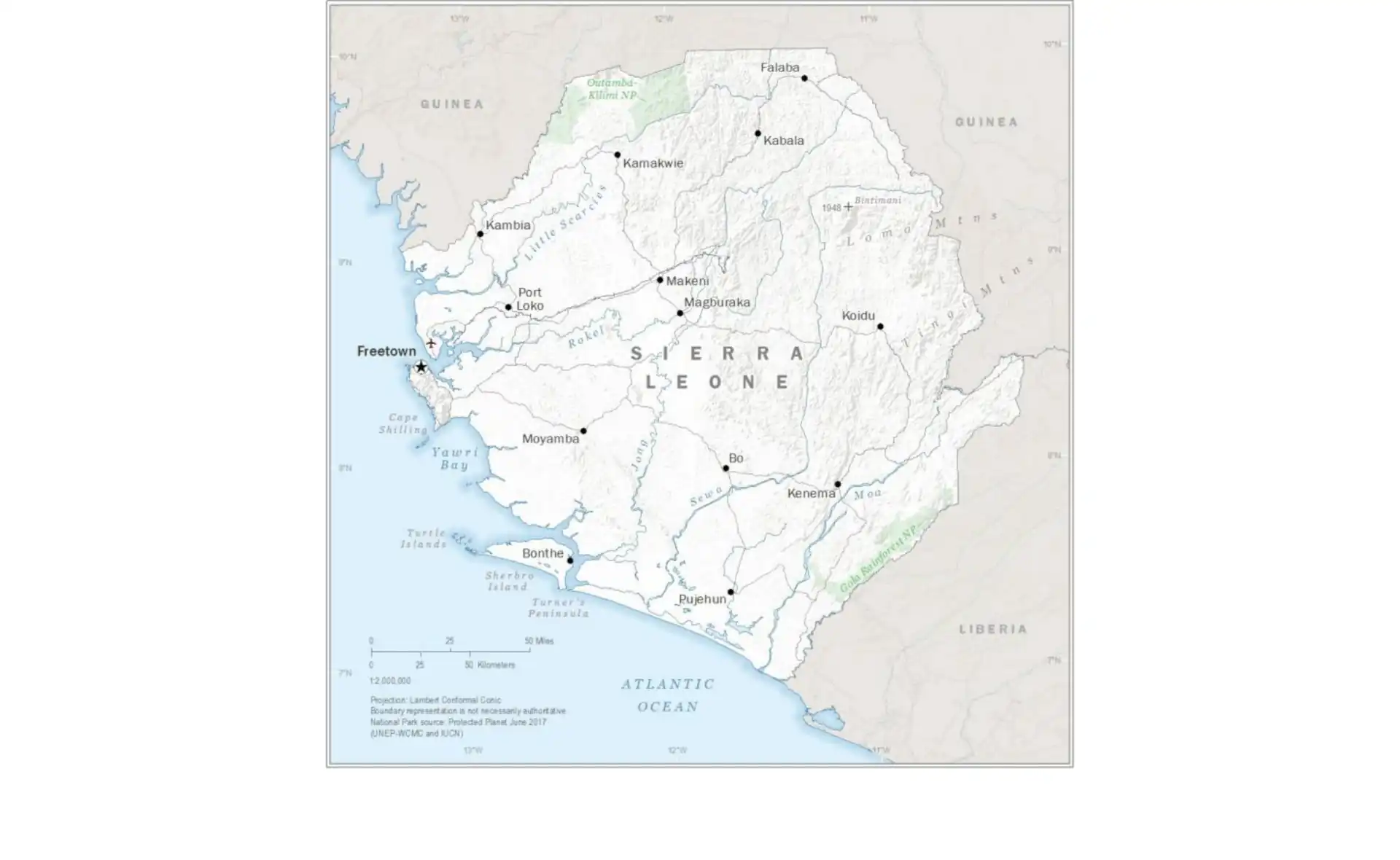
Since 2017 Sierra Leone has been divided into five regions (Northern, North West, Southern and Eastern provinces and the Western Area) and 16 districts. The main towns are Freetown, Bo, Kenema, Makeni, Koidu (the diamond centre of Kono District), Port Loko, Lunsar and Waterloo.
Geographic Diversity: Mountains Meet the Sea
Sierra Leone covers 71,740 square kilometers along West Africa's Atlantic coast, roughly the size of South Carolina. The country's geography divides into four distinct regions: the coastal belt of mangrove swamps, the Sierra Leone Peninsula, the interior plains, and the interior plateau and mountains. This diverse topography creates varied ecosystems and climate zones within a relatively small area. The coastline stretches for 402 kilometers, featuring some of West Africa's most beautiful beaches alongside productive fishing grounds and historic ports.
The Sierra Leone Peninsula, where the capital Freetown sits, contains the Western Area Peninsula Forest Reserve with mountains rising directly from the sea to nearly 900 meters at Picket Hill. These mountains create a dramatic backdrop to Freetown and influence local climate patterns, catching moisture from Atlantic winds. The peninsula's isolation from the mainland by estuaries historically made it an ideal location for establishing a colony for freed slaves. Today, these same mountains face deforestation pressure from urban expansion and charcoal production.
Moving inland, the landscape transitions through rolling hills to plateaus, with the northeastern highlands reaching the country's highest point at Mount Bintumani (1,948 meters). Rivers including the Rokel, Jong, Sewa, Moa, and Mano flow from the interior to the Atlantic, creating fertile valleys and providing transportation routes. The Gola Rainforest along the Liberian border represents one of West Africa's last remaining biodiversity hotspots, while savanna woodlands in the north support different ecosystems. This geographic diversity concentrates multiple climate zones and ecological niches within the country's borders.
Total Area
71,740 km²
Coastline
402 km
Population
8.6 million
Highest Peak
1,948 meters
Diamonds and Natural Resources
Sierra Leone's diamond deposits, discovered in the 1930s, have profoundly shaped the country's history for better and worse. The alluvial diamonds found in riverbeds and swamps across eastern districts like Kono and Kenema are among the world's highest quality. These gems formed millions of years ago deep within the Earth and were brought to the surface by ancient volcanic activity, then scattered by erosion. The ease of mining alluvial diamonds with basic tools made them accessible to artisanal miners but also vulnerable to exploitation and smuggling.
The Diamond Economy: Blessing and Curse
Sierra Leone's relationship with diamonds illustrates the resource curse phenomenon:
- Conflict Diamonds - During the civil war (1991-2002), rebels used diamond sales to fund violence, bringing international attention to "blood diamonds"
- Kimberley Process - Post-war reforms including certification systems aim to ensure legitimate diamond trade
- Artisanal Mining - Hundreds of thousands depend on small-scale mining, often in dangerous conditions
- Economic Impact - Despite vast deposits, diamond wealth rarely reaches ordinary citizens due to smuggling and corruption
- Environmental Damage - Unregulated mining leaves scarred landscapes and polluted waterways
Beyond diamonds, Sierra Leone possesses significant deposits of rutile (titanium dioxide), bauxite, gold, and iron ore. The Marampa iron ore mine, first worked in the 1930s, has been revived in recent years, and the large Tonkolili deposit has also been developed. Rutile mining near Bonthe produces high-grade titanium dioxide for paint and aerospace industries. Marine resources include abundant fish stocks that support both local consumption and export. Agricultural potential remains largely untapped, with only a fraction of arable land under cultivation despite favorable climate and soils.
Historical Foundations
Before European contact, the region hosted various ethnic groups with sophisticated political and social systems. The Temne and Limba peoples inhabited coastal and northern areas, while Mende-speaking groups dominated the south and east. These societies organized around chiefdoms, practiced agriculture and trade, and developed complex cultural traditions. Islam arrived peacefully through Mandinka and Fula traders from the north, creating a religious diversity that persists today. Iron working, weaving, and other crafts flourished alongside regional trade networks.
Portuguese explorer Pedro de Sintra named Sierra Leone in 1462, but significant European involvement began with the British in the late 18th century. In 1787, British philanthropists established the "Province of Freedom" in what became Freetown, settling 400 freed slaves from Britain. Despite initial failures, subsequent waves of settlers arrived: Nova Scotian Blacks who fought for Britain in the American Revolution (1792), Jamaican Maroons (1800), and most significantly, "Recaptives" or "Liberated Africans" rescued from slave ships after Britain abolished the slave trade (1807 onwards).
These diverse groups of freed slaves, collectively known as Krio or Creole, developed a unique culture blending African, European, and American influences. They established schools, churches, and businesses in Freetown, creating what became known as the "Athens of West Africa" for its educational institutions. The British gradually extended control inland through treaties and wars with indigenous chiefs, formally establishing the Sierra Leone Colony and Protectorate in 1896. This dual system—direct rule in the Colony and indirect rule in the Protectorate—created divisions that influenced post-independence politics.
From Independence to Civil War
Sierra Leone gained independence on April 27, 1961, under Sir Milton Margai's leadership, inheriting a Westminster-style democracy and hope for prosperity based on diamond wealth. However, ethnic tensions, corruption, and economic mismanagement soon emerged. The division between the Western-educated Krio elite and the indigenous majority, combined with competition between major ethnic groups, created political instability. Sir Milton's Sierra Leone People's Party (SLPP), dominated by Mendes, faced opposition from the All People's Congress (APC), drawing support from Temnes and northerners.
Siaka Stevens' APC rule (1968-1985) transformed Sierra Leone into a one-party state, institutionalizing corruption and ethnic favoritism. The economy collapsed despite diamond wealth, with revenues disappearing into patronage networks. Education and infrastructure deteriorated while Stevens enriched supporters and suppressed opposition. His handpicked successor, Joseph Momoh, inherited a bankrupt state unable to pay civil servants or provide basic services. This state failure created conditions for conflict, with unemployed youth, marginalized rural populations, and corrupt military providing fertile ground for rebellion.
The civil war began in March 1991 when the Revolutionary United Front (RUF), led by Foday Sankoh and backed by Charles Taylor's forces from Liberia, invaded from the east. What started as a rebellion against corruption devolved into a brutal conflict characterized by atrocities against civilians. The RUF's use of child soldiers, amputations, and sexual violence shocked the world. Various military coups, intervention by Nigerian-led ECOMOG forces, and the emergence of civil defense militias (kamajors) complicated the conflict. The war devastated infrastructure, displaced half the population, and killed an estimated 70,000 people before ending in 2002.
Cultural Diversity and Resilience
Sierra Leone's population comprises 16 ethnic groups, each maintaining distinct languages and customs while contributing to national culture. The Temne (35%) and Mende (31%) form the largest groups, historically competing for political power but also intermarrying and cooperating. The Krio, though only 2% of the population, exert cultural influence through their language—Krio serves as a lingua franca—and historical role in education and administration. Other significant groups include the Limba, Kono, Mandingo, Loko, and Fula, each with unique traditions.
Language and Communication
While English serves as the official language, Krio enables communication across ethnic lines. This creole language, blending English with African languages, developed among freed slaves and spread throughout the country. Most Sierra Leoneans speak their ethnic language, Krio, and often English, creating a multilingual society. Radio broadcasts in various languages maintain cultural connections while promoting national unity.
Secret Societies
Traditional secret societies like Poro (for men) and Sande/Bondo (for women) play crucial roles in cultural transmission and social organization. These societies conduct initiation ceremonies marking the transition to adulthood, teaching cultural values, practical skills, and maintaining social order. Despite modernization and religious opposition, secret societies adapt and persist, particularly in rural areas.
Music and Dance
Sierra Leonean music blends traditional and modern styles. Palm wine music, played on acoustic guitars with percussion, emerged in Freetown's bars. Traditional drums and dances mark ceremonies and celebrations. Modern genres include Sierra Leone's distinctive hip-hop and reggae scenes addressing social issues. Popular artists such as Emmerson have used music to comment on politics and social issues.
Religious practice shows similar diversity and tolerance, with Muslims (78%) and Christians (21%) often participating in each other's celebrations. Indigenous beliefs persist alongside organized religions, particularly in rural areas. The civil war tested but didn't break this religious harmony, with religious leaders playing crucial reconciliation roles. Traditional healers continue providing healthcare and spiritual guidance, especially where modern medicine remains inaccessible. This cultural resilience helped Sierra Leone survive and recover from devastating conflict.
Post-War Recovery and Reconciliation
Sierra Leone's post-war recovery represents one of Africa's most remarkable transformations. The Truth and Reconciliation Commission, modeled on South Africa's but adapted to local contexts, allowed victims to confront perpetrators in traditional reconciliation ceremonies. The Special Court for Sierra Leone prosecuted those bearing greatest responsibility, including Charles Taylor, setting legal precedents for international justice. Disarmament, demobilization, and reintegration programs processed over 70,000 combatants, including thousands of child soldiers requiring special rehabilitation.
Democratic governance slowly rebuilt with international support. The 2002 elections under Ahmad Tejan Kabbah marked a return to civilian rule, followed by peaceful transfers of power in subsequent elections. Ernest Bai Koroma's presidency (2007-2018) saw economic growth and infrastructure development before the Ebola crisis. Julius Maada Bio's 2018 election marked another peaceful transition between rival parties, demonstrating democratic maturation. Bio was re-elected in 2023 in a vote the opposition disputed. However, corruption, ethnic tensions, and weak institutions continue challenging governance.
Economic recovery faced setbacks including the 2014-2016 Ebola epidemic that killed nearly 4,000 Sierra Leoneans and reversed development gains. The health system collapse during Ebola exposed chronic underinvestment in basic services. International aid helped rebuild, but dependency remains high. Youth unemployment and underemployment, which affect a majority of young people, threatens stability as former combatants and war-affected youth struggle for opportunities. Education expansion increased enrollment but quality remains poor. Infrastructure slowly improves with new roads and electricity projects, though most rural areas lack basic services.
Freetown: Capital of Contrasts
Freetown, home to over 1.2 million people, embodies Sierra Leone's complexities and potential. The city spreads from historic downtown along the harbor up forested hillsides, creating a dramatic setting but also environmental challenges. The Cotton Tree, a huge kapok tree where freed slaves are said to have prayed on arrival, stood in the city centre as a symbol of freedom until a storm brought it down in May 2023. Colonial architecture stands alongside modern buildings and sprawling informal settlements. The contrast between hilltop mansions and hillside slums visible in single views captures national inequality.
The city faces severe urban challenges. Inadequate planning and rapid growth strain infrastructure, with most residents lacking reliable electricity, water, and sanitation. Annual flooding during rainy seasons devastates poor communities built in flood-prone areas. The August 2017 mudslide that killed over 1,000 people highlighted deforestation's deadly consequences. Traffic congestion, waste management, and youth unemployment create daily struggles. Yet Freetown buzzes with entrepreneurial energy, from street traders to tech startups attempting to leapfrog traditional development stages.
Cultural life thrives despite challenges. The National Museum preserves historical artifacts while contemporary artists display in makeshift galleries. Lumley Beach attracts weekend crowds seeking relief from urban stress. Restaurants serve traditional cassava leaves and groundnut stew alongside international cuisine. Religious tolerance manifests in mosques and churches standing side by side. Educational institutions from Fourah Bay College—West Africa's oldest university—to new technical schools prepare youth for uncertain futures. Freetown remains Sierra Leone's window to the world while struggling with its colonial past and post-war present.
Environmental Challenges and Conservation
Sierra Leone's environment faces severe pressure from population growth, economic activities, and climate change. Deforestation accelerates as agriculture expands, timber exports grow, and urban areas sprawl. Only a small fraction of the original closed forest remains, and much of it is fragmented and degraded. The Western Area Peninsula Forest Reserve, protecting Freetown's water supply, loses coverage to housing and farming despite protected status. Mangrove destruction for rice cultivation and development threatens coastal protection and fisheries.
Mining's environmental impact extends beyond visible scars. Artisanal diamond mining leaves thousands of abandoned pits that become stagnant water pools breeding mosquitoes and causing injuries. Siltation from mining clogs rivers and destroys fish habitats. Industrial mining for rutile and bauxite, while more regulated, still causes habitat destruction and water pollution. Communities near mining areas report health problems from contaminated water and air pollution. Rehabilitation of mined areas rarely occurs, leaving permanent environmental damage.
Conservation efforts struggle against economic pressures. The Gola Rainforest National Park, established in 2011, protects crucial biodiversity including forest elephants, pygmy hippos, and chimpanzees. Community forestry programs attempt to balance conservation with local needs. Marine protected areas aim to restore depleted fish stocks. However, weak enforcement, limited resources, and poverty-driven resource exploitation undermine conservation. Climate change adds urgency with changing rainfall patterns, coastal erosion, and temperature increases threatening agriculture and livelihoods. Sustainable development remains more aspiration than reality.
Tourism Potential and Beaches
Sierra Leone possesses extraordinary tourism potential largely unrealized due to infrastructure limitations and image problems from the civil war. The country's beaches rank among West Africa's finest, with pristine white sand, clear waters, and dramatic settings. The Western Area Peninsula beaches near Freetown—including River No. 2, Tokeh, and York—offer world-class tropical beach experiences just minutes from the capital. Further south, the Turtle Islands offer remote island settings accessible only by boat.
Sierra Leone's Coastal Treasures
The country's beaches offer diverse experiences:
- River No. 2 Beach - Where river meets ocean, creating a unique swimming experience with mountain backdrop
- Banana Islands - Historic slave trade sites now offering snorkeling and cultural tourism
- Turtle Islands - A remote group of small islands with fishing villages, beaches and nesting sea turtles
- Bonthe Island - Colonial architecture and traditional culture on a historic trading island
- Bureh Beach - Emerging surf destination with consistent waves and local surf community
Wildlife tourism centers on Tacugama Chimpanzee Sanctuary, which rehabilitates orphaned chimps while educating visitors. The Tiwai Island Wildlife Sanctuary protects rare primates in a community-managed reserve. Historical tourism includes Bunce Island's slave castle ruins, providing sobering reminders of the Atlantic slave trade. Cultural tourism could showcase secret society ceremonies, traditional crafts, and vibrant music scenes. However, poor roads, limited accommodation, and weak marketing keep visitor numbers far below those of better-known West African destinations.
Education and Human Development
Education in Sierra Leone faces enormous challenges rebuilding from war destruction while meeting contemporary needs. The Free Quality School Education program launched in 2018 increased primary enrollment dramatically, but overwhelmed schools struggle with 100+ students per classroom. Teacher shortages, especially in rural areas, combine with low pay and limited training to reduce education quality. School infrastructure often lacks basics like roofs, toilets, and teaching materials. Despite constitutional guarantees, many families cannot afford uniforms, books, and informal fees.
Higher education remains limited, with several public universities and a growing number of private institutions serving relatively small numbers. Fourah Bay College, established in 1827, produced generations of West African leaders but now struggles with funding and brain drain. Technical and vocational training slowly expands but cannot meet youth employment needs. Traditional apprenticeships in trades provide alternative pathways but lack formal recognition. Distance education and technology offer potential solutions, though electricity and internet access remain limited.
Health indicators improve slowly from catastrophic war and Ebola levels. Maternal mortality remains among the world's highest due to limited access to skilled birth attendance. The Free Healthcare Initiative for pregnant women and children under five increased service utilization but faces drug shortages and quality issues. Traditional medicine provides primary healthcare for most rural populations. Mental health services barely exist despite widespread trauma from war and Ebola. International support rebuilt some infrastructure, but sustainable healthcare financing remains elusive. Breaking cycles of poor health and poverty requires sustained investment in human capital.
Future Prospects and Challenges
Sierra Leone's future depends on transforming natural wealth into sustainable development while maintaining peace and building inclusive institutions. The young population—60% under 25—represents both opportunity and challenge. Harnessing youth energy requires massive job creation beyond traditional sectors. Technology adoption shows promise with mobile money widespread and tech hubs emerging. However, creating productive employment for thousands entering the workforce annually remains daunting.
Economic diversification beyond mining is essential but challenging. Agriculture modernization could improve food security and create rural employment. Tourism development could generate foreign exchange and jobs if infrastructure improves. Sustainable fishing and value-added processing offer potential. However, these require investment, skills, and governance improvements. Regional integration through ECOWAS provides frameworks but implementation lags. Climate change adaptation adds urgency to development challenges.
Ultimately, Sierra Leone's trajectory depends on breaking cycles of poor governance, conflict, and underdevelopment. The country demonstrated remarkable resilience surviving civil war and Ebola. Traditional reconciliation mechanisms and cultural cohesion provide social capital for development. International goodwill exists based on historical connections and sympathy for past suffering. Yet translating potential into progress requires visionary leadership, reduced corruption, and sustained effort. As Sierra Leone enters its seventh decade of independence, the question remains whether this generation can finally deliver the promise of prosperity from the Lion Mountains to the Atlantic shore. The answer will determine if Sierra Leone becomes another African success story or remains trapped by its history.
Frequently Asked Questions about Sierra Leone
What is the capital of Sierra Leone?
Freetown is the capital and largest city. It lies on a mountainous peninsula on the Atlantic coast beside one of the largest natural harbours in Africa.
What currency does Sierra Leone use?
Sierra Leone uses the leone. In July 2022 the currency was redenominated: one new leone (SLE) replaced 1,000 old leones (SLL).
What languages are spoken in Sierra Leone?
English is the official language, but Krio, an English-based creole, is spoken across the country as a common language. Mende and Temne are the largest local languages.
When was the civil war in Sierra Leone?
The civil war lasted from 1991 to 2002 and killed an estimated 50,000 to 70,000 people. A UN-backed Special Court later tried those most responsible, including former Liberian president Charles Taylor.
What is the highest mountain in Sierra Leone?
Mount Bintumani (Loma Mansa) in the Loma Mountains of the north-east, at about 1,945 meters, is the highest point in Sierra Leone.