North Africa Map: Explore the Mediterranean Gateway to Africa
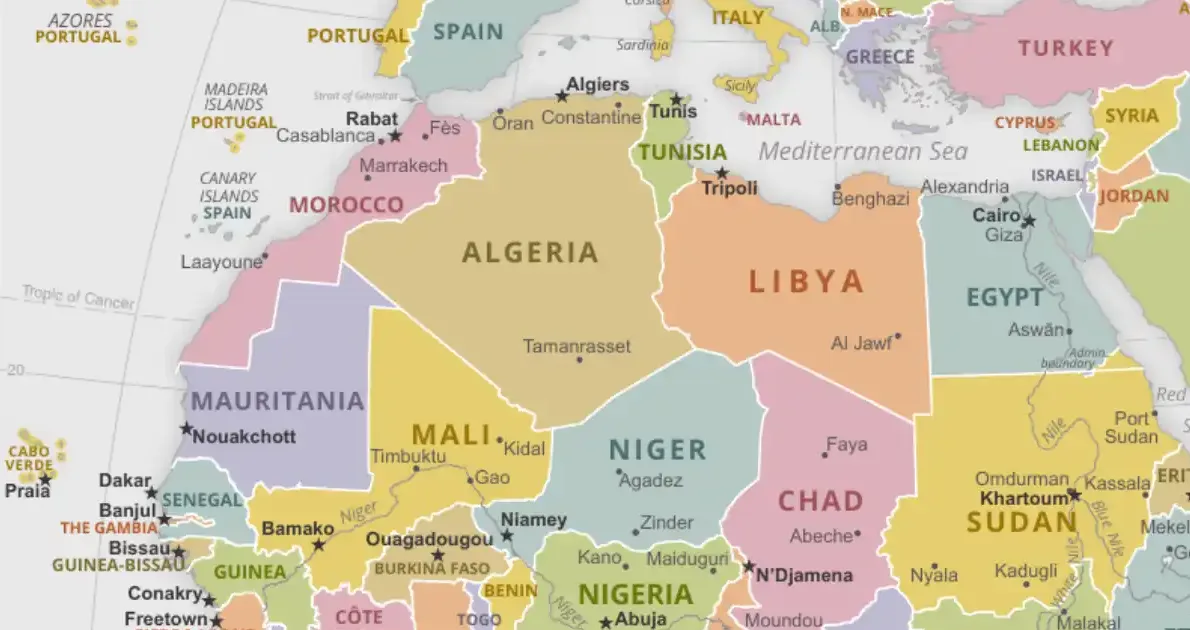
North Africa is the northernmost part of the continent, running along the Mediterranean Sea from Morocco's Atlantic coast in the west to Egypt's Red Sea coast in the east, with the Sahara Desert filling most of the interior. The UN counts 6 countries in North Africa: Morocco, Algeria, Tunisia, Libya, Egypt and Sudan. Mauritania is often added as a seventh (it is a member of the Arab Maghreb Union), and the region also contains the disputed territory of Western Sahara. Morocco, Algeria, Tunisia, Libya and Mauritania together form the Maghreb (Arabic for "the west").
For population, languages and history of the region’s 6 countries (UN grouping), see our North Africa region guide. Some definitions also include Mauritania and Western Sahara.
Last updated: September 2026
North African Countries and Capitals
| Country | Capital | Area (km²) | Population (approx.) |
|---|---|---|---|
| Algeria | Algiers | 2,381,741 | 46 million |
| Sudan | Khartoum | 1,861,484 | 50 million |
| Libya | Tripoli | 1,759,540 | 7 million |
| Egypt | Cairo | 1,001,450 | 115 million |
| Morocco | Rabat | 446,550* | 38 million |
| Tunisia | Tunis | 163,610 | 12 million |
| Mauritania (often included) | Nouakchott | 1,030,700 | 5 million |
*Excluding Western Sahara (about 266,000 km²), most of which Morocco administers but whose status is disputed. Populations are rounded 2024 estimates.
Country Overviews
Egypt (Arab Republic of Egypt)
Located in the northeastern corner of Africa, Egypt spans 1,001,450 square kilometers and has about 115 million people, the most in North Africa. Around 95% of them live in the Nile valley and delta, on well under a tenth of the land. Cairo, whose metropolitan area has over 20 million people, is the capital and one of Africa's largest cities; a New Administrative Capital is being developed to its east, with government ministries moving there in stages. Egypt's strategic location controlling the Suez Canal makes it a vital link between Africa, Asia, and Europe.
Libya (State of Libya)
Libya covers 1,759,540 square kilometers, making it the fourth-largest country in Africa. Despite its vast size, Libya's population of approximately 7 million is concentrated along the Mediterranean coast, particularly in Tripoli and Benghazi. The Sahara Desert covers about 90% of the country, containing significant oil reserves that form the backbone of Libya's economy.
Tunisia (Republic of Tunisia)
The smallest North African country at 163,610 square kilometers, Tunisia punches above its weight in historical and cultural significance. With a population of about 12 million, Tunisia was the birthplace of the Arab Spring in 2011. The country features diverse landscapes from Mediterranean beaches to Saharan dunes, with the ancient city of Carthage near modern Tunis serving as a reminder of its rich historical heritage.
Algeria (People's Democratic Republic of Algeria)
Algeria is Africa's largest country by area, covering 2,381,741 square kilometers. However, most of its roughly 46 million inhabitants live in the northern coastal region, as the Sahara Desert dominates the southern 80% of the country. Algiers, the capital, showcases a blend of French colonial architecture and traditional Islamic design, reflecting the country's complex history.
Morocco (Kingdom of Morocco)
Morocco encompasses 446,550 square kilometers (or 710,850 including Western Sahara) and has about 38 million people. Its capital is Rabat; Casablanca is the largest city. Unique among North African countries for having both Atlantic and Mediterranean coastlines, Morocco features the Atlas Mountains, which create diverse climate zones. Cities like Marrakech, Fez, and Casablanca are renowned for their historical medinas and vibrant culture.
Mauritania (Islamic Republic of Mauritania)
Often included in North Africa, Mauritania bridges the Arab Maghreb and Sub-Saharan Africa. It is not in the UN's North Africa group (the UN places it in West Africa), but it belongs to the Arab Maghreb Union. Covering 1,030,700 square kilometers with a population of about 5 million, the country is largely desert, with most people living along the Senegal River in the south or in the capital, Nouakchott.
Sudan (Republic of the Sudan)
Sudan is included in North Africa by the UN geoscheme. It covers 1,861,484 square kilometers and has about 50 million people. The Blue and White Nile meet at Khartoum, the capital. Since April 2023 the country has been in a civil war between the army and the Rapid Support Forces, which has displaced millions of people; the army-backed government operated largely from Port Sudan on the Red Sea until it returned to Khartoum in January 2026.
Geographic Features of North Africa
North Africa's geography is defined by several major features that have shaped human settlement and cultural development:
The Sahara Desert
The Sahara, the world's largest hot desert, dominates North Africa's landscape. Covering approximately 9 million square kilometers, it extends from the Atlantic Ocean to the Red Sea. Despite popular perception, the Sahara isn't just sand dunes—it includes rocky plateaus, mountains (like the Ahaggar and Tibesti), oases, and seasonal rivers. The desert has expanded and contracted throughout history, influencing human migration and settlement patterns.
The Atlas Mountains
Stretching 2,500 kilometers across Morocco, Algeria, and Tunisia, the Atlas Mountains create a natural barrier between the Mediterranean coast and the Sahara. The highest peak, Mount Toubkal in Morocco, reaches 4,167 meters. These mountains capture moisture from Atlantic and Mediterranean winds, creating fertile valleys and supporting diverse ecosystems.
The Nile River
The Nile, flowing about 6,650 kilometers from the Great Lakes region and the Ethiopian Highlands north through Sudan and Egypt to the Mediterranean, has been Egypt's lifeline for millennia. The river's annual floods historically deposited rich silt, enabling agriculture in an otherwise arid region. Today, the Aswan High Dam regulates the river's flow, providing irrigation and hydroelectric power while fundamentally altering the river's ecosystem.
Mediterranean Coastline
North Africa's Mediterranean coast stretches over 5,000 kilometers, featuring important ports like Alexandria, Tripoli, Tunis, Algiers, and Tangier. This coastline enjoys a Mediterranean climate with hot, dry summers and mild, wet winters, supporting agriculture including olives, citrus fruits, and grapes.
Climate and Ecosystems
North Africa exhibits dramatic climate variations from north to south:
- Mediterranean Climate Zone: Along the coast, supporting dense populations and agriculture
- Semi-Arid Steppe: A transitional zone between the coast and desert
- Desert Climate: Characterized by extreme temperature variations and minimal rainfall
- Oasis Ecosystems: Scattered throughout the Sahara, supporting date palms and small communities
- Mountain Climates: The Atlas Mountains feature snow in winter and support unique flora and fauna
Cultural and Historical Significance
North Africa's strategic location has made it a melting pot of civilizations:
Ancient Civilizations
The region hosted some of humanity's earliest civilizations. Ancient Egypt developed along the Nile over 5,000 years ago, while Carthage dominated the western Mediterranean from modern Tunisia. The indigenous Berber (Amazigh) peoples have inhabited the region for millennia, maintaining their languages and customs despite successive conquests.
Islamic Conquest and Arabization
The 7th-century Arab conquest brought Islam and the Arabic language, fundamentally transforming North African society. However, the process of Arabization varied by region, with Berber languages and customs persisting, especially in mountainous areas of Morocco and Algeria.
Colonial Period
European colonialism profoundly impacted North Africa. France colonized Algeria (1830–1962) and ruled Tunisia (1881–1956) and most of Morocco (1912–1956) as protectorates, with Spain holding northern Morocco. Italy ruled Libya from 1911 until 1943 (independence came in 1951), and Britain occupied Egypt from 1882, keeping forces there until 1956, and jointly ruled Sudan with Egypt until 1956. This period left lasting influences on languages, legal systems, and infrastructure.
Modern North Africa: Economy and Development
Today's North African countries face both opportunities and challenges:
Natural Resources
- Oil and Gas: Libya and Algeria possess significant hydrocarbon reserves
- Phosphates: Morocco (including Western Sahara) holds roughly 70% of known world phosphate reserves
- Tourism: Egypt, Morocco, and Tunisia attract millions of visitors annually
- Agriculture: Despite arid conditions, the region produces dates, olives, citrus, and grains
- Renewable Energy: Vast solar and wind potential, with major projects underway
Economic Challenges
North African economies face several challenges including youth unemployment, water scarcity, political instability in some countries, and dependence on commodity exports. However, the region also shows promise with growing tech sectors, particularly in Egypt and Morocco, and increasing regional integration efforts.
Transportation and Infrastructure
North Africa's infrastructure reflects both ancient trade routes and modern development:
- Trans-Saharan Routes: Historical caravan routes connected sub-Saharan Africa with the Mediterranean
- Modern Highways: The Cairo-Dakar Highway and Trans-Maghreb Highway facilitate regional connectivity
- Railways: Networks primarily serve coastal areas, with ambitious expansion plans
- Ports: Major ports like Port Said, Alexandria, and Tangier-Med serve global shipping
- Airports: Cairo, Casablanca and Algiers are the region's main international hubs
Environmental Challenges and Conservation
North Africa faces significant environmental challenges requiring regional cooperation:
Water Scarcity
The region is one of the world's most water-stressed, with countries like Libya and Egypt relying heavily on fossil aquifers and the Nile River. Desalination plants along the coast increasingly supplement freshwater supplies, while traditional water management techniques like foggaras (underground channels) are being revived.
Desertification
Climate change and human activities accelerate desert expansion, threatening agricultural areas and forcing population displacement. The Great Green Wall initiative aims to plant a barrier of trees across the Sahel to combat desertification.
Biodiversity Conservation
Despite harsh conditions, North Africa hosts unique biodiversity including the endangered Barbary macaque, various gazelle species, and the fennec fox. Protected areas like Morocco's Toubkal National Park and Egypt's Ras Mohammed National Park work to preserve these ecosystems.
Related Maps
For the wider Arab world, see the Middle East and North Africa (MENA) map. Physical features are covered on where the Atlas Mountains are and where the Nile River is. Countries to the south appear on the West Africa, Central Africa and Sub-Saharan Africa maps.
Frequently Asked Questions
Which countries are in North Africa?
The UN counts six countries in North Africa: Algeria, Egypt, Libya, Morocco, Sudan and Tunisia. Mauritania is often added as a seventh, and the region also includes the disputed territory of Western Sahara.
Is North Africa part of the Middle East?
North Africa is geographically part of Africa, but culturally, linguistically and politically it shares strong ties with the Arab Middle East. The combined region is often referred to as MENA (Middle East and North Africa).
What is the largest country in North Africa?
Algeria is the largest country in North Africa by area, covering 2,381,741 km². It is also the largest country in all of Africa.
What language is spoken in North Africa?
Arabic is the dominant official language across North Africa. Berber (Amazigh) languages are also widely spoken and are co-official in Morocco and Algeria, while French is widely used in Morocco, Algeria and Tunisia.
What is the climate like in North Africa?
North Africa has a Mediterranean climate along the coast and an arid desert climate inland. The Sahara Desert occupies the majority of the region's territory.