Central Africa Map: Exploring the Heart of the Continent
Where Is Central Africa?
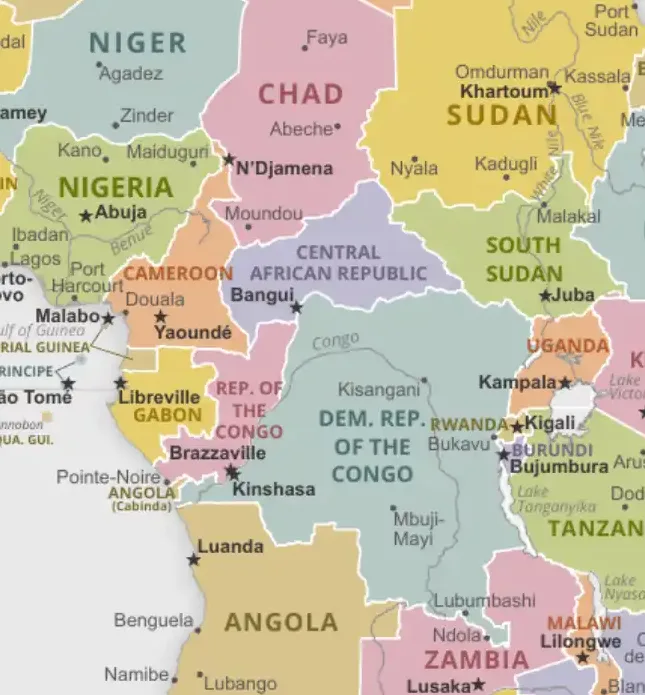
Central Africa is the middle of the continent, straddling the Equator between the Gulf of Guinea (Atlantic Ocean) in the west and the Great Lakes and Rift Valley in the east, and stretching from the Sahara in Chad south to Angola. Using the UN definition, it has 9 countries: Angola, Cameroon, the Central African Republic, Chad, the Democratic Republic of the Congo, Equatorial Guinea, Gabon, the Republic of the Congo and São Tomé and Príncipe. Its core is the Congo Basin, drained by the Congo River and covered by the world's second-largest tropical rainforest.
For capitals, population and history of the region’s 9 countries, see our Central Africa region guide.
Last updated: September 2026
Together the nine countries cover about 6.6 million km² and have a combined population of over 210 million (2024 estimates), almost half of it in the DR Congo. Angola is sometimes grouped with Southern Africa instead, and some definitions add Rwanda and Burundi.
Map Controls
Legend
Countries of Central Africa
🇦🇴 Angola
Angola, the region's third-largest country, lies on the Atlantic coast at the southern edge of Central Africa and is often grouped with Southern Africa too. Its oil-rich Cabinda exclave is separated from the rest of the country by a strip of DR Congo territory. Since its civil war ended in 2002, oil and diamonds have dominated the economy.
🇨🇲 Cameroon
Often called "Africa in miniature," Cameroon showcases incredible geographical and cultural diversity within its triangular shape. From the coastal mangroves and Mount Cameroon (4,040 m, the highest peak in West and Central Africa) to the northern savannas and southeastern rainforests, the country encompasses virtually every African ecosystem. This diversity extends to its population, with over 250 ethnic groups and languages, making it one of Africa's most culturally rich nations.
🇨🇫 Central African Republic
The Central African Republic (CAR) occupies a strategic position at the heart of the continent, serving as a transition zone between the Congo Basin rainforests to the south and the Sahel savannas to the north. Despite its wealth in natural resources including diamonds, gold, uranium, and timber, CAR is one of the world's least developed countries and has faced armed conflict since 2013.
🇹🇩 Chad
Chad, the region's northernmost country, bridges Central Africa with the Sahara Desert. Its diverse geography ranges from the Tibesti Mountains in the north, where the Sahara's highest peak Emi Koussi rises, to the fertile lands around Lake Chad in the west and savanna regions in the south. Oil exports, which began in 2003 via a pipeline through Cameroon, now supplement a mainly agricultural and pastoral economy.
🇨🇩 Democratic Republic of the Congo
The Democratic Republic of the Congo (DRC) dominates Central Africa both in size and significance. As Africa's second-largest country and home to the vast Congo River system and rainforest, the DRC contains extraordinary biodiversity and mineral wealth. Its resources include cobalt (essential for modern electronics), copper, diamonds, gold, and coltan, making it crucial to global supply chains despite decades of conflict in the east of the country.
🇬🇶 Equatorial Guinea
Equatorial Guinea consists of a mainland region (Río Muni) and five inhabited islands, including Bioko Island, where the capital Malabo is located. A new capital, Ciudad de la Paz, is being built on the mainland. Since discovering significant offshore oil reserves in the 1990s, this small nation has experienced dramatic economic growth, achieving one of Africa's highest per capita GDPs, though wealth distribution remains highly unequal.
🇬🇦 Gabon
Gabon is one of Africa's most forested countries, with rainforest covering close to 90% of its territory. Oil and manganese make it one of the region's higher-income countries; a military takeover in 2023 ended more than 50 years of rule by the Bongo family. Gabon is also a conservation leader, with a network of national parks protecting its incredible biodiversity, including forest elephants, gorillas, and countless endemic species.
🇨🇬 Republic of the Congo
The Republic of the Congo, also known as Congo-Brazzaville to distinguish it from its larger neighbor, stretches from the Atlantic coast to the Congo River. The country combines coastal oil wealth with vast interior rainforests, making it an important player in both energy markets and conservation efforts. The Congo River forms much of its eastern border, creating a natural boundary with the DRC.
🇸🇹 São Tomé and Príncipe
This island nation in the Gulf of Guinea, just north of the Equator, is Africa's second-smallest country after Seychelles, made up of two main islands and several islets. Once the world's largest cocoa producer (early 1900s), it now relies on cocoa, tourism and foreign aid, and is exploring for offshore oil. The islands' isolation has resulted in unique biodiversity, with many endemic species found nowhere else on Earth.
Geography and Physical Features
The Congo Basin
The Congo Basin dominates Central Africa's geography, covering approximately 3.7 million square kilometers across multiple countries. This vast depression contains the world's second-largest tropical rainforest after the Amazon, playing a crucial role in global climate regulation and carbon storage. The basin's complex river system, centered on the Congo River, creates an intricate network of waterways that have historically served as the region's primary transportation routes.
Major Rivers
The Congo River, Africa's second-longest river at 4,700 kilometers, defines much of Central Africa's geography and economy. Its massive discharge rate is second only to the Amazon globally, carrying more water than any other African river. Major tributaries include the Ubangi, Sangha, and Kasai rivers, which create vast wetland systems supporting incredible biodiversity. The river's hydroelectric potential is enormous, with the proposed Grand Inga Dam potentially capable of powering much of Africa.
Mountain Ranges and Highlands
Central Africa features several significant highland regions. The Cameroon Volcanic Line extends from Mount Cameroon on the coast through the Adamawa Plateau into the continental interior. In eastern DRC, the Mitumba Mountains and volcanic peaks of the Virunga range mark the western edge of the Great Rift Valley. Chad's Tibesti Mountains in the north include volcanic peaks rising over 3,000 meters from the Sahara Desert floor.
Climate Zones
Equatorial Rainforest Climate
The core of Central Africa experiences a hot, humid equatorial climate with year-round rainfall. Temperatures remain consistently high (24-28°C), with minimal seasonal variation. Annual rainfall exceeds 1,500mm, supporting the lush rainforest ecosystem.
Tropical Savanna Climate
Northern and southern margins of the region experience distinct wet and dry seasons. These areas support savanna grasslands and open woodlands, with rainfall ranging from 600-1,500mm annually. This climate zone includes northern Cameroon, CAR, and southern Chad.
Highland Climate
Mountainous areas enjoy cooler temperatures and unique microclimates. The Cameroon Highlands, eastern DRC mountains, and Chad's Tibesti region experience temperature variations based on elevation, with some peaks occasionally receiving frost.
Natural Resources and Economy
Minerals
Central Africa contains vast mineral wealth including copper, cobalt, diamonds, gold, uranium, and coltan. The DRC alone produces about 70% of the world's mined cobalt.
Oil & Gas
Significant petroleum reserves exist in Angola, Equatorial Guinea, Gabon, the Republic of the Congo, Chad and Cameroon, making oil exports a major economic driver for these nations.
Timber
The Congo Basin forests contain valuable hardwood species. Sustainable forestry practices are crucial for balancing economic needs with conservation.
Hydropower
The Congo River system has enormous hydroelectric potential, with current and planned projects that could transform Africa's energy landscape.
Biodiversity and Conservation
The Congo Rainforest Ecosystem
The Congo Basin rainforest harbors extraordinary biodiversity, including over 10,000 plant species, 1,000 bird species, and 400 mammal species. This ecosystem is home to iconic wildlife such as forest elephants, lowland gorillas, chimpanzees, bonobos (found only in DRC), and the mysterious okapi. The forest also supports millions of people, including indigenous communities like the Ba'Aka, Baka, and Twa peoples who have lived sustainably in these forests for millennia.
Conservation Challenges
Central Africa faces significant conservation challenges including deforestation from logging and agricultural expansion, poaching for bushmeat and ivory, and habitat fragmentation from infrastructure development. Climate change poses additional threats, potentially altering rainfall patterns crucial for forest survival. However, the region has established numerous protected areas, including transboundary conservation initiatives like the Sangha Trinational (Cameroon, CAR, Congo) and the Greater Virunga Transboundary Collaboration.
Marine and Coastal Ecosystems
The Atlantic coast of Central Africa features important marine ecosystems, including mangrove forests, coral reefs around São Tomé and Príncipe, and critical nesting beaches for sea turtles. The Gulf of Guinea is one of the world's most productive fishing grounds, though overfishing and oil extraction pose significant threats to marine biodiversity.
Cultural Heritage and Languages
Linguistic Diversity
Central Africa is one of the world's most linguistically diverse regions, with over 700 languages spoken across the nine countries. The major language families include Niger-Congo (particularly Bantu languages), Nilo-Saharan, and Afroasiatic. Colonial languages (French, Portuguese, Spanish, and English in Cameroon) serve as official languages and lingua francas, facilitating communication across ethnic boundaries.
Traditional Kingdoms and Societies
The region has a rich history of traditional kingdoms and complex societies. The Kingdom of Kongo once controlled vast territories across modern Angola, DRC, and Congo. The Luba and Lunda empires in the DRC developed sophisticated political systems and artistic traditions. In Cameroon, numerous kingdoms like the Bamoun maintain cultural traditions while adapting to modern governance structures.
Music and Arts
Central Africa has profoundly influenced global music, particularly through Congolese rumba and soukous, which spread throughout Africa and beyond. Traditional music featuring drums, xylophones, and complex polyphonic singing remains vital to cultural expression. The region is also renowned for its sculptural traditions, mask-making, and contemporary arts scenes in cities like Kinshasa and Douala.
Modern Challenges and Opportunities
Economic Development
Central Africa faces the paradox of vast natural wealth alongside widespread poverty. While resource extraction drives GDP growth in several countries, economic diversification remains limited. Infrastructure development, particularly transportation networks connecting landlocked areas to ports, is crucial for regional integration. The African Continental Free Trade Area presents opportunities for increased intra-regional trade.
Political Stability and Governance
Several governments in the region have been in power for decades, and armed conflict continues in eastern DR Congo and parts of the Central African Republic. Chad (2021) and Gabon (2023) have both gone through military-led transitions, and Cameroon faces a separatist conflict in its English-speaking regions.
Regional Cooperation
The Economic Community of Central African States (ECCAS) promotes regional integration and cooperation. Joint initiatives address shared challenges including security, environmental conservation, and economic development. The Central African Economic and Monetary Community (CEMAC) shares a common currency, the Central African CFA franc, among six members: Cameroon, CAR, Chad, the Republic of the Congo, Equatorial Guinea and Gabon, facilitating trade and economic coordination.
Climate Change and Environmental Sustainability
Central Africa plays a crucial role in global climate regulation through its vast forests. International initiatives like REDD+ provide funding for forest conservation while supporting local development. Balancing conservation with economic development needs remains a key challenge, requiring innovative approaches that benefit both people and nature.
Tourism and Travel
Ecotourism Opportunities
Central Africa offers unique ecotourism experiences, from western lowland gorilla tracking in the Republic of the Congo (Odzala-Kokoua), the Central African Republic (Dzanga-Sangha) and Gabon to exploring rainforests and observing forest elephants. São Tomé and Príncipe's endemic species and beautiful beaches attract nature lovers. The region's national parks, though less visited than East African destinations, provide authentic wilderness experiences.
Cultural Tourism
Cities like Kinshasa and Douala offer vibrant cultural scenes with music, art, and cuisine. Traditional festivals, markets, and cultural sites provide insights into Central Africa's rich heritage. Historical sites related to the colonial period and independence movements offer educational tourism opportunities.
Adventure Tourism
The region offers adventure activities including river expeditions on the Congo, mountain climbing on Mount Cameroon, and exploring volcanic landscapes in the Virunga region. The challenging logistics of travel in some areas add to the adventure appeal for intrepid travelers.
Using This Map
The buttons above the map switch between the nine countries (click a marker for capital, area, population and main resources), the main rivers of the Congo system, the largest cities and a selection of national parks. For capitals and history, see the Central Africa region guide; neighbouring regions are covered on the East Africa, West Africa and Southern Africa maps.
Frequently Asked Questions
Which countries are in Central Africa?
Under the UN definition used on this map, Central Africa has 9 countries: Angola, Cameroon, the Central African Republic, Chad, the Democratic Republic of the Congo, the Republic of the Congo, Equatorial Guinea, Gabon and São Tomé and Príncipe.
What is the largest country in Central Africa?
The Democratic Republic of the Congo is by far the largest country in Central Africa with an area of 2,344,858 km² — the second-largest country in all of Africa.
What is the Congo Basin?
The Congo Basin is the world's second-largest tropical rainforest after the Amazon, covering parts of six Central African countries. It is a critical carbon sink and home to forest elephants, gorillas and bonobos.
What languages are spoken in Central Africa?
French is the most widely used official language, alongside Portuguese (Angola, São Tomé and Príncipe, Equatorial Guinea), Spanish (Equatorial Guinea) and English (Cameroon). Lingala, Kikongo, Sango, Fang and many other Bantu languages are spoken regionally.