Central African Republic: The Heart of Africa
The Central African Republic (CAR) is a landlocked country near the geographic centre of Africa, covering about 623,000 km². Its capital and largest city is Bangui, on the Ubangi River. It has about 5.5 million people (2025 UN estimate); French and Sango are official. CAR borders Chad, Sudan, South Sudan, DR Congo, the Republic of the Congo and Cameroon, and became independent from France on 13 August 1960.
The Central African Republic (CAR) is a landlocked country of 622,984 square kilometres lying close to the geographic centre of Africa, which is why it is sometimes called the "Heart of Africa". It is bordered by six countries and has about 5.5 million people, most of them living in the south-west and west. The country has savannas in the north, rainforest in the south-west, important river systems and deposits of diamonds and gold, but decades of instability have made it one of the world's poorest countries. This page covers CAR's place on the map, its geography, history, wildlife, economy and current challenges.
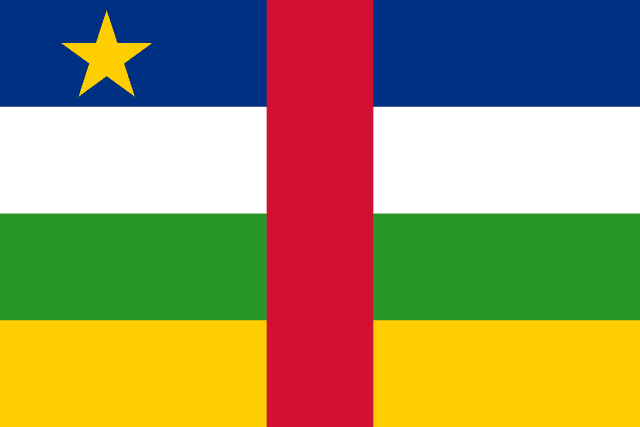
Flag of Central African Republic
Central African Republic on the Map of Africa
View the CAR's central position in Africa, truly at the heart of the continent and bordered by six different countries:
Map of Central African Republic
Explore the detailed map of the Central African Republic showing its regions, rivers, forests, and major cities:

Central African Republic Facts at a Glance
| Official name | Central African Republic |
|---|---|
| Capital | Bangui |
| Largest city | Bangui |
| Region | Central Africa |
| Population | About 5.5 million (2025 UN estimate) |
| Area | 622,984 km² (240,535 sq mi) – landlocked, near the geographic centre of Africa |
| Coastline | Landlocked |
| Official languages | French and Sango (Sango is the national lingua franca) |
| Currency | Central African CFA franc (XAF) |
| Government | Presidential republic |
| Independence | 13 August 1960, from France |
| Neighbouring countries | 6: Chad, Sudan, South Sudan, DR Congo, Republic of the Congo, Cameroon. The Ubangi River forms much of the southern border with DR Congo. |
| Administrative divisions | 20 prefectures, plus the capital Bangui as an autonomous commune |
| Main cities | Bangui, Bimbo, Berbérati, Carnot, Bambari, Bouar |
| Highest point | Mont Ngaoui, about 1,410 m (4,626 ft), on the border with Cameroon |
| Rivers and lakes | Ubangi and Sangha (Congo basin) in the south; Ouham and Bamingui (Chari basin) in the north |
| Climate | Tropical: humid and forested in the south, savanna in the centre, semi-arid in the far north-east; rainy season about May–October |
| Economy | Subsistence farming, timber, diamonds and gold; one of the world's poorest countries after years of armed conflict since 2013 |
| Time zone | UTC+1 (West Africa Time) |
| Calling code | +236 |
Population figures are rounded 2025 estimates from the UN World Population Prospects 2024 unless stated otherwise. Facts checked September 2026.
See also: Bangui city guide, countries of Central Africa, landlocked countries in Africa, French-speaking countries in Africa, African independence timeline.
The Geographical Heart of Africa
The Central African Republic truly lives up to its name by occupying the geographical center of the African continent. This landlocked nation is bordered by Chad to the north, Sudan and South Sudan to the northeast and east, Democratic Republic of the Congo to the south, Republic of the Congo to the southwest, and Cameroon to the west. This central position has made the CAR a natural crossroads for trade, migration, and cultural exchange throughout African history, while its strategic location continues to influence regional dynamics and international interest.
The country's position at approximately 7°North latitude places it in the transition zone between the Sahel region and the equatorial forests, creating diverse ecological zones that support different ecosystems and human activities. This geographical location results in a tropical climate with distinct wet and dry seasons, supporting both savanna grasslands and gallery forests along river valleys. The country also sits on a major watershed: rivers in the south drain to the Ubangi and Congo and ultimately the Atlantic Ocean, while rivers in the north flow to the Chari and Lake Chad.
River Systems: Lifelines Across the Continent
The Central African Republic serves as a crucial watershed region where major African river systems originate, earning it additional significance beyond its central geographical position. The Ubangi River, a major tributary of the Congo River, forms much of the country's southern border and provides the primary transportation route connecting the landlocked CAR to maritime ports. This river system supports fishing, agriculture, and transportation while serving as the main highway for trade with neighboring countries.
The Sangha River in the southwest flows toward the Congo Basin, creating important wildlife corridors and supporting forest ecosystems shared with Cameroon and Republic of the Congo. In the north, the Chari River system flows toward Lake Chad, connecting the CAR to the Sahel region and demonstrating the country's role as a bridge between different African regions. These river systems support diverse aquatic life, provide water for agriculture and urban areas, and create fertile floodplains that have supported human settlement for thousands of years.
Rapids and waterfalls along these rivers create both transportation challenges and opportunities for hydroelectric power generation. The Boali Falls on the M'Bali River near Bangui provide hydroelectric power for the capital region while creating a scenic attraction for visitors. River transport remains crucial for moving goods and people in a country where road infrastructure is limited, though seasonal variations in water levels and aging vessel fleets constrain capacity and reliability.
Diverse Ecosystems: From Savanna to Forest
The Central African Republic encompasses diverse ecosystems that reflect its position bridging different African ecological zones. The northern regions feature sudan savanna characterized by grasslands with scattered trees, supporting livestock grazing and cultivation of crops like millet, sorghum, and cotton. This savanna ecosystem supports large mammal populations including elephants, buffalo, and various antelope species that migrate seasonally following rainfall patterns and grass growth.
Southern regions contain portions of the Congo Basin rainforest, creating dense forest ecosystems that harbor extraordinary biodiversity. These forests support forest elephants, western lowland gorillas, chimpanzees, forest buffalo, and numerous endemic species found nowhere else on Earth. The forests provide timber resources, non-timber forest products, and ecosystem services including carbon storage and climate regulation that benefit both local communities and global environmental health.
Gallery forests along river valleys create important wildlife corridors that connect different ecosystems while providing refuge for animals during dry seasons. These riverine forests support higher biodiversity than surrounding savannas and provide crucial habitat for primates, birds, and other forest-dependent species. Wetlands and seasonal floodplains support aquatic birds, fish populations, and unique plant communities adapted to alternating wet and dry conditions.
Diamond Wealth: Geological Treasures
The Central African Republic possesses significant diamond deposits that have shaped the country's economy and history for over a century. The country produces both industrial diamonds used in cutting tools and drilling equipment, and gem-quality stones valued for jewelry and investment. Diamond mining occurs throughout the country but concentrates in the southwestern regions where alluvial deposits in riverbeds and ancient terraces contain easily accessible stones.
Artisanal diamond mining employs tens of thousands of Central Africans who work small-scale operations using basic tools to extract diamonds from alluvial gravels. This sector provides livelihoods for mining communities while supplying diamonds to international markets through buying networks that connect remote mining areas to global trading centers. However, diamond wealth has also contributed to conflicts and governance challenges, earning some CAR diamonds the designation "blood diamonds" or "conflict diamonds."
Gold mining also occurs throughout the country, with both artisanal miners and international companies extracting precious metals from alluvial deposits and hard rock formations. Other mineral resources include uranium, iron ore, copper, and various industrial minerals that remain largely unexploited due to infrastructure constraints and security challenges. The potential for mineral wealth to drive economic development depends on improving governance, security, and infrastructure while ensuring that local communities benefit from resource extraction.
Wildlife Sanctuary: Conservation Priorities
The Central African Republic contains some of Africa's most important wildlife populations and serves as a crucial conservation priority for protecting endangered species and ecosystems. The country's national parks and reserves cover a large share of its territory, protecting representative ecosystems from savanna grasslands to dense rainforests. These protected areas support populations of forest elephants, western lowland gorillas, chimpanzees, and numerous other species that have declined dramatically elsewhere in Africa.
Dzanga-Sangha National Park in the southwest protects pristine rainforest habitat and contains one of Africa's most important forest elephant populations. The park's famous Dzanga Bai (forest clearing) regularly draws dozens, and at times more than a hundred, forest elephants that come to drink mineral-rich water and socialize, creating exceptional wildlife viewing opportunities. This ecosystem also supports western lowland gorillas, forest buffalo, bongo antelope, and over 350 bird species in pristine forest habitats.
Manovo-Gounda St Floris National Park in the north, a UNESCO World Heritage Site, once supported some of Central Africa's richest savanna wildlife. Poaching and armed conflict have severely depleted its elephants, rhinos and other large mammals, and it is on UNESCO's List of World Heritage in Danger. Dzanga-Sangha, by contrast, is part of the Sangha Trinational World Heritage Site shared with Cameroon and the Republic of the Congo.
Bangui: Capital at the Heart
Bangui, the capital and largest city of the Central African Republic, lies on the Ubangi River opposite the Congolese town of Zongo. With roughly a million people in its urban area, it is the political, economic and cultural centre of the country and the only large city.
Most of the country's imports and exports travel by road along the corridor to the Cameroonian port of Douala, about 1,500 km away; the Ubangi River route south to Brazzaville is an alternative when water levels allow. Bangui hosts the government, foreign embassies and the many UN and humanitarian agencies working in the country.
Bangui's markets showcase the cultural diversity of the Central African Republic, with vendors selling goods from across the country and region. The central market offers everything from locally grown agricultural products to diamonds and gold, while specialized markets focus on textiles, crafts, and traditional medicines. The city's mosques, churches, and cultural centers reflect the religious and ethnic diversity that characterizes the CAR, though periodic conflicts have strained community relations.
Cultural Diversity: Unity Across Ethnic Groups
The Central African Republic has more than 80 ethnic groups. The largest include the Gbaya (Baya), Banda, Mandja, Sara, Mboum, Ngbaka (M'Baka) and Yakoma peoples, each with distinct traditions and languages. This diversity reflects historical migrations and the country's position as a crossroads; the region was also badly affected by slave raiding from the north and east in the 19th century.
Sango is spoken by almost the entire population as a lingua franca and, along with French, is an official language. Most Central Africans speak their ethnic language at home, Sango for everyday communication between groups, and French mainly in education, administration and the media.
Religious diversity encompasses Christianity (primarily Catholic and Protestant denominations), Islam (particularly in northern regions), and traditional African religions that maintain strong influences throughout the country. Many Central Africans practice syncretic religions that combine elements from different traditions, reflecting the cultural adaptation and tolerance that characterizes much of African spirituality. Religious festivals, traditional ceremonies, and cultural celebrations provide opportunities for different communities to share their heritage while building national unity.
Agricultural Foundation: Feeding the Nation
Agriculture employs around three-quarters of the Central African Republic's workforce and forms the foundation of the national economy, though productivity remains below potential due to limited mechanization, poor transportation infrastructure, and periodic conflicts that disrupt farming activities. The country's tropical climate and fertile soils support both subsistence farming for household consumption and cash crop production for domestic and export markets.
Food crops include cassava, yams, plantains, maize, millet, and sorghum, with different crops favored in different ecological zones depending on rainfall patterns and soil conditions. Cassava serves as the primary staple food, providing carbohydrates and food security even during drought periods due to its drought tolerance and storage capabilities. Farmers also grow vegetables, fruits, and legumes that provide nutrition and income for rural families.
Cash crops include cotton, coffee, and tobacco that provide export earnings and employment in processing industries. Cotton cultivation concentrates in northern regions where climate conditions favor fiber production, while coffee grows in forest regions with higher rainfall and cooler temperatures. Livestock keeping includes cattle in northern savannas, goats and sheep throughout the country, and poultry for both subsistence and commercial purposes. However, conflicts between farmers and herders over land and water resources create ongoing challenges for agricultural development.
Forest Resources: Balancing Use and Conservation
The Central African Republic's forest resources represent both economic opportunities and conservation challenges, with forests covering about 36% of the national territory and supporting both local livelihoods and global biodiversity conservation goals. These forests provide timber for construction and export, non-timber forest products including fruits, medicines, and crafts materials, and ecosystem services including carbon storage, water regulation, and climate modification.
Timber extraction focuses on valuable hardwood species including mahogany, sapele, and other tropical woods valued in international markets. Logging operations provide employment and export revenues, though sustainable forestry practices are essential for maintaining forest ecosystems and preventing habitat destruction. Community forestry programs aim to involve local communities in forest management while providing them with benefits from sustainable timber harvesting and non-timber forest product collection.
Non-timber forest products support rural livelihoods through collection and sale of fruits, nuts, medicines, honey, and crafts materials. These products provide important nutritional supplements and income sources for forest communities while requiring minimal infrastructure investment. Traditional ecological knowledge guides sustainable harvesting practices that have been developed over generations, though market access and value addition remain limited by poor transportation and processing infrastructure.
Transportation Challenges: Connecting a Landlocked Nation
Transportation infrastructure represents one of the Central African Republic's greatest development challenges, with limited road networks, no railways, and dependence on river and air transport for connections to international markets. The country's landlocked position requires all international trade to pass through neighboring countries, creating additional costs and dependencies that limit economic competitiveness and access to global markets.
River transport on the Ubangi links Bangui with Brazzaville and the Congo River, but low water in the dry season often interrupts traffic. The main trade route is therefore the road corridor through western CAR to Douala in Cameroon. Road conditions are poor and many routes become impassable in the rainy season.
Air transport serves government, business, and humanitarian operations, with Bangui's international airport providing connections to regional and international destinations. Smaller airstrips throughout the country support mining operations, conservation programs, and humanitarian activities, though high costs limit accessibility for most Central Africans. Improving transportation infrastructure remains crucial for economic development, though investments require substantial financing and technical expertise.
Education and Human Development
Education in the Central African Republic faces significant challenges including limited infrastructure, teacher shortages, and periodic disruptions due to conflicts that have affected many regions. Primary education is officially free and compulsory, though many children lack access to schools, particularly in rural areas and regions affected by insecurity. Secondary and higher education opportunities are even more limited, with insufficient institutions and resources to meet growing demand from a young population.
The University of Bangui serves as the country's primary higher education institution, offering programs in various fields though capacity remains limited relative to demand. Technical and vocational training programs aim to provide practical skills for economic development, but require expansion and better equipment to meet labor market needs. Literacy rates remain low, particularly among women and rural populations, limiting human capital development and economic opportunities.
International development organizations and humanitarian agencies provide educational support including school construction, teacher training, and educational materials. However, sustainable improvements require increased government investment, improved security conditions, and community engagement to ensure that educational investments reach the most marginalized populations. Language of instruction policies balance the use of French (official language) with local languages and Sango (national language) to improve educational access and cultural relevance.
Health Care and Social Services
Health care in the Central African Republic faces enormous challenges including limited infrastructure, chronic shortages of medical personnel, and inadequate funding that leave large portions of the population without access to basic health services. The country has some of the world's worst health indicators, with high rates of maternal and infant mortality, low life expectancy, and limited capacity to address both infectious diseases and chronic health conditions.
Infectious diseases including malaria, respiratory infections, and diarrheal diseases remain leading causes of illness and death, particularly among children. HIV/AIDS prevalence is moderate but requires continued prevention and treatment efforts. Periodic outbreaks of diseases including measles, meningitis, and viral hemorrhagic fevers strain the limited health care system and require international assistance for effective response.
Traditional medicine plays important roles in health care, particularly in rural areas where modern medical facilities are unavailable. Traditional healers treat various conditions using plant medicines and spiritual practices that have been developed over generations. International humanitarian organizations provide essential health services including emergency medical care, vaccination programs, and treatment for malnutrition, though sustainable health system development requires increased government capacity and community engagement.
History: From Ubangi-Shari to Independence
Before colonial rule the region was home to many small societies and was devastated by 19th-century slave raids from Sudanese and Chadian sultanates. France established the colony of Ubangi-Shari in the 1890s, later part of French Equatorial Africa, where concession companies used forced labour to extract rubber and other products. Independence leader Barthélemy Boganda proclaimed the Central African Republic in 1958 but died in a plane crash in 1959; the country became independent on 13 August 1960. Jean-Bédel Bokassa seized power in 1966 and declared himself emperor in 1976, before being overthrown with French help in 1979.
Political Challenges and Governance
Since independence the Central African Republic has experienced repeated coups, mutinies and rebellions. In 2013 the mainly Muslim Séléka rebel coalition seized Bangui, triggering reprisals by "anti-balaka" militias and intercommunal violence that displaced over a million people at its peak. A UN peacekeeping mission (MINUSCA) has been deployed since 2014, and a peace agreement with the main armed groups was signed in 2019.
State authority has been gradually restored in many areas with the help of UN peacekeepers and, since 2018, Russian military instructors and private security forces. Armed groups still operate in parts of the north, east and north-west, and hundreds of thousands of people remain displaced inside the country or as refugees abroad. A new constitution adopted by referendum in 2023 removed presidential term limits.
Governance challenges include weak institutions, limited administrative capacity, and inadequate resources for providing basic services to the population. Corruption and lack of transparency undermine public trust and economic development, though civil society organizations and international partners work to promote accountability and democratic governance. Successful governance reform requires addressing root causes of conflict including ethnic tensions, resource competition, and economic marginalization.
International Relations and Regional Role
The Central African Republic's strategic location and ongoing challenges make it a focus of international attention and regional cooperation efforts. The country belongs to the Economic Community of Central African States (ECCAS) and the Economic and Monetary Community of Central Africa (CEMAC), whose central bank issues the CFA franc, though instability limits its capacity for active regional leadership. Neighboring countries provide humanitarian assistance, trade opportunities, and security cooperation.
International partnerships include development assistance from European Union countries, the United States, and multilateral organizations, as well as peacekeeping support from the United Nations and African Union. France, the former colonial power, withdrew its last troops in 2022, while Russia has become a key security partner and Chinese companies are active in mining. However, international engagement requires careful coordination to avoid creating dependencies or exacerbating conflicts.
Regional security cooperation focuses on addressing cross-border criminal activities, managing refugee flows, and preventing conflict spillover effects. The CAR hosts refugees from neighboring countries while also generating refugee populations that seek safety in surrounding nations. Effective regional cooperation could help address shared challenges including wildlife trafficking, environmental degradation, and economic development needs that transcend national boundaries.
Tourism Potential: Discovering Hidden Treasures
The Central African Republic possesses exceptional tourism potential based on its unique wildlife, pristine ecosystems, and cultural heritage, though security concerns and infrastructure limitations currently restrict visitor numbers. Wildlife tourism focuses on national parks where visitors can view forest elephants, gorillas, chimpanzees, and hundreds of bird species in some of Africa's most pristine habitats.
Dzanga-Sangha National Park offers world-class wildlife viewing opportunities, including the famous Dzanga Bai where forest elephants gather in large numbers. Gorilla trekking provides opportunities to observe western lowland gorillas in their natural habitat while supporting conservation efforts and local community development. The park's pristine forests also offer excellent bird watching, with over 350 species recorded in the area.
Cultural tourism opportunities include visits to traditional villages, craft centers, and cultural festivals that showcase the diversity of Central African traditions. The Boali Falls, about 90 km north-west of Bangui, provide a scenic attraction and hydroelectric power, while river trips offer opportunities to experience the Ubangi River transportation system. However, developing sustainable tourism requires improved security, infrastructure investment, and capacity building to ensure that tourism benefits local communities while protecting natural and cultural resources.
Environmental Conservation: Global Responsibilities
The Central African Republic's forests and ecosystems provide global environmental benefits including carbon storage, biodiversity conservation, and climate regulation that extend far beyond national boundaries. These ecosystems support species found nowhere else on Earth while providing ecosystem services that benefit both local communities and international environmental goals.
Climate change impacts include shifting rainfall patterns that affect agriculture and forest ecosystems, while deforestation and habitat destruction threaten biodiversity and reduce carbon storage capacity. Conservation efforts focus on protecting remaining forests through improved protected area management, community-based conservation programs, and sustainable development initiatives that provide alternative livelihoods for forest-dependent communities.
International environmental partnerships include funding for forest conservation through REDD+ (Reducing Emissions from Deforestation and forest Degradation) programs and other climate finance mechanisms. However, successful conservation requires addressing underlying causes of environmental degradation including poverty, weak governance, and limited economic opportunities in forest regions. Conservation success depends on ensuring that local communities benefit from protecting natural resources.
Economic Development Opportunities
The Central African Republic possesses significant economic potential based on its natural resources, strategic location, and human capital, though realizing this potential requires addressing security challenges, improving governance, and investing in infrastructure development. The country's mineral wealth, including diamonds and gold, could provide foundations for economic growth if properly managed and governed.
Agricultural development opportunities include increasing productivity through improved seeds, fertilizers, and farming techniques, as well as developing value-added processing industries that create employment and capture more value from agricultural products. The country could become a significant food producer for the Central African region if transportation and marketing infrastructure can be developed.
Regional trade opportunities could position the CAR as a transit hub connecting different parts of Central Africa, while its river connections to the Congo Basin provide potential access to maritime ports. However, economic development requires sustained peace, improved governance, and substantial infrastructure investment that will require international partnership and domestic commitment to reform.
The Central African Republic at a Glance
On the map, the Central African Republic sits in the middle of the continent, bordered by Chad, Sudan, South Sudan, DR Congo, the Republic of the Congo and Cameroon. Its capital Bangui lies on the Ubangi River in the far south. The country combines savanna in the north with rainforest in the south-west, has rich wildlife and mineral resources, and is working to recover from more than a decade of conflict.
Central African Republic: Frequently Asked Questions
What is the capital of Central African Republic?
The capital of Central African Republic is Bangui.
What is the population of Central African Republic?
Central African Republic has about 5.5 million people (2025 UN estimate). The largest city is Bangui.
How big is Central African Republic?
Central African Republic covers 622,984 km² (240,535 sq mi), landlocked, near the geographic centre of Africa.
What language is spoken in Central African Republic and what is its currency?
Official languages: French and Sango (Sango is the national lingua franca). Currency: Central African CFA franc (XAF).
Which countries border Central African Republic?
Central African Republic borders Chad, Sudan, South Sudan, DR Congo, Republic of the Congo and Cameroon. The Ubangi River forms much of the southern border with DR Congo.
When did Central African Republic become independent?
Central African Republic became independent on 13 August 1960 from France.