Chad: Gateway Between Sahara and Sudan
Chad is a large landlocked country in north-central Africa, covering about 1.28 million km² from the Sahara to the tropical south. Its capital and largest city is N'Djamena, and it has about 21 million people (2025 UN estimate). French and Arabic are official. Chad borders Libya, Sudan, the Central African Republic, Cameroon, Nigeria and Niger, and became independent from France on 11 August 1960. Since 2023 it has taken in several hundred thousand refugees from the war in Sudan.
Chad, officially the Republic of Chad, is a large landlocked country in north-central Africa where the Sahara meets the Sahel and the savanna. Covering about 1.28 million square kilometres, it stretches from the Tibesti Mountains and desert of the north to the farmland of the south, and it takes its name from Lake Chad on its western border. Chad has about 21 million people from well over 100 ethnic groups, with French and Arabic as official languages. This page covers Chad's location on the map, Lake Chad, its peoples and history, its oil-based economy and the challenges it faces.
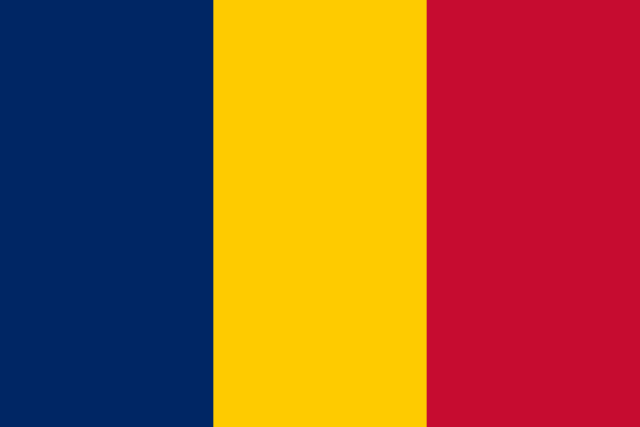
Flag of Chad
Chad on the Map of Africa
View Chad's central position in Africa, a vast landlocked country bridging the Sahara Desert and Sub-Saharan Africa, bordered by six countries:
Map of Chad
Explore the detailed map of Chad showing Lake Chad, the Sahel region, major cities, and diverse geographical zones from desert to savanna:

Chad Facts at a Glance
| Official name | Republic of Chad |
|---|---|
| Capital | N'Djamena |
| Largest city | N'Djamena |
| Region | Central Africa |
| Population | About 21 million (2025 UN estimate) |
| Area | 1,284,000 km² (495,755 sq mi) – the fifth-largest country in Africa |
| Coastline | Landlocked |
| Official languages | French and Arabic; over 100 local languages, with Chadian Arabic as a lingua franca |
| Currency | Central African CFA franc (XAF) |
| Government | Presidential republic (a new constitution was adopted in 2023 after a military transition) |
| Independence | 11 August 1960, from France |
| Neighbouring countries | 6: Libya, Sudan, Central African Republic, Cameroon, Nigeria, Niger. Chad borders Nigeria and Cameroon in and around Lake Chad. |
| Administrative divisions | 23 provinces |
| Main cities | N'Djamena, Moundou, Abéché, Sarh, Kélo, Am Timan |
| Highest point | Emi Koussi, 3,415 m (11,204 ft), a volcano in the Tibesti Mountains |
| Rivers and lakes | Chari and Logone rivers (meeting at N'Djamena); Lake Chad |
| Climate | Desert in the north, Sahel in the centre and tropical savanna in the south, where the rainy season is about May–October |
| Economy | Oil (from the Doba basin, exported by pipeline through Cameroon), livestock, cotton and gum arabic |
| Time zone | UTC+1 (West Africa Time) |
| Calling code | +235 |
Population figures are rounded 2025 estimates from the UN World Population Prospects 2024 unless stated otherwise. Facts checked September 2026.
See also: N'Djamena city guide, countries of Central Africa, landlocked countries in Africa, French-speaking countries in Africa, Arabic-speaking countries in Africa, largest countries in Africa by area, African independence timeline.
Strategic Crossroads: Bridge Between Two Africas
Chad occupies one of Africa's most strategic positions, serving as a natural bridge between the Sahara Desert and Sub-Saharan Africa while connecting the Arab-Berber world of North Africa with sub-Saharan Africa in ways that have shaped trade, culture, and politics for over a millennium. The country borders six nations: Libya to the north, Sudan to the east, Central African Republic to the south, Cameroon and Nigeria to the southwest, and Niger to the west. This central location has made Chad a crossroads for trans-Saharan trade routes, migration patterns, and cultural exchange that continues influencing contemporary African geopolitics and regional integration efforts.
The country's vast territory encompasses multiple climate zones and ecosystems, from the pure Sahara Desert in the north to the humid Sudan savanna in the south, creating natural boundaries and opportunities that have supported different societies and economic systems throughout history. Chad's position along ancient trade routes connecting the Mediterranean with Sub-Saharan Africa has made it a melting pot of Arab, African, and Islamic influences while maintaining distinct local traditions and governance systems adapted to diverse environmental conditions.
Lake Chad: Shrinking Giant of the Sahel
Lake Chad, which gives the country its name, is a large but very shallow lake shared by Chad, Cameroon, Niger and Nigeria. In the 1960s it covered around 25,000 square kilometres; after the Sahel droughts of the 1970s and 1980s and increased water use it shrank by roughly 90%. It has partly recovered since the 1990s, but it remains much smaller, split into a northern and a southern pool, and its area varies greatly with the seasons. Millions of people around its shores depend on it for fishing, farming and livestock.
The lake's fluctuations have shaped human settlement and economic activities for thousands of years, supporting fishing communities, providing water for livestock, and enabling agriculture in otherwise arid environments. Traditional fishing techniques, seasonal migration patterns, and trading networks developed around the lake's resources while supporting complex societies that adapted to environmental variability and seasonal changes in water levels and fish populations.
Contemporary challenges include managing competing demands for water resources, addressing environmental degradation, and supporting populations displaced by the lake's contraction while implementing regional cooperation initiatives aimed at sustainable water management and climate adaptation. The Lake Chad Basin Commission, whose members are the four lakeshore countries plus the Central African Republic and Libya, coordinates efforts to address transboundary water management challenges while supporting affected communities through alternative livelihood programs and environmental restoration efforts.
N'Djamena: Capital at the Confluence
N'Djamena, Chad's capital and largest city with more than a million inhabitants, lies at the confluence of the Chari and Logone rivers, directly across the Logone from the Cameroonian town of Kousséri. Founded by the French in 1900 as Fort-Lamy, it was renamed N'Djamena in 1973. It is Chad's political, economic and cultural centre and a hub for humanitarian operations in the Sahel.
The city serves as headquarters for government institutions, foreign embassies, and international organizations working throughout the region while hosting Chad's main airport, university, and commercial districts. N'Djamena's markets showcase the cultural diversity of Chadian society, with vendors selling goods from across the country and neighboring regions while demonstrating the continuing importance of trade networks that have connected the Sahel with Central Africa for centuries.
Urban challenges include rapid population growth, limited infrastructure, and seasonal flooding from the Chari River that require continued investment in urban planning, flood management, and service delivery to accommodate growing numbers of rural migrants seeking economic opportunities and fleeing environmental pressures in rural areas. The city's cultural institutions, including museums and cultural centers, preserve and promote Chadian heritage while supporting contemporary artistic expression and cultural development.
Cultural Mosaic: Arab and African Heritage
Chad's cultural landscape reflects extraordinary diversity, with well over 100 ethnic groups creating one of Africa's most complex cultural mosaics that bridges Arab and African traditions while maintaining distinct local identities and practices. The Sara people, comprising about 30% of the population, dominate southern regions and maintain strong agricultural traditions and indigenous religious practices, while northern regions are home to Arab groups, Toubou peoples, and other communities that practice Islam and maintain pastoral lifestyles adapted to semi-arid environments.
Religious diversity encompasses Islam (primarily Sunni), Christianity (both Catholic and Protestant), and traditional African religions that often blend elements from different spiritual traditions. Arabic serves as an official language alongside French, while Sara and other local languages maintain importance for daily communication and cultural transmission. This linguistic and religious diversity requires careful political management to maintain national unity while respecting different community traditions and practices.
Traditional arts including music, dance, storytelling, and crafts reflect this cultural diversity while adapting to contemporary contexts and influences. Ceremonial music and dance traditions vary significantly across different ethnic groups and regions, with northern areas featuring Arab and Islamic influences while southern regions maintain strong connections to African musical traditions and performance styles. Crafts including leatherwork, metalwork, and textile production demonstrate sophisticated artistic traditions while providing income through domestic and regional markets.
Petroleum Discovery: Economic Transformation
Oil changed Chad's economy in the early 2000s. The Doba basin project in the south, developed by an international consortium with World Bank support, began commercial production in 2003. The World Bank withdrew from the project in 2008 after Chad weakened a law that had earmarked oil revenues for poverty reduction. Oil has since provided most of Chad's export earnings and a large share of government revenue.
Chadian crude is exported through a pipeline of about 1,070 kilometres to an offshore loading terminal near Kribi on the coast of Cameroon. Other fields have since been developed by other companies, including in the Bongor basin.
However, oil dependence creates vulnerabilities to global market fluctuations while raising questions about economic diversification and sustainable development beyond the petroleum sector. Environmental concerns include protecting fragile ecosystems from oil development impacts while ensuring that local communities benefit from resource extraction through employment, infrastructure development, and social programs that address their needs and priorities.
Agricultural Diversity: From Desert to Savanna
Chad's vast territory encompasses diverse agricultural systems adapted to different climate zones, from pastoralism in northern semi-arid regions to intensive agriculture in southern areas with higher rainfall and more fertile soils. Agriculture and herding employ most of the population and provide the foundation for food security and rural livelihoods, though productivity remains constrained by limited mechanization, poor infrastructure, and climate variability that affects both crops and livestock production.
Southern regions with sudan savanna climate support cultivation of millet, sorghum, maize, cotton, and various cash crops that provide both subsistence and market income for farming families. Cotton production, supported by state marketing systems and international partnerships, provides export revenues and employment while supporting rural development through processing industries and agricultural services. Food crops including millet and sorghum demonstrate adaptation to semi-arid conditions and provide food security during drought periods.
Livestock production includes cattle, goats, sheep, and camels that are raised using traditional pastoral systems adapted to seasonal rainfall patterns and grazing availability. Pastoral communities move seasonally between grazing areas while maintaining complex social and economic relationships with sedentary agricultural communities. However, climate change, population growth, and resource competition create tensions between different livelihood systems while requiring innovative approaches to resource management and conflict resolution.
Zakouma National Park: Wildlife Conservation Success
Zakouma National Park in south-eastern Chad is one of Central Africa's best-known conservation success stories. Managed since 2010 by the conservation organisation African Parks in partnership with the government, the park covers about 3,000 square kilometres of Sudanian savanna and seasonal wetlands supporting elephants, lions, Kordofan giraffes, buffalo, many antelope species and large flocks of water birds.
Poaching had cut the park's elephants from several thousand in the early 2000s to around 450 by 2010. Intensive anti-poaching work stopped the killing and the herd has since grown again, with many calves born. Black rhinos were reintroduced in 2018. African Parks also manages the Ennedi Natural and Cultural Reserve in the north-east, known for its sandstone arches and rock art; the Ennedi Massif and the Lakes of Ounianga are UNESCO World Heritage Sites.
Tourism development focuses on sustainable practices that generate income for local communities while supporting conservation efforts through park fees and employment opportunities. However, tourism remains limited by infrastructure constraints, security concerns, and competition from better-known regional destinations. Community-based conservation programs ensure that local peoples benefit from wildlife protection while maintaining traditional relationships with natural resources through sustainable use practices and alternative livelihood opportunities.
Transportation Challenges: Connecting a Vast Territory
Chad's vast territory and landlocked position create significant transportation challenges that constrain economic development, market access, and social service delivery while requiring substantial infrastructure investment to connect different regions and provide access to international markets. The country's road network covers major urban centers and regional capitals, though road quality varies significantly and many rural areas remain inaccessible during rainy seasons when unpaved roads become impassable.
International trade depends on transportation corridors through neighboring countries, with different routes serving different regions depending on geographic proximity and political relationships. Southern Chad relies primarily on routes through Cameroon to access Atlantic Ocean ports, while northern regions may use routes through Libya or Sudan depending on security conditions and diplomatic relationships. These dependencies on neighboring countries create vulnerabilities while requiring continued regional cooperation and diplomatic engagement.
Air transport provides essential connectivity for government operations, humanitarian activities, and business travel, with N'Djamena serving as the main international gateway while smaller airports serve provincial centers and support mining, oil, and aid operations in remote areas. River transport along the Chari and Logone rivers provides seasonal connectivity for communities along waterways, though limited infrastructure and seasonal water level variations constrain capacity and reliability.
Education System: Building Human Capital
Chad's education system faces significant challenges including limited infrastructure, teacher shortages, and low enrollment rates, particularly among girls and rural populations, though government efforts and international support have achieved progress in expanding access and improving quality across different regions and social groups. Primary education is officially free and compulsory, but many children lack access to schools due to geographic barriers, poverty, and cultural factors that prioritize traditional education and economic activities over formal schooling.
The University of N'Djamena serves as the country's primary higher education institution, offering programs in various fields while conducting research relevant to national development needs including agriculture, petroleum engineering, and social sciences. Technical and vocational training programs aim to provide practical skills for economic development, though they require expansion and better equipment to meet labor market demands and support economic diversification efforts.
Language of instruction policies balance the use of French and Arabic (official languages) with local languages that facilitate learning and cultural preservation. Literacy rates remain low, particularly among women and rural populations, limiting human capital development and economic opportunities. International development organizations provide educational support including school construction, teacher training, and educational materials, though sustainable improvements require increased government investment and community engagement to ensure educational access reaches the most marginalized populations.
Healthcare Challenges and Progress
Chad's healthcare system faces enormous challenges including limited infrastructure, chronic shortages of medical personnel, and inadequate funding that leave large portions of the population without access to basic health services, resulting in some of the world's worst health indicators including high maternal and infant mortality rates and low life expectancy. Government health programs, supported by international partners, provide primary healthcare and vaccination services while working to expand rural health facilities and train additional health workers.
Major health challenges include infectious diseases such as malaria, respiratory infections, and diarrheal diseases that remain leading causes of illness and death, particularly among children. Malnutrition affects significant portions of the population, particularly during dry seasons and drought periods when food security deteriorates. HIV/AIDS prevalence is relatively low compared to other African countries but requires continued prevention and treatment efforts to maintain low transmission rates.
Traditional medicine plays important roles in healthcare delivery, particularly in rural areas where modern medical facilities are unavailable. Traditional healers treat various conditions using plant medicines and spiritual practices that have been developed over generations. International humanitarian organizations provide essential health services including emergency medical care, nutrition programs, and disease prevention initiatives, though sustainable health system development requires increased government capacity and improved infrastructure throughout the country.
Climate Change and Environmental Challenges
Chad faces severe climate change impacts including declining rainfall, increased temperatures, and more frequent droughts that affect agriculture, livestock production, water resources, and human migration patterns throughout the country. These environmental changes disproportionately impact rural populations who depend directly on natural resources for their livelihoods while creating tensions between different communities competing for increasingly scarce water and grazing resources.
Desertification pressures affect large areas of the country as the Sahara Desert expands southward, reducing agricultural productivity and forcing pastoral communities to migrate toward areas with better water and grazing availability. This environmental degradation contributes to resource conflicts, food insecurity, and population displacement that require both adaptation strategies and international assistance to address effectively.
Adaptation efforts include promoting drought-resistant crop varieties, improving water management systems, and supporting alternative livelihoods that reduce dependence on rain-fed agriculture and pastoralism. International climate finance and technical assistance support government efforts to build resilience while addressing the needs of vulnerable populations affected by environmental changes. However, successful adaptation requires substantial investment in infrastructure, technology, and institutional capacity that exceed current government resources and capabilities.
History: From Kanem-Bornu to Independence
The Lake Chad region was the heart of the Kanem Empire, founded around the 9th century, which later became Kanem-Bornu and lasted for roughly a thousand years. The Muslim sultanates of Baguirmi and Ouaddai also controlled parts of present-day Chad. In 2001, the skull of Sahelanthropus tchadensis ("Toumaï"), dated to around 7 million years ago, was found in the Djurab Desert. France conquered the area around 1900 and made it part of French Equatorial Africa. Chad became independent on 11 August 1960.
Civil war broke out in the 1960s between the government and northern rebels, and Libya occupied the Aouzou Strip in the 1970s; the International Court of Justice awarded the strip to Chad in 1994. Hissène Habré ruled from 1982 to 1990 and was later convicted of crimes against humanity by a special court in Senegal (2016). Idriss Déby ruled from 1990 until his death in 2021, after which a military council took power. A new constitution was approved by referendum in 2023 and a presidential election in 2024 formally ended the transition.
Regional Security and Peacekeeping
Chad's army is one of the most experienced in the region. It has fought jihadist groups in the Sahel, contributed troops to the UN mission in Mali (MINUSMA, which ended in 2023) and participates in the Multinational Joint Task Force against Boko Haram around Lake Chad.
Domestic security challenges include conflicts between farmers and herders over land and water, rebel groups based in southern Libya, and Boko Haram attacks in the Lake Chad area. In late 2024 Chad ended its defence cooperation agreement with France, and the last French troops left the country in January 2025.
Chad hosts one of Africa's largest refugee populations. Since the war in Sudan began in April 2023, hundreds of thousands of people, many fleeing violence in Darfur, have crossed into eastern Chad around Adré and Abéché, adding to earlier refugees from Sudan and the Central African Republic. Humanitarian agencies support both refugees and the poor host communities that share water, land and services with them.
Political Development and Governance
Chad's politics have long been dominated by the army and by a strong presidency, with periods of armed rebellion. The 2023 constitution established a presidential republic, and elections in 2024 installed a new president, parliament and senate, though opposition parties and observers criticised the transition as lacking inclusiveness.
Governance challenges include building effective institutions, combating corruption, and ensuring that oil revenues benefit broader development goals rather than elite enrichment. Civil society organizations, though constrained by limited resources and political restrictions, work to promote transparency, accountability, and citizen participation in government decisions. International partners provide technical assistance and capacity building support while encouraging democratic reforms and good governance practices.
National unity remains challenging given the country's ethnic, religious, and regional diversity, requiring political systems that provide representation and opportunities for different communities while maintaining national cohesion. Constitutional reforms and electoral processes must balance competing interests while ensuring that political institutions serve all Chadians regardless of their ethnic, religious, or regional backgrounds.
International Relations and Regional Integration
Chad's international relationships reflect both its strategic importance and its need for external support to address development challenges and security threats. France remains an important partner for development aid despite the end of military cooperation, while China, the United Arab Emirates, the United States and others provide investment, assistance and diplomatic support. Chad participates actively in regional organizations including the African Union, Economic Community of Central African States, and various Sahel security initiatives.
Regional integration efforts focus on trade facilitation, infrastructure development, and security cooperation that could help address shared challenges including climate change, extremism, and economic development. Chad's membership in regional economic organizations provides market access opportunities while requiring harmonization of policies and standards that could support economic growth and diversification beyond the petroleum sector.
International development partnerships include support from multilateral organizations, bilateral donors, and humanitarian agencies that provide financing and technical assistance for education, healthcare, infrastructure, and governance reforms. However, aid dependence creates challenges for building domestic capacity and ensuring sustainable development that does not rely indefinitely on external assistance and support.
Economic Diversification Beyond Oil
While petroleum production has transformed Chad's economy and government finances, economic diversification remains essential for sustainable development and reducing vulnerability to oil price fluctuations and eventual resource depletion. Agriculture, livestock, and fishing provide livelihoods for most Chadians and offer opportunities for productivity improvements, value addition, and export development that could generate employment and income for rural populations.
Manufacturing and processing industries could add value to agricultural products, livestock, and other raw materials while creating employment opportunities for Chad's young and growing population. The country's position as a regional crossroads provides opportunities for developing transportation, logistics, and trading services that support regional integration and economic cooperation throughout Central Africa and the Sahel.
Mining potential includes various minerals and industrial materials that remain largely unexplored and undeveloped due to infrastructure constraints and limited investment in geological surveys and exploration activities. Tourism development could leverage the country's wildlife, cultural heritage, and natural attractions, though security concerns and infrastructure limitations currently constrain visitor numbers and tourism revenues.
Chad at a Glance
On the map, Chad is a vast landlocked country in north-central Africa, bordered by Libya, Sudan, the Central African Republic, Cameroon, Nigeria and Niger. Its capital N'Djamena lies in the south-west on the Chari River, near Lake Chad. The north is Sahara desert with the Tibesti and Ennedi mountains, the centre is Sahel, and the south is savanna farmland where most people live.
Chad: Frequently Asked Questions
What is the capital of Chad?
The capital of Chad is N'Djamena.
What is the population of Chad?
Chad has about 21 million people (2025 UN estimate). The largest city is N'Djamena.
How big is Chad?
Chad covers 1,284,000 km² (495,755 sq mi), the fifth-largest country in Africa.
What language is spoken in Chad and what is its currency?
Official languages: French and Arabic; over 100 local languages, with Chadian Arabic as a lingua franca. Currency: Central African CFA franc (XAF).
Which countries border Chad?
Chad borders Libya, Sudan, Central African Republic, Cameroon, Nigeria and Niger. Chad borders Nigeria and Cameroon in and around Lake Chad.
When did Chad become independent?
Chad became independent on 11 August 1960 from France.