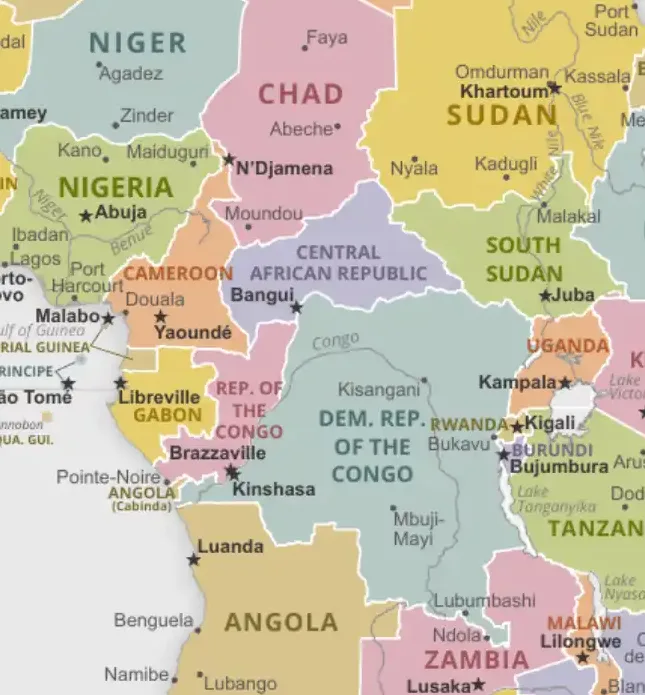
About Central Africa
Geography & Climate
Central Africa is characterized by dense tropical rainforests, major river systems, and diverse ecosystems:
- Congo Basin: The world's second-largest rainforest after the Amazon
- Congo River: Africa's second-longest river, vital for transportation and trade
- Equatorial Climate: Hot and humid year-round with heavy rainfall
- Rich Biodiversity: Home to mountain gorillas, bonobos, forest elephants, and okapi
Culture & Languages
Central Africa is linguistically diverse with French as the most common colonial language, alongside Portuguese in Angola and São Tomé and Príncipe. Indigenous languages include Lingala, Swahili, and hundreds of ethnic languages. The region features diverse cultural groups including Bantu peoples, Pygmy communities, and various ethnic kingdoms.
History
Central Africa has a complex and rich history:
- Ancient Kingdoms: Kongo Kingdom, Luba Empire, and other powerful states
- Colonial Era: Harsh exploitation under Belgian (Congo), French, Portuguese (Angola, São Tomé), German (Kamerun until 1916) and Spanish (Equatorial Guinea) rule
- Independence: Most countries became independent in 1960; Equatorial Guinea followed in 1968, and Angola and São Tomé and Príncipe in 1975
- Post-Colonial Challenges: Civil conflicts, political instability, and humanitarian crises
- ECCAS Formation: Economic Community of Central African States established in 1983
Economy
The region's economy is driven by abundant natural resources:
- Mineral Wealth: DR Congo holds vast reserves of cobalt, copper, diamonds, and coltan
- Oil Production: Angola, the Republic of the Congo, Gabon, Equatorial Guinea, Chad and Cameroon export oil
- Timber: Extensive logging in the Congo Basin (though threatening biodiversity)
- Agriculture: Cocoa, coffee, palm oil, and cassava
- Mining: Diamonds, gold, and uranium
Major Cities
- Kinshasa, DR Congo: Largest city in Central Africa (about 17 million in the metro area) and the largest French-speaking city in the world
- Luanda, Angola: Capital and major port city
- Yaoundé, Cameroon: Political capital
- Douala, Cameroon: Economic hub and largest port
- Brazzaville, Republic of Congo: Capital facing Kinshasa across Congo River
- Libreville, Gabon: Capital and coastal city
Environmental Significance
Central Africa plays a crucial role in global climate regulation:
- Carbon Sink: The Congo Basin forests are one of the world's largest tropical carbon sinks
- Biodiversity Hotspot: Thousands of plant and animal species, many endemic
- World Heritage Sites: Virunga National Park, Okapi Wildlife Reserve, Garamba
- Conservation Challenges: Deforestation, poaching, and habitat loss threaten ecosystems
ECCAS (Economic Community of Central African States)
Central African nations cooperate through ECCAS (11 members, including Burundi and Rwanda) and the smaller CEMAC monetary union, whose six members share the Central African CFA franc. ECCAS promotes economic integration, peace, and security. Member states work towards free movement of goods and people, though implementation faces challenges due to infrastructure gaps and political instability.
Wildlife & Conservation
- Mountain gorillas in Virunga Mountains
- Bonobos (found only in DR Congo)
- Forest elephants
- Western lowland gorillas
- Okapi (rare forest giraffe relative)
- Thousands of bird species