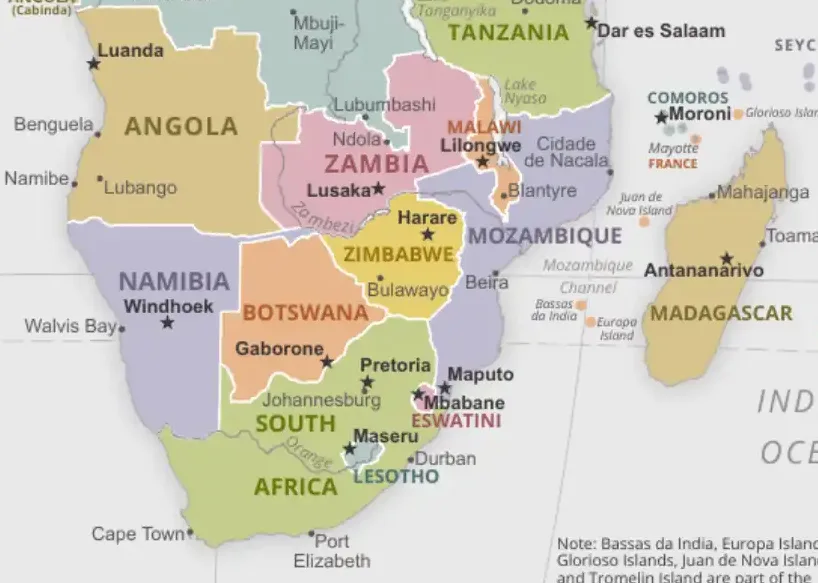
About Southern Africa
Geography & Climate
Southern Africa features incredibly diverse landscapes including:
- Kalahari Desert: Semi-arid savanna spanning Botswana, Namibia, and South Africa
- Namib Desert: Often described as the world's oldest desert, along Namibia's Atlantic coast
- Drakensberg Mountains: Major mountain range in South Africa and Lesotho
- Coastal Regions: Diverse coastlines from Atlantic to Indian Ocean
- Highland Kingdoms: Lesotho and Eswatini's mountainous terrain
Culture & Languages
Southern Africa is linguistically diverse with English widely spoken alongside Afrikaans, Zulu, Xhosa, and other indigenous languages. The region has a complex cultural heritage shaped by indigenous African peoples, European colonization, and more recent immigration.
Unique Geographic Features
The region has several remarkable geographic characteristics:
- Three Landlocked Countries: Botswana, Lesotho, and Eswatini have no coastline
- Lesotho's Uniqueness: Entirely surrounded by South Africa - one of only three enclaved countries in the world
- Varied Elevations: From coastal plains to high mountain plateaus
- Victoria Falls: On the Zambia/Zimbabwe border, sometimes included in the region
Economy
Southern Africa is one of the continent's most industrialised regions, although incomes are very unequal. Its economy is driven by:
- Mineral Resources: World-leading production of diamonds, gold, platinum, and other precious metals
- SADC Economic Bloc: Southern African Development Community promotes regional integration
- Tourism: Safari destinations, natural wonders, and diverse wildlife
- Agriculture: Commercial farming, particularly in South Africa
- Financial Services: Johannesburg is Africa's financial hub
- Manufacturing: Most developed industrial base on the continent
Major Cities
- Johannesburg, South Africa: Economic hub and largest city (about 4.8 million in the metropolitan municipality, 2022 census)
- Cape Town, South Africa: Legislative capital and major tourist destination
- Pretoria, South Africa: Executive (administrative) capital; Bloemfontein is the judicial capital
- Durban, South Africa: Major port city on the Indian Ocean
- Windhoek, Namibia: Capital and largest city of Namibia
- Gaborone, Botswana: One of Africa's fastest-growing cities
Natural Resources & Mining
Southern Africa is extraordinarily rich in mineral resources:
- Diamonds: Botswana and South Africa are major producers
- Gold: South Africa has historically been the world's largest producer
- Platinum: South Africa holds most of the world's known platinum-group metal reserves and is the largest producer
- Other Minerals: Chrome, manganese, coal, uranium, and more
Wildlife & Conservation
The region is renowned for its wildlife and conservation efforts:
- Kruger National Park (South Africa)
- Okavango Delta (Botswana) - UNESCO World Heritage Site
- Etosha National Park (Namibia)
- Home to the "Big Five": lion, leopard, rhinoceros, elephant, and Cape buffalo
- Leading safari and ecotourism destinations
Regional Integration
All five countries belong to the Southern African Customs Union (SACU), the world's oldest customs union (1910), and to the 16-member Southern African Development Community (SADC), which promotes wider economic cooperation. The currencies of Namibia, Lesotho and Eswatini are pegged one-to-one to the South African rand. The region has strong economic ties and significant cross-border trade and movement of people.