Southern Africa Map: Countries, Borders & Geography
Where Is Southern Africa?
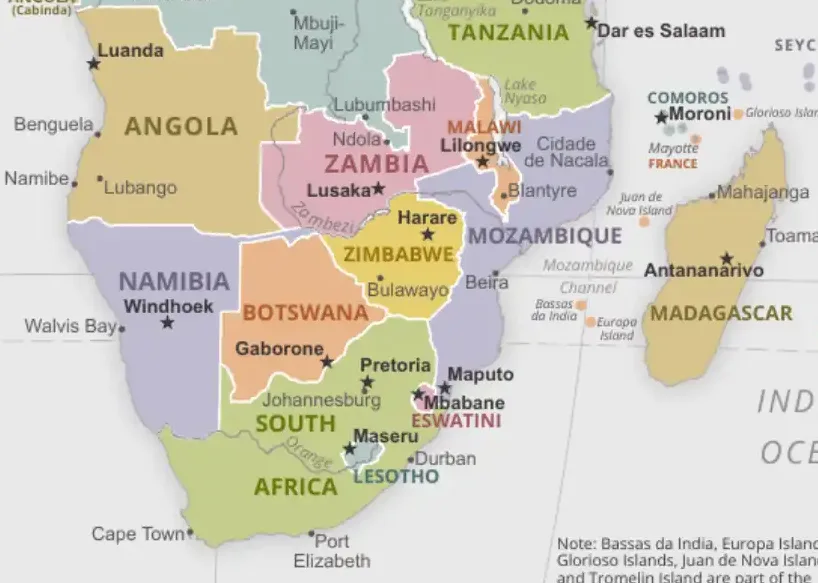
Southern Africa is the southern tip of the continent, roughly everything south of the Congo Basin and Tanzania, between the Atlantic Ocean on the west and the Indian Ocean on the east. This map shows the 9 countries most often called Southern Africa: South Africa, Namibia, Botswana, Zimbabwe, Mozambique, Zambia, Malawi, Lesotho and Eswatini. Its best-known features are the Kalahari and Namib deserts, the Okavango Delta, Victoria Falls on the Zambezi River and the Drakensberg mountains.
Country counts vary by definition: this map covers the 9 countries commonly called Southern Africa, while the UN grouping used in our Southern Africa region guide has 5 (South Africa, Botswana, Namibia, Lesotho and Eswatini).
Last updated: September 2026
Six of the nine are landlocked (Botswana, Zimbabwe, Zambia, Malawi, Lesotho and Eswatini), and Lesotho is entirely surrounded by South Africa. Angola is sometimes counted as Southern African too. Use the buttons above the map to filter by coastal or landlocked countries, major mining economies or top attractions.
The 9 Countries of Southern Africa
All nine are members of the Southern African Development Community (SADC). Populations are approximate 2024 estimates.
🇿🇦 South Africa
Capital: Pretoria (Executive), Cape Town (Legislative), Bloemfontein (Judicial)
Population: about 63 million
Area: 1,219,090 km²
Languages: 12 official languages, including Zulu, Xhosa, Afrikaans, English and South African Sign Language
Africa's most industrialised economy, with coasts on both the Atlantic and Indian oceans. Major producer of platinum, gold, chrome and coal; home to Johannesburg (the financial centre), Cape Town, Kruger National Park and the Drakensberg. Democratic since the end of apartheid in 1994.
Key Features: Table Mountain, Kruger National Park, Drakensberg, Cape Winelands, platinum and gold mining
🇳🇦 Namibia
Capital: Windhoek
Population: about 3 million
Area: 824,292 km²
Languages: English, Afrikaans, German, indigenous languages
One of the world's most sparsely populated countries, on the Atlantic coast. Known for the Namib Desert and Sossusvlei dunes, Etosha National Park, Fish River Canyon, diamonds and uranium. A German colony until 1915, then ruled by South Africa until independence in 1990.
Key Features: Namib Desert, diamond mining, unique wildlife, dramatic landscapes, conservation success
🇧🇼 Botswana
Capital: Gaborone
Population: about 2.5 million
Area: 581,730 km²
Languages: English, Setswana
Landlocked country covered largely by the Kalahari, with the Okavango Delta (a UNESCO World Heritage Site) in the northwest and Chobe's elephant herds in the north. Diamond revenues and stable, multi-party politics turned it from one of the world's poorest countries in 1966 into an upper-middle-income economy.
Key Features: One of the world's top diamond producers by value, Okavango Delta, Chobe National Park, Kalahari
🇿🇼 Zimbabwe
Capital: Harare
Population: about 16 million
Area: 390,757 km²
Languages: English, Shona, Ndebele
Landlocked country between the Zambezi and Limpopo rivers, sharing Victoria Falls and Lake Kariba with Zambia. Named after Great Zimbabwe, the medieval stone city (UNESCO World Heritage Site). Mines platinum, gold and lithium; in 2024 it introduced a new currency, the ZiG (Zimbabwe Gold), alongside the widely used US dollar.
Key Features: Victoria Falls, Great Zimbabwe ruins, mineral wealth, archaeological heritage, wildlife parks
🇲🇿 Mozambique
Capital: Maputo
Population: about 35 million
Area: 799,380 km²
Languages: Portuguese
Long Indian Ocean country (about 2,500 km of coastline) and former Portuguese colony, independent since 1975; its civil war ended in 1992. Large offshore gas fields are being developed in the far north, where an insurgency in Cabo Delgado has continued since 2017. The Bazaruto and Quirimbas archipelagos are known for beaches and coral reefs.
Key Features: Natural gas reserves, coastline, emerging energy sector, Portuguese heritage, coral reefs
🇿🇲 Zambia
Capital: Lusaka
Population: about 21 million
Area: 752,618 km²
Languages: English
Landlocked country whose Copperbelt makes it one of Africa's largest copper producers. Shares Victoria Falls and the Kariba Dam with Zimbabwe, and has major parks such as South Luangwa and Kafue. Several peaceful handovers of power since 1991.
Key Features: Copper mining, Victoria Falls, wildlife parks, hydroelectric power, peaceful democracy
🇲🇼 Malawi
Capital: Lilongwe
Population: about 21 million
Area: 118,484 km²
Languages: English, Chichewa
Narrow landlocked country known as the "Warm Heart of Africa". Lake Malawi, which fills much of its eastern side, holds more fish species than any other lake in the world; Lake Malawi National Park is a UNESCO World Heritage Site. Tobacco is the main export.
Key Features: Lake Malawi, tobacco farming, friendly culture, freshwater biodiversity, peaceful democracy
🇱🇸 Lesotho
Capital: Maseru
Population: about 2.3 million
Area: 30,355 km²
Languages: Sesotho, English
The "Kingdom in the Sky", completely surrounded by South Africa. Its lowest point is about 1,400 m above sea level, the highest low point of any country. Exports water to South Africa through the Lesotho Highlands Water Project, as well as textiles and diamonds.
Key Features: Mountain kingdom, completely surrounded by South Africa, water exports, highland terrain, traditional culture
🇸🇿 Eswatini
Capital: Mbabane (administrative), Lobamba (legislative and royal)
Population: about 1.2 million
Area: 17,364 km²
Languages: Swati, English
Small landlocked kingdom, known as Swaziland until 2018, between South Africa and Mozambique. Africa's last absolute monarchy, known for the Umhlanga (Reed Dance) and Incwala ceremonies; sugar is the main export.
Key Features: Absolute monarchy, traditional festivals, sugar production, cultural heritage, conservation areas
SADC: Regional Integration and Development
The Southern African Development Community (SADC) represents one of Africa's most important regional organizations, promoting economic integration, political cooperation, and sustainable development among Southern African countries.
SADC Member Countries
SADC includes 16 member states, with the 9 core Southern African countries plus:
- Core Southern Africa (9): South Africa, Namibia, Botswana, Zimbabwe, Mozambique, Zambia, Malawi, Lesotho, Eswatini
- Extended SADC (7): Angola, Democratic Republic of Congo, Tanzania, Madagascar, Mauritius, Seychelles, Comoros
SADC Achievements
- Trade Integration: Free Trade Area reducing tariffs and trade barriers
- Infrastructure Development: Regional Infrastructure Development Master Plan
- Peace and Security: Conflict prevention and resolution mechanisms
- Resource Sharing: Water resources and energy cooperation
- Human Development: Education, health, and gender equality initiatives
Economic Powerhouses
- South Africa: Regional economic leader, financial services, manufacturing hub
- Botswana: Diamond wealth, stable governance, conservation leadership
- Namibia: Mining, tourism, desert conservation
- Zambia: Copper production, regional energy supplier
- Mozambique: Emerging natural gas, coastal tourism
Mineral Wealth and Mining Heritage
Southern Africa hosts some of the world's richest mineral deposits, driving economic development and attracting international investment for over a century.
Major Mineral Resources
Precious Metals and Gems
- Gold: South Africa (historically the world's largest producer, still with some of the largest reserves), Zimbabwe
- Diamonds: Botswana (one of the top two producers by value), South Africa, Namibia
- Platinum: South Africa (roughly 90% of known platinum-group metal reserves), Zimbabwe
- Emeralds: Zambia (significant producer)
Industrial Minerals
- Copper: Zambia (major global producer), Democratic Republic of Congo border region
- Chromium: South Africa (significant reserves)
- Coal: South Africa, Mozambique, Zimbabwe
- Iron Ore: South Africa
Energy Resources
- Natural Gas: Mozambique (large offshore fields in the Rovuma Basin; exports began in 2022)
- Coal: South Africa, Mozambique (thermal and metallurgical)
- Uranium: Namibia (significant deposits)
- Hydroelectric: Zambia, Mozambique (regional power suppliers)
Mining Heritage and Impact
- Economic Development: Mining drives regional economies and employment
- Infrastructure: Railway lines, ports, cities built around mining
- Social Impact: Labor migration patterns, urbanization
- Environmental Concerns: Sustainable mining practices, rehabilitation
- Beneficiation: Value-added processing and manufacturing
Natural Wonders and Biodiversity
Southern Africa hosts some of the world's most spectacular natural attractions and diverse ecosystems, from desert landscapes to wetlands, supporting exceptional wildlife and tourism industries.
Iconic Natural Attractions
Victoria Falls (Zimbabwe/Zambia)
- Description: "The Smoke that Thunders" - one of world's largest waterfalls
- Dimensions: 1,708m wide, 108m high
- UNESCO Status: World Heritage Site
- Activities: Adventure tourism, bungee jumping, white-water rafting
Okavango Delta (Botswana)
- Description: One of the world's largest inland deltas, where the Okavango River spreads out and evaporates in the Kalahari
- Size: 15,000 km² seasonal floodplains
- Wildlife: Exceptional concentrations of African wildlife
- Tourism: Luxury safari destination, mokoro (dugout canoe) trips
Namib Desert (Namibia)
- Age: World's oldest desert (55+ million years)
- Features: Sossusvlei dunes, desert-adapted wildlife
- Conservation: Namib-Naukluft National Park
- Attractions: Dramatic landscapes, unique ecosystems
Kalahari Desert (Botswana/Namibia/South Africa)
- Size: 900,000 km² semi-arid savanna
- Peoples: San/Bushmen traditional hunter-gatherers
- Wildlife: Specialized desert adaptations
- Features: Salt pans, seasonal water holes
Wildlife and Conservation
- Big Five: Lion, leopard, elephant, buffalo, rhinoceros populations
- Kruger National Park: South Africa's flagship wildlife destination
- Chobe National Park: Botswana's elephant concentrations
- Conservation Success: White rhino recovery, wildlife corridors
- Community Conservation: Local participation in wildlife management
Cultural Heritage and Diversity
Southern Africa showcases remarkable cultural diversity, with indigenous African traditions, colonial influences, and modern multicultural societies creating unique regional identities.
Indigenous Peoples and Cultures
San/Bushmen (Kalahari Region)
- Heritage: Original hunter-gatherer peoples, ancient rock art
- Location: Botswana, Namibia, South Africa
- Traditions: Traditional knowledge, sustainable living
- Challenges: Land rights, cultural preservation
Bantu-Speaking Peoples
- Zulu (South Africa): Largest ethnic group, warrior traditions
- Xhosa (South Africa): Nelson Mandela's people, click languages
- Shona (Zimbabwe): Great Zimbabwe builders, stone carving
- Sotho-Tswana: Botswana, Lesotho, South Africa groups
Colonial Heritage
- British Influence: English language, legal systems, architecture
- Afrikaner Heritage: Descendants of Dutch, German and French Huguenot settlers; Afrikaans language
- German Colonial: Namibian architecture, cultural influences
- Portuguese Legacy: Mozambique's language and traditions
Modern Multicultural Societies
- South Africa: "Rainbow Nation" with 12 official languages
- Namibia: German, Afrikaans, and indigenous language mix
- Botswana: Setswana culture with English education
- Urban Centers: Cosmopolitan cities with diverse populations
Traditional Arts and Crafts
- Stone Sculpture: Zimbabwe's world-renowned artists
- Beadwork: Zulu and other traditional designs
- Textiles: Traditional patterns and modern adaptations
- Music: Traditional rhythms, modern fusion styles
- Rock Art: Ancient San paintings in caves and overhangs
Economy
South Africa accounts for most of the region's economic output, with mining, manufacturing (including vehicle assembly for export), financial services and tourism. Botswana and Namibia depend heavily on diamonds and other minerals, Zambia on copper, and Mozambique increasingly on gas and coal. Malawi and much of rural Zimbabwe, Zambia and Mozambique rely on smallholder farming of maize, tobacco, sugar and cotton, which makes the region vulnerable to droughts such as the severe El Niño drought of 2024.
Climate and Geography
Southern Africa encompasses diverse climatic zones and geographical features, from coastal plains to highland plateaus, supporting varied ecosystems and economic activities.
Climate Zones
Mediterranean Climate (South Africa's Cape)
- Characteristics: Mild, wet winters and warm, dry summers
- Location: Western Cape Province around Cape Town
- Agriculture: Wine production, wheat, fruit cultivation
- Biodiversity: Fynbos vegetation, endemic species
Subtropical Climate (Coastal Regions)
- Characteristics: Warm temperatures, summer rainfall
- Location: Eastern South Africa, Mozambique coast
- Agriculture: Sugar cane, tropical fruits, cotton
- Tourism: Beach destinations, warm ocean waters
Semi-Arid Climate (Kalahari)
- Characteristics: Low rainfall, high evaporation rates
- Location: Botswana, western South Africa, southern Namibia
- Adaptations: Drought-resistant vegetation and wildlife
- Activities: Cattle ranching, wildlife conservation
Arid Climate (Namib Desert)
- Characteristics: Very low rainfall, extreme temperatures
- Location: Namibian coast, parts of South Africa
- Features: Sand dunes, desert-adapted species
- Resources: Diamond mining, tourism
Highland Climate (Lesotho, Eastern Escarpment)
- Characteristics: Cool temperatures, mountain climate
- Location: Lesotho, Eswatini highlands, Drakensberg
- Features: Snow in winter, summer rainfall
- Resources: Water catchment, hydroelectric potential
Travel and Tourism
Southern Africa offers world-class tourism experiences, combining wildlife safaris, natural wonders, cultural heritage, and adventure activities in well-developed tourism infrastructure.
Must-See Destinations
Wildlife and Nature
- Kruger National Park, South Africa: Premier Big Five destination
- Okavango Delta, Botswana: UNESCO World Heritage wetland paradise
- Victoria Falls, Zimbabwe/Zambia: One of world's greatest waterfalls
- Sossusvlei, Namibia: Spectacular desert landscapes and dunes
- Chobe National Park, Botswana: Massive elephant herds
Cultural and Historical Sites
- Great Zimbabwe, Zimbabwe: Ancient stone city ruins
- Robben Island, South Africa: Nelson Mandela's prison, UNESCO site
- Cape Town, South Africa: Table Mountain, wine regions, history
- Twyfelfontein, Namibia: Ancient rock art site
- Sani Pass, Lesotho: Mountain kingdom access and culture
Adventure Activities
- Victoria Falls: Bungee jumping, white-water rafting, helicopter flights
- Namibian Deserts: Sandboarding, hot air ballooning, desert camping
- South African Coast: Shark cage diving, whale watching
- Drakensberg Mountains: Hiking, rock climbing, mountain lodges
- Okavango Delta: Mokoro trips, walking safaris, fly camping
Tourism Infrastructure
- Accommodation: Luxury safari lodges to backpacker hostels
- Transportation: Well-developed road networks, domestic flights
- Safety: Established tourism safety standards and protocols
- Guides: Professional safari guides and cultural interpreters
- Conservation: Tourism supporting wildlife and community conservation
Best Travel Seasons
- Dry Season (May-September): Best for wildlife viewing and outdoor activities
- Wet Season (November-March): Green landscapes, bird watching, fewer crowds
- Shoulder Seasons (April, October): Pleasant weather, moderate prices
- Regional Variations: Different optimal times for different countries and activities
Using Our Interactive Map
Map Features
- All Countries View: Complete overview of all 9 Southern African nations
- Coastal Countries: Focus on nations with Atlantic and Indian Ocean coastlines
- Landlocked Countries: Explore inland nations and their unique characteristics
- Mining Powerhouses: Highlight countries with significant mineral wealth
- Major Attractions: Locate natural wonders and tourist destinations
Click any marker for the country's capital, approximate population, area, main languages and a one-line summary.
Related Maps
See the South Africa map, where the Kalahari Desert is, the Southern Africa region guide and the neighbouring Central Africa and East Africa maps.
Frequently Asked Questions
Which countries are in Southern Africa?
This map uses the common 9-country definition: South Africa, Namibia, Botswana, Zimbabwe, Zambia, Malawi, Mozambique, Eswatini and Lesotho. The UN geoscheme counts only 5 (South Africa, Namibia, Botswana, Lesotho and Eswatini), and Angola is sometimes added.
What is the most developed country in Southern Africa?
South Africa is the region's largest and most industrialised economy and one of the three largest economies in Africa. Botswana and Namibia have relatively high incomes per person but much smaller economies.
Is South Africa the same as Southern Africa?
No. South Africa is a single country, while Southern Africa is the region around it: 9 countries on this map, or 5 under the UN definition.
Which Southern African countries are landlocked?
Six: Botswana, Zimbabwe, Zambia, Malawi, Lesotho and Eswatini. Lesotho is completely surrounded by South Africa.
What is SADC?
The Southern African Development Community is a regional bloc of 16 member states (the 9 countries on this map plus Angola, the DR Congo, Tanzania, Madagascar, Mauritius, Seychelles and Comoros) promoting economic integration and security cooperation across Southern Africa.