South Africa Map: Provinces, Cities and Geography
South Africa sits at the southern tip of Africa, between the Atlantic Ocean to the west and the Indian Ocean to the south and east. It borders Namibia, Botswana, Zimbabwe, Mozambique and Eswatini, and completely surrounds Lesotho. The country covers 1,221,037 km², has about 63 million people and is divided into nine provinces. It has three capitals: Pretoria (executive), Cape Town (legislative) and Bloemfontein (judicial). Johannesburg is the largest city. The map below shows the provinces, main cities, national parks, wine regions and heritage sites. For how South Africa sits on the continent and the world map, see Where is South Africa located?
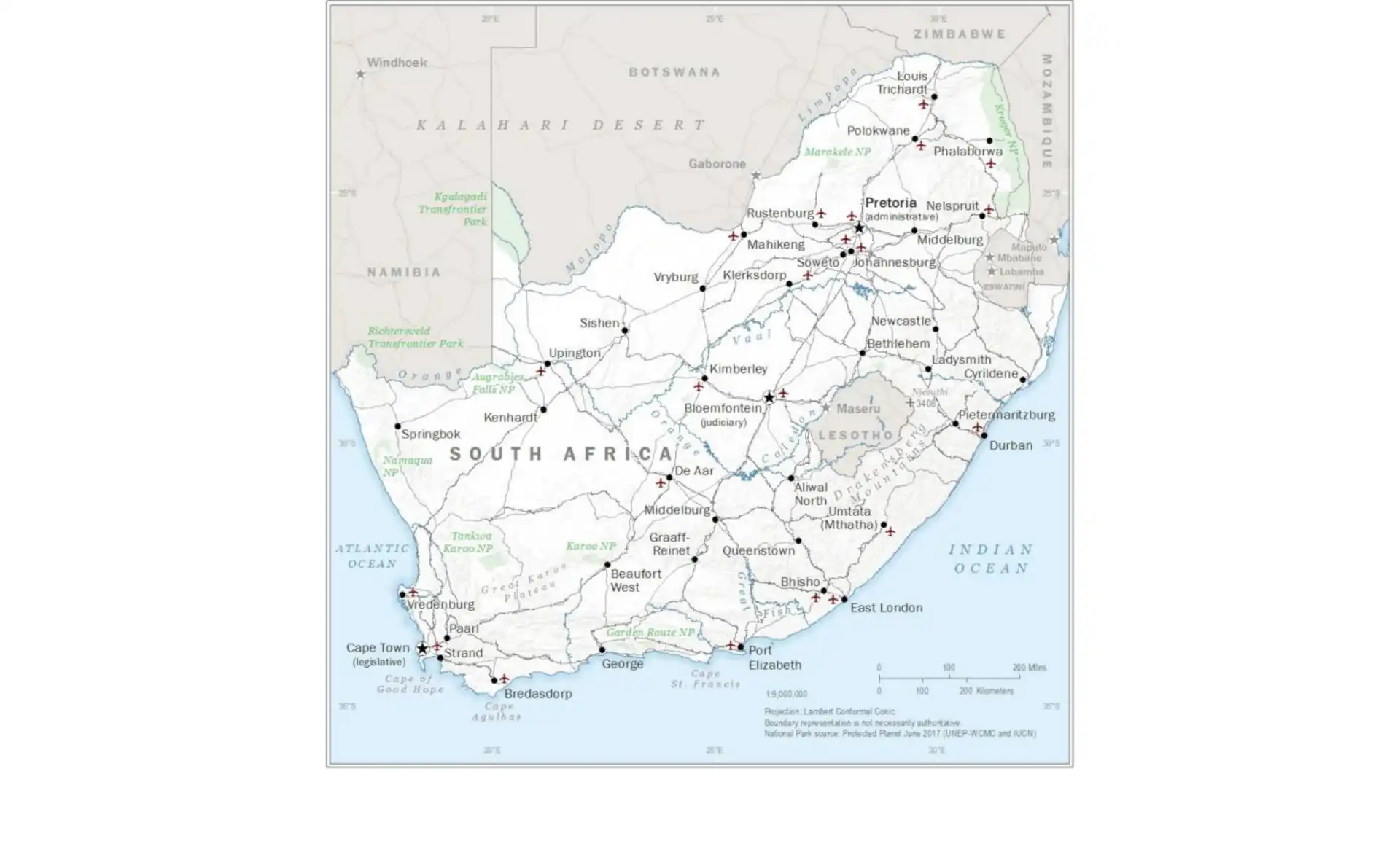
Last updated: September 2026
Interactive South Africa Map
Understanding South Africa: Geography and Location
South Africa occupies the southernmost position on the African continent, bordered by the Atlantic Ocean to the west and the Indian Ocean to the east and south. The country shares land borders with six nations: Namibia and Botswana to the northwest, Zimbabwe to the north, Mozambique and Eswatini to the northeast, and completely surrounds the mountain kingdom of Lesotho. Ships travelling between the Atlantic and Indian Oceans pass the Cape of Good Hope. Cape Agulhas, about 150 km to the south-east, is the true southern tip of Africa.
The country's geography is extraordinarily diverse, featuring a narrow coastal plain that rises dramatically to a vast interior plateau known as the Highveld. The Great Escarpment, a massive cliff face, separates the coastal regions from the interior, creating some of the world's most spectacular mountain scenery. The highest peak, Mafadi in the Drakensberg Mountains, rises to 3,451 meters above sea level.
The Nine Provinces of South Africa
Western Cape
Capital: Cape Town (also South Africa's legislative capital)
Highlights: Table Mountain, Cape Winelands, Garden Route, Cape Point, Stellenbosch University, world-class beaches and wine estates.
Economy: Tourism, wine production, agriculture, manufacturing, and services.
Eastern Cape
Capital: Bhisho (largest city: Gqeberha, formerly Port Elizabeth)
Highlights: Birthplace of Nelson Mandela, Wild Coast, Addo Elephant National Park, rich Xhosa cultural heritage.
Economy: Automotive manufacturing, agriculture, tourism, and traditional crafts.
KwaZulu-Natal
Capital: Pietermaritzburg (Durban is largest city)
Highlights: Drakensberg Mountains, Indian Ocean beaches, Zulu cultural sites, iSimangaliso Wetland Park.
Economy: Tourism, agriculture, manufacturing, and port activities in Durban.
Gauteng
Capital: Johannesburg (the province also contains Pretoria, the national executive capital)
Highlights: Economic powerhouse, gold mining heritage, Soweto, Cradle of Humankind, modern financial district.
Economy: Finance, mining, manufacturing, and services - generates about a third of South Africa's GDP. Smallest province by area but largest by population.
Limpopo
Capital: Polokwane
Highlights: Kruger National Park (northern section), baobab trees, cultural heritage sites, borders Zimbabwe, Botswana, and Mozambique.
Economy: Mining, agriculture, tourism, and cross-border trade.
Mpumalanga
Capital: Mbombela (formerly Nelspruit)
Highlights: Kruger National Park (southern section), Panorama Route, Blyde River Canyon, God's Window.
Economy: Tourism, mining, forestry, and agriculture.
North West
Capital: Mahikeng
Highlights: Pilanesberg National Park, Sun City resort, platinum mining region, traditional Tswana culture.
Economy: Mining (platinum, diamonds), agriculture, and tourism.
Free State
Capital: Bloemfontein (also South Africa's judicial capital)
Highlights: Golden Gate Highlands National Park, vast agricultural plains, historical Anglo-Boer War sites.
Economy: Agriculture (maize, wheat, sunflowers), gold mining, and renewable energy.
Northern Cape
Capital: Kimberley (diamond mining center)
Highlights: Kalahari Desert, diamond mining heritage, Augrabies Falls, astronomical observatories, largest province by area.
Economy: Mining (diamonds, iron ore), agriculture, and renewable energy projects.
South African Culture and Heritage
South Africa is often called the Rainbow Nation because of its cultural diversity. It has twelve official languages and many ethnic groups. Its history includes the indigenous Khoikhoi and San peoples, Bantu-speaking groups who settled the region over many centuries, Dutch and British colonial rule, Indian and Cape Malay communities, and a modern democratic society that emerged from apartheid.
Languages and Cultural Groups
The twelve official languages are Zulu, Xhosa, Afrikaans, English, Sepedi (Northern Sotho), Setswana, Sesotho, Xitsonga, siSwati, Tshivenda, isiNdebele and South African Sign Language, which was added in 2023. In the 2022 census the most common home languages were Zulu (about 24%), Xhosa (about 16%), Afrikaans and Sepedi (about 10% each) and English (about 9%). English is the main language of business and government.
African Cultural Heritage: The majority of South Africans belong to various African ethnic groups, each with distinct traditions, languages, and customs. Zulu culture is known for its warrior traditions, colorful beadwork, and traditional dancing. Xhosa culture, which produced leaders such as Nelson Mandela, emphasizes respect for ancestors and traditional healing practices. The San people, among the world's oldest cultures, have contributed rock art sites that date back thousands of years.
Afrikaner Culture: Descended from Dutch, German, and French settlers, Afrikaners developed a distinct culture centered around the Afrikaans language, Reformed Christianity, and agricultural traditions. Despite the dark legacy of apartheid, Afrikaner culture includes significant contributions to literature, music, and cuisine.
Indian and Coloured Communities: South Africa has the largest community of Indian descent in Africa, concentrated mainly in KwaZulu-Natal around Durban. The Coloured community, mainly in the Western and Northern Cape, has mixed heritage and its own cultural identity, including distinctive food and the Afrikaans-based variety known as Kaaps.
Arts, Music, and Literature
South African arts reflect the country's diverse heritage and complex history. Traditional African art includes intricate beadwork, pottery, and wood carving, while contemporary artists address themes of identity, politics, and social change. The country has produced world-renowned musicians across genres, from jazz legends like Hugh Masekela and Miriam Makeba to contemporary artists like Black Coffee and Die Antwoord.
South African literature has gained international recognition through authors like J.M. Coetzee (Nobel Prize winner), Nadine Gordimer (Nobel Prize winner), and contemporary voices like Damon Galgut and Lauren Beukes. These writers have explored themes of identity, apartheid, and post-apartheid society, contributing significantly to world literature.
Economic Landscape and Development
South Africa is Africa's most industrialised economy and, with Nigeria and Egypt, one of the continent's three largest by GDP. The country's economic development has been shaped by its abundant natural resources, well-developed infrastructure, and strategic location for international trade. However, the economy also faces significant challenges including high unemployment, inequality, and the need for economic transformation.
Key Economic Sectors
Mining Industry: South Africa remains one of the world's largest producers of gold, platinum, chromium, and diamonds. The mining industry, centered in Gauteng and surrounding areas, has been the foundation of the country's economic development since the late 19th century. The country produces roughly 70% of the world's platinum and remains a significant gold producer, though production has declined from historical peaks.
Manufacturing: The manufacturing sector includes automotive assembly (with major plants producing vehicles for both domestic and export markets), steel production, chemicals, and food processing. Cities like Gqeberha (Port Elizabeth), Durban and Cape Town host significant manufacturing facilities, while Gauteng serves as the industrial heartland.
Financial Services: Johannesburg serves as Africa's financial capital, hosting the continent's largest stock exchange and numerous international banks. South African financial institutions have expanded across Africa, making the country a regional financial hub.
Agriculture: Despite contributing a relatively small percentage to GDP, agriculture remains important for employment and food security. South Africa produces maize, wheat, sugar, citrus fruits, and is world-renowned for its wine industry centered in the Western Cape.
Tourism: The tourism industry contributes significantly to the economy, attracting visitors for wildlife safaris, cultural experiences, wine tourism, and adventure activities. Major attractions include Kruger National Park, Cape Town's Table Mountain, the Garden Route, and historical sites related to the struggle against apartheid.
Economic Challenges and Opportunities
South Africa faces significant economic challenges including high unemployment (particularly among youth), income inequality, and the need for economic transformation to address historical inequities. The government has implemented Black Economic Empowerment policies to increase participation of previously disadvantaged communities in the economy.
However, the country also presents numerous opportunities, including renewable energy development (the country has excellent solar and wind resources), technological innovation, and its role as a gateway to African markets. South African companies have successfully expanded across Africa, leveraging the country's advanced business infrastructure and expertise.
Natural Wonders and Wildlife
South Africa hosts some of the world's most spectacular natural environments and diverse wildlife populations. The country's varied climates and topography support an extraordinary range of ecosystems, from Mediterranean-type vegetation in the Western Cape to savanna grasslands in the interior and subtropical forests along the eastern coast.
National Parks and Conservation
Kruger National Park: Covering nearly 20,000 square kilometers, Kruger is one of Africa's largest game reserves and a flagship conservation area. The park hosts the "Big Five" (lion, leopard, elephant, buffalo, and rhinoceros) along with hundreds of other mammal, bird, and plant species. Kruger's success in wildlife conservation serves as a model for parks across Africa.
Table Mountain National Park: This urban national park surrounding Cape Town includes the iconic Table Mountain, Cape Point, and significant portions of the Cape Floral Kingdom. The park protects unique fynbos vegetation found nowhere else on Earth and offers spectacular views of Cape Town and the surrounding coastline.
Addo Elephant National Park: Located in the Eastern Cape, this park has successfully recovered elephant populations from near extinction to over 600 individuals. The park also protects other wildlife and demonstrates successful conservation through community involvement.
iSimangaliso Wetland Park: This UNESCO World Heritage Site in KwaZulu-Natal protects coastal forests, lakes, beaches, and marine environments. The park is crucial for sea turtle nesting and hosts diverse marine life including whales, dolphins, and coral reefs.
Marine Environment and Coastline
South Africa's coastline of about 2,800 kilometres includes some of the world's most diverse marine environments. The meeting of the Atlantic and Indian Oceans creates unique conditions supporting extraordinary marine biodiversity. The country's waters host southern right whales (which migrate to breed in coastal bays), great white sharks, seals, penguins, and numerous fish species.
The Cape Floral Region, the smallest of the world's six floral kingdoms, has about 9,000 plant species, roughly 70% of them found nowhere else. That is about a fifth of Africa's plant species on less than 0.5% of its area. The region is a UNESCO World Heritage Site.
Climate and Seasonal Patterns
South Africa's location in the Southern Hemisphere means seasons are opposite to those in the Northern Hemisphere. The country experiences diverse climatic conditions, from Mediterranean climate in the Western Cape to subtropical conditions along the eastern coast and semi-arid conditions in the interior.
The best time to visit varies by region and interests: wildlife viewing is excellent year-round in Kruger, though winter (May-September) offers better game viewing conditions. The Western Cape is most pleasant during spring and autumn, while the eastern coast is ideal for beach activities during summer (November-March).
Historical Journey: From Ancient Times to Modern Democracy
South Africa's history spans millions of years, from early human evolution to the development of complex societies and the modern democratic state. Archaeological evidence shows that the region has been continuously inhabited for over 100,000 years, making it one of the longest-settled areas on Earth.
Early History and Indigenous Peoples
The San and Khoikhoi were the original inhabitants of southern Africa, developing sophisticated hunter-gatherer and pastoral societies over thousands of years. Their rock art, found throughout the country, provides invaluable insights into ancient life and spiritual beliefs. Bantu-speaking peoples migrated into the region over many centuries, establishing agricultural communities and developing iron-working technologies.
Various African kingdoms flourished in the region, including the powerful Zulu kingdom under leaders like Shaka Zulu, who revolutionized military tactics and created a formidable empire in what is now KwaZulu-Natal. Other significant groups included the Xhosa, Sotho, and Tswana peoples, each developing distinct cultural and political systems.
Colonial Period and Union Formation
European contact began in 1488 when Portuguese explorer Bartolomeu Dias rounded the Cape of Good Hope. The Dutch East India Company established a refreshment station at Cape Town in 1652, which gradually expanded into a settler colony. British occupation in 1795 led to complex interactions between British and Dutch (later Afrikaner) communities, culminating in the Anglo-Boer Wars (1880–81 and 1899–1902).
The Union of South Africa was formed in 1910, uniting the four colonies into a self-governing dominion within the British Empire. However, this union excluded the majority African population from political participation, setting the stage for decades of racial segregation and conflict.
Apartheid Era and Liberation Struggle
The National Party's victory in 1948 led to the implementation of apartheid, a system of institutionalized racial segregation that severely restricted the rights of non-white South Africans. This system created separate living areas, education systems, and economic opportunities based on racial classification.
Resistance to apartheid grew through organizations like the African National Congress (ANC), led by figures such as Nelson Mandela, Oliver Tambo, and Walter Sisulu. The struggle intensified following events like the Sharpeville Massacre (1960) and the Soweto Uprising (1976), drawing international attention and sanctions against the apartheid regime.
Nelson Mandela, imprisoned for 27 years for his anti-apartheid activities, became the global symbol of the struggle for freedom. His release in 1990 and subsequent negotiations with President F.W. de Klerk led to South Africa's peaceful transition to democracy.
Democratic Transformation
South Africa's first democratic elections in 1994 brought Nelson Mandela to power as president and marked the beginning of the "Rainbow Nation" era. The Truth and Reconciliation Commission, led by Archbishop Desmond Tutu, helped the country confront its apartheid past while promoting reconciliation.
The democratic era has brought significant achievements including a progressive constitution, expanded access to education and healthcare, and integration into the global community. However, challenges remain, including addressing the legacy of apartheid, reducing inequality, and building a more inclusive economy.
Tourism and Travel in South Africa
South Africa offers world-class tourism experiences ranging from wildlife safaris and cultural tours to adventure sports and culinary tourism. The country's well-developed tourism infrastructure, combined with its natural beauty and cultural richness, makes it one of Africa's premier travel destinations.
Major Tourist Destinations
Cape Town and the Western Cape: Often ranked among the world's most beautiful cities, Cape Town offers Table Mountain, vibrant waterfront areas, nearby wine estates, and easy access to the Garden Route. The city combines urban sophistication with natural beauty and rich cultural heritage.
Safari Destinations: Beyond Kruger National Park, South Africa offers numerous private game reserves and smaller national parks. The country pioneered the concept of luxury safari lodges and maintains high standards for wildlife viewing experiences.
The Garden Route: This coastal stretch of the N2 between Mossel Bay and the Storms River, on the way from Cape Town to Gqeberha, has diverse landscapes including forests, lakes, beaches, and mountains. Attractions include whale watching, ostrich farms, and adventure activities like bungee jumping at Bloukrans Bridge.
Cultural and Historical Sites: Visitors can explore Robben Island (where Mandela was imprisoned), the Cradle of Humankind (UNESCO World Heritage Site), and various museums documenting the struggle against apartheid. Township tours provide insights into contemporary South African life and history.
Adventure and Outdoor Activities
South Africa offers exceptional opportunities for adventure tourism including shark cage diving, whale watching, hiking in the Drakensberg Mountains, and numerous water sports along the extensive coastline. The country's diverse geography supports activities from desert adventures in the Kalahari to mountain climbing and river rafting.
Wine tourism has become increasingly important, with the Cape Winelands offering world-class wine tasting experiences set against spectacular mountain backdrops. South African wines have gained international recognition, and the country now ranks among the world's top wine destinations.
Use the interactive map above to find South Africa's main cities, national parks, wine regions and heritage sites. Click any marker to see its province and a short description, and use the filter buttons to show one category at a time.
South Africa Quick Facts
- Capitals: Pretoria (executive), Cape Town (legislative), Bloemfontein (judicial)
- Largest cities: Johannesburg, Cape Town, Durban, Pretoria (Tshwane), Gqeberha
- Currency: South African rand (ZAR)
- Time zone: South African Standard Time, UTC+2, with no daylight saving
- Calling code: +27
- Highest point: Mafadi, about 3,450 m, in the Drakensberg on the Lesotho border
- Longest river: Orange River, about 2,200 km, which flows to the Atlantic
- Driving: on the left
More maps: Southern Africa map, Kalahari Desert map and the South Africa country profile. Neighbours: Namibia, Botswana, Zimbabwe, Mozambique, Eswatini and Lesotho.
Frequently Asked Questions
Where is South Africa on the map of Africa?
South Africa occupies the southern tip of the African continent. It borders Namibia, Botswana, Zimbabwe, Mozambique and Eswatini, and Lesotho is entirely enclosed within its territory.
How many provinces does South Africa have?
South Africa has nine provinces: Western Cape, Eastern Cape, Northern Cape, KwaZulu-Natal, Free State, North West, Gauteng, Mpumalanga and Limpopo. Northern Cape is the largest by area and Gauteng has the most people.
How many capitals does South Africa have?
South Africa has three capitals: Pretoria (executive), Cape Town (legislative) and Bloemfontein (judicial). Johannesburg is the largest city but not a national capital.
What is the population of South Africa?
South Africa has about 63 million people (2024 estimate). It is the most populous country in Southern Africa.
Is South Africa the same as Southern Africa?
No. South Africa is a single country. Southern Africa is the wider region, which also includes Namibia, Botswana, Lesotho and Eswatini, and in broader definitions Zimbabwe, Mozambique, Zambia, Malawi and Angola.