Botswana: Africa's Diamond of Democracy and Safari Paradise
Botswana is a landlocked country in Southern Africa covering about 581,730 km², most of it the Kalahari Desert. Its capital and largest city is Gaborone and it has about 2.6 million people (2025 UN estimate), making it one of the least densely populated countries in the world. English is the official language and Setswana the national language. Botswana borders South Africa, Namibia, Zimbabwe and Zambia, and gained independence from Britain on 30 September 1966.
Botswana, officially the Republic of Botswana, stands as one of Africa's most remarkable success stories, transforming from one of the world's poorest countries at independence in 1966 to a middle-income nation renowned for its stable democracy, responsible governance, and spectacular wildlife conservation achievements. This landlocked Southern African country covers 581,730 square kilometers of primarily semi-arid landscape, with the Kalahari Desert occupying over 70% of its territory. Home to about 2.6 million people, Botswana has leveraged its diamond wealth wisely, creating one of Africa's most prosperous societies while maintaining cultural traditions and setting aside close to 40% of its land for national parks, game reserves and wildlife management areas. The country is globally renowned for the pristine Okavango Delta, exceptional safari experiences in Chobe and other national parks, and serving as a beacon of good governance and democratic stability in a region often marked by political turmoil.

Flag of Botswana - Africa's Diamond of Democracy
Botswana on the Map of Africa
View Botswana's strategic position in Southern Africa, a landlocked country bordered by South Africa, Namibia, Zimbabwe, and sharing a short border with Zambia:
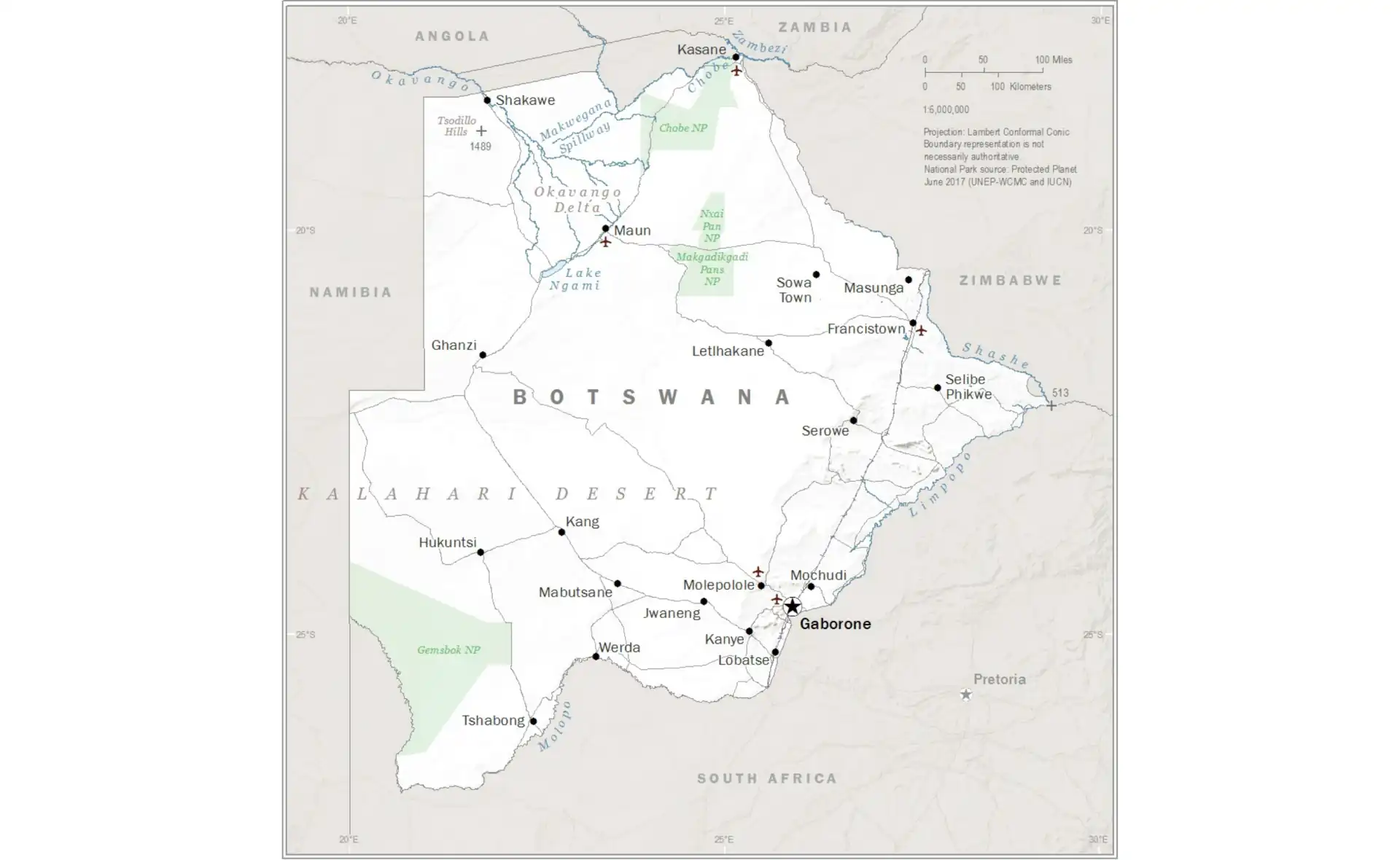
Map of Botswana
Explore the detailed map of Botswana showing the Okavango Delta, Kalahari Desert, national parks, major cities, and diverse geographical features:
Botswana Facts at a Glance
| Official name | Republic of Botswana |
|---|---|
| Capital | Gaborone |
| Largest city | Gaborone |
| Region | Southern Africa |
| Population | About 2.6 million (2025 UN estimate) |
| Area | 581,730 km² (224,607 sq mi) – landlocked; roughly the size of France or Texas |
| Coastline | Landlocked |
| Official languages | English (official); Setswana is the national language |
| Currency | Botswana pula (BWP) |
| Government | Parliamentary republic (the president is elected by the National Assembly) |
| Independence | 30 September 1966, from the United Kingdom (formerly the Bechuanaland Protectorate) |
| Neighbouring countries | 4: South Africa, Namibia, Zimbabwe, Zambia. The border with Zambia is very short (roughly 150 m) at Kazungula on the Zambezi, crossed by the Kazungula Bridge since 2021. |
| Administrative divisions | 10 districts, plus town and city councils (Gaborone, Francistown and others) |
| Main cities | Gaborone, Francistown, Molepolole, Maun, Mogoditshane, Serowe, Selebi-Phikwe |
| Highest point | Otse Hill (Monalanong Hill), 1,491 m (4,892 ft) |
| Rivers and lakes | Okavango (feeding the Okavango Delta), Chobe, Limpopo (border with South Africa), Shashe; Makgadikgadi salt pans |
| Climate | Semi-arid; hot summers with most rain from November to March, dry, cool winters. The Kalahari covers about 70% of the country |
| Economy | Diamonds (Jwaneng and Orapa mines) dominate exports and government revenue; tourism, beef and services are the other pillars |
| Time zone | UTC+2 (Central Africa Time) |
| Calling code | +267 |
Population figures are rounded 2025 estimates from the UN World Population Prospects 2024 unless stated otherwise. Facts checked September 2026.
See also: Gaborone city guide, countries of Southern Africa, landlocked countries in Africa, English-speaking countries in Africa, African independence timeline.
The Kalahari: Africa's Great Desert Sanctuary
The Kalahari Desert dominates Botswana's landscape, creating one of the world's largest continuous stretches of sand that paradoxically supports remarkable biodiversity and human communities that have adapted to semi-arid conditions over thousands of years. Unlike traditional deserts, the Kalahari receives sufficient rainfall to support grasslands, scattered trees, and seasonal water sources that sustain both wildlife and human settlements. This vast ecosystem spans across Botswana into neighboring South Africa and Namibia, creating transboundary conservation opportunities while supporting unique desert-adapted species found nowhere else on Earth.
The Central Kalahari Game Reserve, covering 52,800 square kilometers, represents one of the world's largest protected areas and demonstrates Botswana's commitment to conservation while highlighting tensions between traditional land use and modern conservation approaches. The reserve protects crucial habitats for desert-adapted species including brown hyenas, meerkats, and various antelope species that have evolved strategies for surviving in water-scarce environments. Seasonal migrations see vast herds of wildebeest, zebras, and other ungulates moving across the Kalahari in search of fresh grazing, creating one of Africa's most spectacular yet least-known wildlife spectacles.
The San people, also known as Bushmen, represent the Kalahari's indigenous inhabitants whose traditional knowledge of desert survival, plant medicines, and animal behavior developed over millennia of adaptation to this challenging environment. Their complex understanding of seasonal patterns, water sources, and ecological relationships provides invaluable insights for both conservation efforts and climate adaptation strategies. However, modern developments including mining, commercial farming, and conservation policies have disrupted traditional lifestyles while creating debates about indigenous rights, land tenure, and cultural preservation in contemporary Botswana.
Okavango Delta: The Jewel of Africa
The Okavango Delta represents one of the world's largest inland deltas and Africa's most pristine wilderness area, where the Okavango River spreads across 15,000 square kilometers of the Kalahari to create a water wonderland that supports exceptional biodiversity and offers unparalleled safari experiences. This UNESCO World Heritage site operates on seasonal flood cycles that begin with rains in Angola's highlands, with floodwaters reaching the delta months later to transform semi-arid landscapes into lush wetlands teeming with wildlife, fish, and over 500 bird species.
The delta's unique ecosystem combines permanent swamps, seasonal floodplains, dry grasslands, and scattered islands that create diverse habitats supporting elephants, hippos, crocodiles, lions, leopards, wild dogs, and numerous antelope species in concentrations that vary dramatically with seasonal water levels. Traditional mokoro (dugout canoe) safaris provide intimate wildlife viewing experiences as skilled polers navigate narrow channels between papyrus and reed beds where elephants feed and rare sitatunga antelopes hide in dense vegetation.
Conservation of the Okavango Delta requires international cooperation since the river originates in Angola and flows through Namibia before reaching Botswana, creating challenges and opportunities for transboundary conservation efforts. Climate change, upstream water use, and development pressures threaten this unique ecosystem, making its protection crucial not only for Botswana's tourism industry but for global biodiversity conservation. Community-based conservation programs ensure that local peoples benefit from tourism while maintaining traditional relationships with delta resources through sustainable fishing, gathering, and tourism activities.
Chobe National Park: Elephant Capital of Africa
Botswana has the world's largest elephant population, roughly 130,000 animals, and tens of thousands of them gather along the Chobe River during the dry season months to create one of the continent's most spectacular wildlife viewing experiences. The park's roughly 11,700 square kilometers encompass diverse habitats from the permanent waters of the Chobe River to the seasonal grasslands of the Savuti region, supporting not only massive elephant herds but also lions, leopards, buffalo, and over 450 bird species that make this one of Africa's premier wildlife destinations.
The Chobe River frontage provides year-round water that attracts elephants from across northern Botswana and neighboring countries, creating daily spectacles as herds cross the river, bathe in the shallows, and interact in complex social behaviors that demonstrate elephant intelligence and emotional depth. Boat safaris along the Chobe River offer unique perspectives on wildlife behavior while supporting one of Africa's most successful wildlife tourism industries that generates significant revenues for conservation and community development.
Savuti, located in Chobe's interior, experiences dramatic seasonal transformations as ancient river channels periodically flow and dry according to mysterious geological processes that create feast-or-famine conditions for wildlife. During wet periods, Savuti becomes a wildlife paradise with massive concentrations of zebras, wildebeest, and predators, while dry periods test animal survival strategies and concentrate remaining wildlife around scattered waterholes. This variability creates opportunities to observe dramatic wildlife interactions including lion-elephant conflicts and predator-prey relationships that demonstrate African ecosystems' complexity and resilience.
Diamond Wealth and Responsible Governance
Botswana's discovery of diamonds in the late 1960s transformed the country from one of the world's poorest nations into an upper-middle-income country and one of Africa's longest-running multiparty democracies that demonstrates how natural resource wealth can support broad-based development when combined with good governance and long-term planning. The partnership with De Beers through Debswana has generated billions of dollars in revenues that funded education, healthcare, infrastructure development, and economic diversification while maintaining transparent resource management that avoided the "resource curse" affecting many African countries.
The Jwaneng and Orapa diamond mines rank among the world's most productive, generating high-quality gems that support both government revenues and private sector development while employing thousands of Batswana across skill levels from mining operations to diamond cutting and polishing facilities. Revenue management through the Pula Fund creates financial reserves that protect against commodity price volatility while supporting counter-cyclical spending during economic downturns, demonstrating fiscal responsibility that earns international praise and credit rating upgrades.
However, diamond dependence creates vulnerabilities as global markets shift toward synthetic diamonds and changing consumer preferences, requiring economic diversification into tourism, financial services, manufacturing, and agriculture that can sustain prosperity beyond the diamond era. Educational investments in technical training, university development, and skills programs aim to create human capital capable of supporting economic diversification while maintaining the governance standards that enabled responsible diamond wealth management.
Gaborone: Modern Capital of the Desert
Gaborone, Botswana's capital and largest city, had about 250,000 residents in the city itself at the 2022 census, with considerably more in surrounding villages such as Mogoditshane, Tlokweng and Mmopane. It is the country's political and commercial centre. Built as the new capital in the mid-1960s and inaugurated at independence in 1966, Gaborone has grown from a small administrative center into a modern city featuring government buildings, shopping centers, universities, and residential areas that reflect Botswana's economic progress and urban planning achievements.
The city serves as headquarters for regional organizations including the Southern African Development Community (SADC), demonstrating Botswana's role in promoting regional integration and diplomatic leadership throughout Southern Africa. Modern architecture including the National Assembly building, government complexes, and commercial developments creates an urban landscape that balances functionality with aesthetic considerations while accommodating rapid population growth and economic expansion.
Cultural institutions including the National Museum, Botswana National Arts Festival, and various cultural centers preserve and promote Batswana traditions while supporting contemporary artistic expression and cultural development. The University of Botswana, established in 1982, anchors the city's role as an educational center while conducting research relevant to national development needs including agriculture, mining, and environmental management. Urban challenges include housing shortages, informal settlements, and infrastructure demands that require continued investment and planning to maintain quality of life while accommodating continued growth.
Cultural Heritage and Traditional Governance
Botswana's cultural landscape reflects the heritage of various ethnic groups including the Tswana people who comprise the majority population, along with Kalanga, Herero, San, and other groups that contribute to the country's cultural diversity while sharing common values of respect, consensus-building, and community cooperation. Traditional governance systems based on chiefs (dikgosi) and village assemblies (kgotla) continue operating alongside modern democratic institutions, providing forums for community decision-making, dispute resolution, and cultural preservation that complement formal legal and political systems.
The kgotla system represents one of Africa's most enduring democratic traditions, where community members gather to discuss issues, resolve conflicts, and make collective decisions through consensus-building processes that respect age, wisdom, and community harmony. These traditional institutions influence contemporary governance by promoting consultation, transparency, and community participation in government decisions while preserving cultural values that emphasize collective responsibility and social cohesion.
Setswana serves as the national language while English functions as the official language, creating linguistic unity that supports national identity while accommodating cultural diversity through recognition of minority languages and cultural practices. Traditional music, dance, and storytelling continue playing important roles in cultural expression and education, with styles like setapa dance and praise poetry maintaining cultural connections while adapting to contemporary contexts. Crafts including basket weaving, pottery, and beadwork produce both functional items and artistic expressions that support cultural preservation while generating income through tourism and export markets.
Exceptional Safari Tourism Industry
Botswana has developed one of Africa's most exclusive and sustainable safari tourism industries, emphasizing low-volume, high-value tourism that maximizes revenue while minimizing environmental impact and supporting community development and conservation efforts. This approach contrasts with mass tourism models by limiting visitor numbers while providing exceptional wildlife experiences in pristine environments with world-class accommodation and professional guiding services that create memorable and educational encounters with African wildlife.
Safari destinations beyond the Okavango Delta and Chobe include the Makgadikgadi Pans, vast salt flats that seasonally transform into grasslands supporting massive zebra and wildebeest migrations, and the Tuli Block, where elephants, leopards, and various antelope species thrive along the Limpopo River. Each destination offers unique experiences from horseback safaris and walking safaris to traditional mokoro excursions and cultural visits that provide diverse perspectives on Botswana's natural and cultural heritage.
Community-based tourism initiatives ensure that local communities benefit directly from tourism through employment, joint venture partnerships, and community conservancies that give rural peoples economic incentives for wildlife conservation while maintaining traditional land use practices. Safari lodges and operators contribute to conservation through park fees, anti-poaching support, research funding, and community development programs that demonstrate how responsible tourism can support both conservation and rural development in Africa's most remote and spectacular wilderness areas.
Conservation Leadership and Wildlife Protection
Botswana's commitment to wildlife conservation extends beyond national parks to encompass close to 40% of the country's land area under various forms of protection, creating one of the world's most comprehensive conservation networks that demonstrates how developing countries can balance economic development with environmental protection. This includes national parks, game reserves, wildlife management areas, and community conservancies that provide different levels of protection while accommodating various land use needs including tourism, traditional subsistence, and community development.
Anti-poaching efforts have positioned Botswana as a regional leader in wildlife protection, with well-equipped and trained anti-poaching units working alongside communities, NGOs, and international partners to combat elephant poaching, rhino poaching, and illegal wildlife trade that threatens species survival across Southern Africa. The country's zero-tolerance approach to poaching includes strict penalties, modern surveillance technology, and regional cooperation that helps protect wildlife populations while supporting legal wildlife-based economies.
Conservation challenges include human-wildlife conflict as expanding human settlements and agriculture encroach on wildlife habitats, creating tensions between conservation goals and development needs that require innovative solutions including wildlife corridors, compensation schemes, and alternative livelihoods that reduce human-wildlife conflicts. Climate change poses additional challenges through changing rainfall patterns, temperature increases, and habitat degradation that affect both wildlife and human communities dependent on natural resources for their livelihoods.
Democratic Governance and Political Stability
Botswana has maintained multi-party democracy since independence in 1966, holding regular elections every five years and respecting constitutional limits on presidential terms, which makes it one of Africa's most stable and well-governed countries. The Botswana Democratic Party (BDP) governed continuously from independence until 2024, when the Umbrella for Democratic Change (UDC) won the October general election and the BDP conceded defeat, the country's first change of ruling party, demonstrating the maturity of Botswana's democratic institutions and the peaceful transfer of power that characterizes stable democracies.
Democratic governance is supported by strong institutions including an independent judiciary, free press, active civil society, and traditional governance structures that promote transparency, accountability, and public participation in government decisions. The country consistently ranks highly in international governance indicators including Transparency International's Corruption Perceptions Index, Ibrahim Index of African Governance, and Freedom House democracy rankings that recognize Botswana's achievements in promoting good governance and protecting civil liberties.
Political stability has enabled long-term development planning, consistent policy implementation, and investor confidence that support economic development while maintaining social cohesion and national unity. However, challenges including youth unemployment, inequality, and economic diversification require continued political leadership and institutional effectiveness to address while maintaining democratic governance and social stability that have characterized Botswana's post-independence development.
Economic Diversification Beyond Diamonds
While diamond mining remains central to Botswana's economy, diversification efforts aim to create alternative sources of growth and employment that can sustain prosperity when diamond resources diminish or market conditions change. The government's Economic Stimulus Programme and various development strategies promote manufacturing, financial services, tourism, agriculture, and information technology sectors that could provide employment while reducing dependence on mineral exports and government spending funded by diamond revenues.
The financial services sector benefits from Botswana's political stability, good governance, and strategic location to serve regional markets while developing domestic capital markets and banking services. The Botswana Stock Exchange, insurance companies, and pension funds create financial infrastructure that supports economic development while providing investment opportunities for citizens and businesses seeking to build wealth and expand operations.
Agriculture faces challenges from semi-arid climate conditions, limited water resources, and competition from more favorable agricultural areas in neighboring countries, though opportunities exist in livestock production, crop irrigation, and value-added processing that could serve both domestic and export markets. Manufacturing development focuses on beneficiation of mineral resources, textile production, and food processing that add value to raw materials while creating employment for Botswana's growing urban population.
Education and Human Development Achievements
Botswana's education system has achieved remarkable progress since independence, with near-universal primary education, high secondary school enrollment, and expanding tertiary education opportunities that have created one of Africa's most educated populations. The government's commitment to education as a development priority resulted in substantial budget allocations, infrastructure development, and teacher training programs that dramatically improved literacy rates and educational attainment across all population groups.
The University of Botswana, Botswana University of Agriculture and Natural Resources, and various technical colleges provide higher education and skills training that support economic development while conducting research relevant to national development challenges including agriculture, mining, environmental management, and social development. Educational achievements include high literacy rates, gender parity in education, and growing numbers of graduates in science, technology, engineering, and mathematics fields that support economic diversification and technological development.
However, challenges include ensuring educational quality, addressing skills mismatches between education outputs and labor market needs, and providing relevant training for emerging economic sectors including tourism, information technology, and advanced manufacturing. Educational policy reforms aim to improve technical and vocational training, promote entrepreneurship education, and strengthen links between educational institutions and private sector employers to ensure graduates can contribute effectively to national development.
Healthcare System and Public Health Achievements
Botswana's healthcare system has achieved significant improvements in public health outcomes, including increased life expectancy, reduced infant mortality, and successful management of HIV/AIDS that demonstrates how middle-income countries can achieve health improvements through sustained investment and effective policies. The government's commitment to universal healthcare access includes free primary healthcare, expanded rural health facilities, and specialist services that provide quality healthcare across the country despite challenging geographic conditions.
Botswana still has one of the world's highest HIV prevalence rates, but its prevention and treatment programs have achieved remarkable success in reducing new infections, expanding access to antiretroviral therapy, and supporting affected communities through comprehensive programs that combine medical treatment with social support and prevention education. These achievements position Botswana as a leader in HIV/AIDS management while providing lessons for other African countries facing similar public health challenges.
Healthcare challenges include non-communicable diseases like diabetes, hypertension, and cancer that require different treatment approaches and prevention strategies as population health patterns change with economic development and lifestyle changes. Rural healthcare delivery faces constraints from transportation difficulties, healthcare worker distribution, and infrastructure limitations that require innovative solutions including telemedicine, mobile health units, and community health worker programs that extend healthcare access to remote areas.
Water Resources and Environmental Management
Water scarcity represents one of Botswana's most significant development challenges, with limited rainfall, high evaporation rates, and competing demands from mining, agriculture, urban development, and wildlife conservation requiring innovative water management strategies that balance economic development with environmental sustainability. The North-South Carrier, one of Southern Africa's largest water pipelines, carries water from dams in the wetter north-east (such as Letsibogo and Dikgatlhong) to Gaborone and other towns and mines in the south.
Groundwater resources provide crucial water supplies for rural communities, livestock, and wildlife, though overexploitation and contamination threaten sustainability while creating conflicts between different user groups including communities, commercial farmers, and conservation areas. Water conservation technologies including drip irrigation, rainwater harvesting, and water recycling help maximize available water resources while reducing waste and environmental impacts from water use.
Environmental management policies address challenges including desertification, overgrazing, and habitat degradation that affect both wildlife conservation and human livelihoods in semi-arid environments. Community-based natural resource management programs provide frameworks for sustainable land use that balance conservation goals with community needs while promoting practices that maintain ecosystem health and productivity over the long term.
Regional Integration and International Relations
Botswana's strategic location and political stability make it an important player in Southern African regional integration, with the country hosting the Southern African Development Community (SADC) headquarters and actively supporting regional trade integration, infrastructure development, and conflict resolution efforts. The country's commitment to good governance and democratic principles provides leadership examples for regional democratization while supporting peacekeeping and diplomatic mediation efforts in neighboring countries.
Economic integration through SADC, the Southern African Customs Union (SACU), and various bilateral agreements provides market access for Botswana's products while creating opportunities for regional value chains in manufacturing, agriculture, and services. However, the country's landlocked position creates dependence on neighboring countries for port access and transportation corridors that require continued regional cooperation and infrastructure investment to maintain economic competitiveness.
International relations emphasize partnerships with traditional allies including the United Kingdom, United States, and European Union while developing relationships with emerging economies including China, India, and Brazil that provide alternative sources of investment, technology, and market access. Botswana's reputation for good governance and political stability attracts foreign investment and development assistance while providing diplomatic influence that exceeds the country's small population and economy.
Conclusion: Botswana's Shining Example for Africa
Botswana's position on the map of Africa represents far more than geographical coordinates – it embodies a nation that demonstrates how natural resource wealth can create broad-based prosperity when combined with good governance, democratic institutions, and long-term development planning. From the pristine wilderness of the Okavango Delta to the transformative impact of diamond wealth managed with transparency and responsibility, Botswana offers a model of African success that challenges stereotypes while providing hope for continental development based on African values and institutions.
Understanding Botswana requires appreciating both its remarkable natural heritage and the human achievements that created one of the world's most successful examples of resource-rich development. The country's commitment to conservation, democracy, and inclusive growth creates foundations for continued prosperity while providing examples for other African countries seeking to transform natural endowments into human development and social progress.
Botswana: Frequently Asked Questions
What is the capital of Botswana?
The capital of Botswana is Gaborone.
What is the population of Botswana?
Botswana has about 2.6 million people (2025 UN estimate). The largest city is Gaborone.
How big is Botswana?
Botswana covers 581,730 km² (224,607 sq mi), landlocked; roughly the size of France or Texas.
What language is spoken in Botswana and what is its currency?
Official languages: English (official); Setswana is the national language. Currency: Botswana pula (BWP).
Which countries border Botswana?
Botswana borders South Africa, Namibia, Zimbabwe and Zambia. The border with Zambia is very short (roughly 150 m) at Kazungula on the Zambezi, crossed by the Kazungula Bridge since 2021.
When did Botswana become independent?
Botswana became independent on 30 September 1966 from the United Kingdom (formerly the Bechuanaland Protectorate).