Middle East and North Africa (MENA) Map
Which Countries Are in MENA?
MENA (Middle East and North Africa) stretches from Morocco on the Atlantic to Iran on the Persian Gulf, and from Turkey in the north to Sudan and Yemen in the south. There is no single official list, but most definitions include about 20 countries plus the Palestinian territories. The African part is Egypt, Libya, Tunisia, Algeria, Morocco and Sudan. The Asian part is Saudi Arabia, Iran, Iraq, Turkey, Syria, Lebanon, Jordan, Israel, Palestine, the United Arab Emirates, Kuwait, Qatar, Bahrain, Oman and Yemen. Some lists, such as the World Bank's, also include Djibouti and Malta, and some add Mauritania, while Sudan and Turkey are sometimes left out.
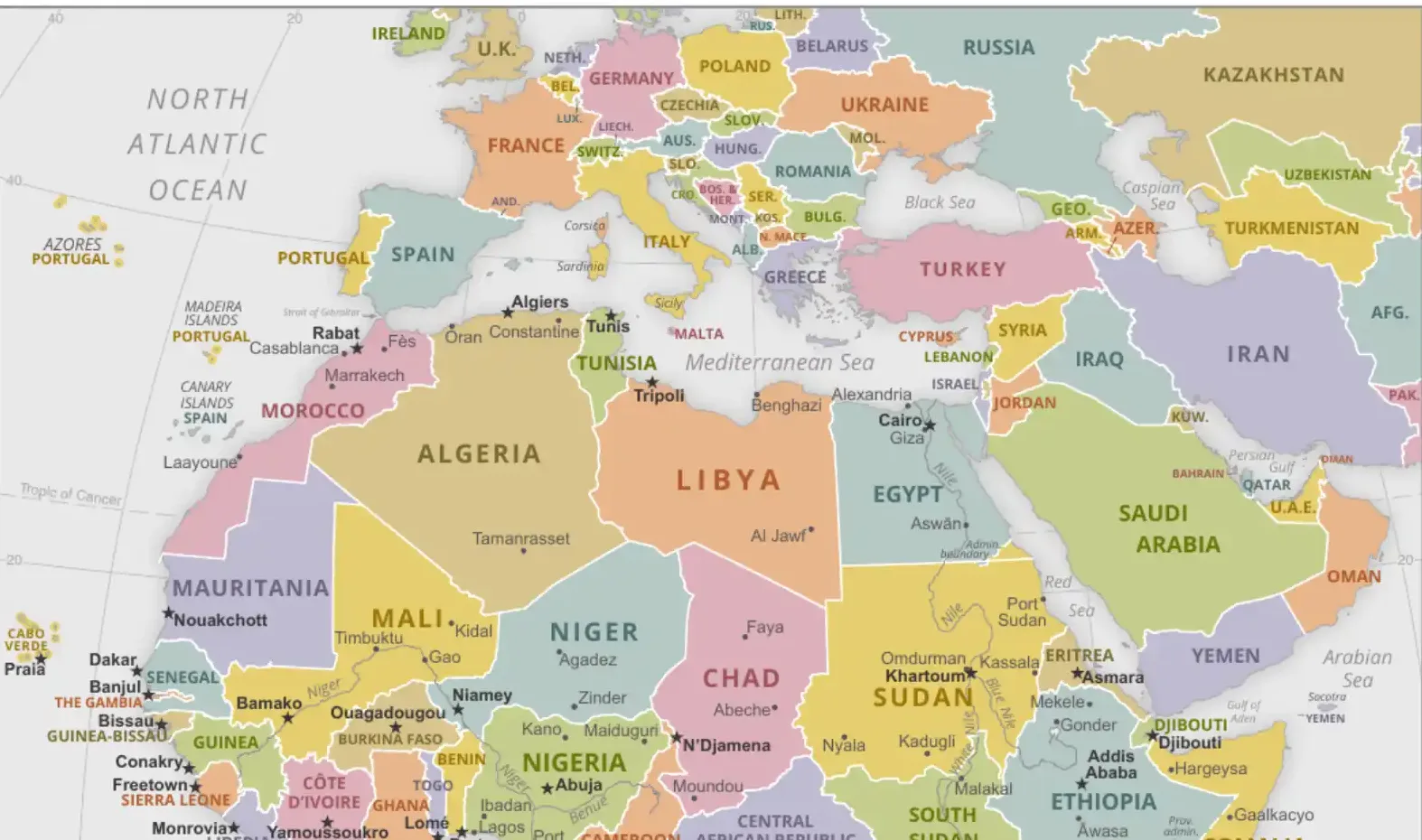
Last updated: September 2026
MENA is not the same as the Arab world. Most MENA countries are Arab League members where Arabic is the main language, but Iran (Persian), Turkey (Turkish) and Israel (Hebrew) are not Arab states. The region has a combined population of about 650 million, a large share of the world's proven oil and gas reserves, and three key shipping chokepoints: the Suez Canal, the Bab-el-Mandeb strait and the Strait of Hormuz. For the African side on its own, see our North Africa map. The interactive map above has a marker for each country, and the buttons filter them by sub-region, oil wealth or Arab League membership.
North African Countries in the MENA Region
North Africa forms the African component of the MENA region, comprising nations that share Mediterranean and Red Sea coastlines, desert landscapes, and deep historical connections to the Middle East through trade, culture, and religion.
🇪🇬 Egypt
Capital: Cairo
Population: about 116 million (2024)
Area: 1,001,450 km²
Languages: Arabic (official)
The most populous Arab country and a cultural centre of the Arab world, known for ancient pharaonic civilisation, the Suez Canal and the Nile Valley, where almost all Egyptians live. A New Administrative Capital is being built east of Cairo. Home to Al-Azhar University, one of Islam's most important institutions, and the crossroads between Africa and Asia.
Key Features: Ancient pyramids, Suez Canal, Arab cultural center, Nile River, historic Islamic institutions
🇱🇾 Libya
Capital: Tripoli
Population: about 7.4 million (2024)
Area: 1,759,540 km²
Languages: Arabic (official)
Africa's fourth-largest country with vast oil reserves and Mediterranean coastline. Known for ancient Roman cities like Leptis Magna, extensive Sahara Desert territory, and strategic location between Egypt and Tunisia. Major oil and gas producer.
Key Features: Major oil reserves, Roman archaeological sites, Mediterranean coast, Sahara Desert, strategic location
🇹🇳 Tunisia
Capital: Tunis
Population: about 12.3 million (2024)
Area: 163,610 km²
Languages: Arabic (official), French
Birthplace of the 2010–11 Arab Spring protests, known for ancient Carthaginian civilisation, well-preserved Roman ruins, and distinctive Mediterranean culture. Smallest North African country with diverse landscapes from beaches to Sahara.
Key Features: Arab Spring birthplace, Carthaginian heritage, Roman ruins, Mediterranean culture
🇩🇿 Algeria
Capital: Algiers
Population: about 47 million (2024)
Area: 2,381,741 km²
Languages: Arabic, Tamazight (Berber)
Africa's largest country by area, rich in oil and natural gas reserves. Known for French colonial history, Berber (Amazigh) culture, and diverse landscapes from Mediterranean coast to vast Sahara Desert. Major energy exporter to Europe.
Key Features: Largest African country, oil and gas wealth, Berber culture, French colonial heritage, Mediterranean coast
🇲🇦 Morocco
Capital: Rabat
Population: about 38 million (2024)
Area: 446,550 km²
Languages: Arabic, Tamazight (Berber), French
Kingdom with Atlantic and Mediterranean coastlines, just 14 km from Spain across the Strait of Gibraltar, known for its historic imperial cities, Berber culture, and proximity to Europe. Features the Atlas Mountains, Sahara Desert, and distinctive architecture. Major phosphate producer and growing tourism destination.
Key Features: Ancient imperial cities, Atlas Mountains, phosphate mining, tourism industry, European proximity
🇸🇩 Sudan
Capital: Khartoum
Population: about 50 million (2024)
Area: 1,861,484 km²
Languages: Arabic, English
Third-largest African country, bridging Arab North Africa and sub-Saharan Africa. Known for ancient Nubian kingdoms, the confluence of the Blue and White Nile at Khartoum and the pyramids of Meroë. A civil war between the army and the Rapid Support Forces since April 2023 has caused one of the world's largest displacement crises.
Key Features: Nile confluence, ancient Nubian civilization, cultural bridge, Meroe pyramids, diverse ethnicities
Geographic Connections and Boundaries
The MENA region's geography creates natural and cultural connections that transcend traditional continental boundaries, forming a coherent economic and cultural sphere.
Physical Geography
Shared Landscapes
- Mediterranean Basin: Shared climate, vegetation, and cultural exchange
- Sahara Desert: World's largest hot desert spanning North Africa
- Arabian Peninsula: Arid landscapes extending from Asia into Red Sea
- Mountain Ranges: Atlas Mountains, Zagros Mountains, Turkish highlands
Major Water Bodies
- Mediterranean Sea: Central to regional trade and cultural exchange
- Red Sea: Connecting Africa and Asia, crucial shipping route
- Persian Gulf: Center of global oil production and export
- Nile River: Lifeline of Northeast Africa, flowing to Mediterranean
Climate Patterns
- Mediterranean Climate: Coastal areas with mild, wet winters
- Arid Desert: Hot, dry conditions across interior regions
- Semi-Arid: Transitional zones supporting agriculture and pastoralism
- Subtropical: Parts of the Gulf and southern regions
Cultural and Religious Unity
Despite political boundaries and diverse histories, the MENA region shares profound cultural and religious connections that create regional identity and cooperation.
Arabic Language and Culture
Linguistic Unity
- Modern Standard Arabic: Official language in most MENA countries
- Regional Dialects: Local variations maintaining mutual intelligibility
- Literary Tradition: Shared classical Arabic literature and poetry
- Media: Pan-Arab television, newspapers, and digital media
Cultural Practices
- Hospitality: Traditional Arab hospitality customs
- Cuisine: Shared dishes, ingredients, and cooking methods
- Music and Arts: Common musical styles and artistic traditions
- Architecture: Islamic architectural influences and styles
Islamic Heritage
Religious Significance
- Holy Cities: Mecca, Medina, Jerusalem, and other sacred sites
- Pilgrimage: Hajj connecting Muslims worldwide
- Islamic Education: Al-Azhar and other traditional universities
- Legal Traditions: Islamic law influences on regional legal systems
Sectarian Diversity
- Sunni Islam: Majority sect across most of the region
- Shia Islam: Significant populations in Iran, Iraq, Lebanon
- Christian Communities: Ancient Christian populations throughout region
- Other Religions: Jewish, Druze, and other minority communities
Economic Integration and Oil Wealth
The MENA region's economy is characterized by vast energy resources, strategic trade routes, and growing economic integration despite political challenges.
Energy Resources
Oil and Gas Reserves
- Persian Gulf: World's largest oil reserves in Saudi Arabia, Iran, Iraq, UAE, Kuwait
- North Africa: Significant oil and gas in Libya, Algeria, Egypt
- Global Supply: MENA produces roughly a third of the world's oil
- Strategic Importance: Critical to global energy security
Economic Diversification
- UAE Model: Dubai and Abu Dhabi as regional business hubs
- Tourism: Egypt, Morocco, Turkey as major destinations
- Agriculture: Egypt's Nile Valley, Morocco's Atlas regions
- Manufacturing: Growing industrial sectors in several countries
Trade and Commerce
Historic Trade Routes
- Silk Road: Ancient trade routes connecting Asia, Africa, Europe
- Spice Routes: Maritime trade across Indian Ocean and Red Sea
- Trans-Saharan Trade: Gold, salt, and goods across the desert
- Mediterranean Commerce: Maritime trade around the sea
Modern Economic Cooperation
- Arab League: Economic cooperation among Arab nations
- GCC: Gulf Cooperation Council for Gulf states
- OPEC: Oil-producing countries coordination
- Regional Banks: Development banks and financial institutions
Historical Significance and Ancient Civilizations
The MENA region has been the birthplace and crossroads of major civilizations, religions, and empires that have shaped world history.
Ancient Civilizations
Mesopotamia (Iraq)
- Cradle of Civilization: World's first cities and writing systems
- Babylonian Empire: Advanced mathematics, astronomy, and law
- Code of Hammurabi: One of world's first legal codes
- Agriculture: Invention of irrigation and farming techniques
Ancient Egypt
- Pharaonic Civilization: 3,000+ years of continuous culture
- Pyramids: Architectural marvels and engineering achievements
- Hieroglyphics: Complex writing system and record keeping
- Trade Networks: Commerce throughout Africa and Mediterranean
Persian Empires
- Achaemenid Empire: First global empire spanning three continents
- Administrative Innovation: Efficient governance systems
- Cultural Tolerance: Respect for local traditions and religions
- Infrastructure: Royal roads and communication networks
Religious Origins
Abrahamic Religions
- Judaism: Ancient origins in the Levant
- Christianity: Birth and early spread throughout the region
- Islam: Origins in Arabian Peninsula, rapid expansion
- Sacred Sites: Jerusalem, Mecca, Medina, and other holy places
Islamic Golden Age
- Scientific Advances: Mathematics, astronomy, medicine, philosophy
- Cultural Centers: Baghdad, Cairo, Cordoba, Damascus
- Preservation of Knowledge: Greek and Roman texts translated and preserved
- Innovation: Algebra, optics, surgical procedures, architectural techniques
Modern Political Dynamics
The MENA region faces complex political challenges while working toward regional cooperation and stability.
Regional Organizations
Arab League
- Founded: 1945 to promote Arab unity and cooperation
- Members: 22 members, including all North African countries plus Mauritania, Somalia, Djibouti, Comoros and Palestine
- Headquarters: Cairo, Egypt
- Goals: Economic integration, cultural cooperation, political coordination
Organization of Islamic Cooperation (OIC)
- Scope: 57 member countries with Muslim populations
- Focus: Islamic solidarity and cooperation
- Initiatives: Economic development, cultural exchange, conflict resolution
- Institutions: Islamic Development Bank, cultural organizations
Contemporary Challenges
Political Transitions
- Arab Spring: Protest movements that began in Tunisia in December 2010
- Governance: Transitions between authoritarian and democratic systems
- Youth Movements: Large youth populations demanding change
- Economic Reform: Balancing stability with modernization
Regional Conflicts
- Israeli-Palestinian Conflict: Ongoing territorial and political disputes
- Syria: Civil war from 2011; the Assad government fell in December 2024, leaving a fragile transition
- Yemen Conflict: War since 2014, a severe humanitarian crisis, and Houthi attacks on Red Sea shipping since late 2023
- Sudan: Civil war since April 2023
- Refugee Crisis: Large displaced populations across the region
Strategic Importance and Global Connections
The MENA region's strategic location continues to make it crucial for global trade, energy security, and international relations.
Critical Chokepoints
Suez Canal (Egypt)
- Global Trade: Around 12% of world trade used the canal before Red Sea attacks from late 2023 diverted many ships around Africa
- Shipping Route: Connects Mediterranean and Red Seas
- Economic Impact: Billions in daily trade value
- Strategic Control: Egyptian sovereignty over crucial waterway
Strait of Hormuz (Persian Gulf)
- Oil Transit: About a fifth of global oil consumption passes through the strait
- Width: About 33 km (21 miles) at its narrowest point
- Regional Control: Iran and Gulf states control access
- Global Impact: Closure would disrupt world energy supplies
International Relations
Global Powers
- United States: Military presence and security partnerships
- European Union: Economic ties and energy imports
- China: Belt and Road Initiative investments
- Russia: Energy cooperation and military partnerships
Regional Power Dynamics
- Saudi Arabia: Guardian of Islam's holy sites, oil wealth
- Iran: Regional power with Shia influence
- Turkey: Bridge between Europe and Asia, NATO member
- Egypt: Most populous Arab country, cultural influence
Cultural Heritage and Tourism
The MENA region offers unparalleled cultural and historical attractions, making it a major global tourism destination.
UNESCO World Heritage Sites
Ancient Wonders
- Pyramids of Giza (Egypt): Last surviving ancient wonder
- Petra (Jordan): Rose-red city carved in rock
- Persepolis (Iran): Capital of ancient Persian Empire
- Palmyra (Syria): Ancient trading city in the desert
Islamic Architecture
- Kairouan (Tunisia): Great Mosque, one of the oldest in North Africa
- Historic Cairo (Egypt): Largest collection of Islamic architecture
- Fez Medina (Morocco): Medieval Islamic city
- Isfahan (Iran): Safavid architectural masterpieces
Modern Tourism Industry
Popular Destinations
- Egypt: about 15 million visitors (2024) to the pyramids, Nile and Red Sea
- Morocco: over 17 million visitors (2024) to the imperial cities and Atlas Mountains
- UAE: Dubai alone received about 19 million overnight visitors in 2024
- Turkey: over 50 million visitors a year to Istanbul, Cappadocia and the coast
Tourism Infrastructure
- Hotels: Luxury resorts and traditional accommodations
- Transportation: Modern airports and highway networks
- Guides: Multilingual tour services and cultural interpretation
- Conservation: Preservation of archaeological and cultural sites
Using Our Interactive MENA Map
The buttons above the map filter the country markers:
Map Features
- All MENA Countries: Complete overview of the entire Middle East and North Africa region
- North Africa: Focus on African countries within the MENA framework
- Middle East: Explore Asian countries of the region
- Oil Rich Countries: Highlight nations with significant energy resources
- Arab League Members: Show countries united by Arab identity and cooperation
Country Information
Click on any country marker to access:
- Basic facts: capital, population, area, languages
- A one-line description of the country
Related Maps
For the African countries in more detail, see the North Africa map, the North Africa region guide and Arabic-speaking countries in Africa. The Horn of Africa map covers the African shore of the Bab-el-Mandeb strait, and the Atlas Mountains map shows the main range of north-west Africa.
Frequently Asked Questions
What countries are included in the MENA region?
Most definitions include about 20 countries plus Palestine. North Africa: Egypt, Libya, Tunisia, Algeria, Morocco and Sudan. Middle East: Saudi Arabia, Iran, Iraq, Turkey, Syria, Lebanon, Jordan, Israel, Palestine, UAE, Kuwait, Qatar, Bahrain, Oman and Yemen. Some lists add Djibouti, Malta or Mauritania, or leave out Sudan and Turkey.
Which countries are in North Africa?
The UN counts six North African countries: Algeria, Egypt, Libya, Morocco, Sudan and Tunisia, plus the disputed territory of Western Sahara. Mauritania is often included in common usage, although the UN places it in West Africa.
Is North Africa part of the Middle East?
No. North Africa is geographically part of Africa, but it shares language, religion and history with the Arab Middle East, which is why the two are often grouped together as MENA.
Is MENA the same as the Arab world?
Not exactly. The Arab world is usually defined as the 22 Arab League members, which include Mauritania, Somalia, Djibouti and Comoros. MENA includes non-Arab Iran, Turkey and Israel but usually leaves out Somalia and Comoros.
What is the largest country in the MENA region?
Algeria is the largest by area, at 2,381,741 km², and is also the largest country in Africa. Egypt has the largest population, at about 116 million.
What languages are spoken in the MENA region?
Arabic is the main language in most countries. Other major languages are Persian (Iran), Turkish (Turkey), Hebrew (Israel), Kurdish, and Berber (Tamazight) languages in Morocco and Algeria. French and English are widely used as second languages.