Ethiopia: The Cradle of Humanity and Africa's Ancient Highland Kingdom
Ethiopia is a landlocked country in the Horn of Africa and, with about 135 million people (2025 UN estimate), the second most populous country in Africa after Nigeria. Its capital and largest city is Addis Ababa, seat of the African Union. Ethiopia covers about 1.1 million km², much of it high plateau split by the Great Rift Valley. It borders Eritrea, Djibouti, Somalia, Kenya, South Sudan and Sudan, and it was never colonised, apart from an Italian occupation from 1936 to 1941.
Ethiopia, officially the Federal Democratic Republic of Ethiopia, is one of Africa's oldest states. Spanning about 1,104,300 square kilometers of the Horn of Africa, it was never colonised (apart from Italy's occupation of 1936–1941), a distinction it shares only with Liberia. Its roughly 135 million people belong to more than 80 ethnic groups. Below you will find Ethiopia on the map of Africa, its highlands and Rift Valley, the fossil sites where "Lucy" was found, the ancient Christian kingdom of Aksum, the Blue Nile, and the basics of its economy and politics.
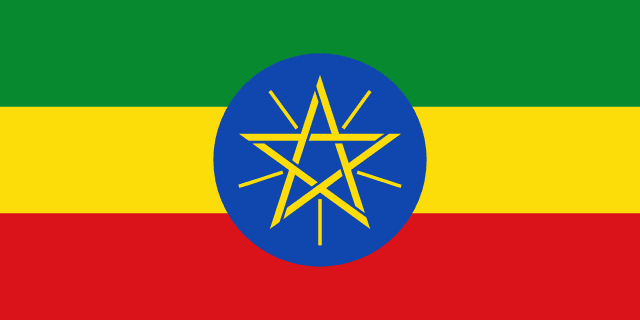
Flag of Ethiopia - Land of Origins
Ethiopia on the Map of Africa
View Ethiopia's strategic position in the Horn of Africa, serving as the continental headquarters of the African Union and a regional power:
Map of Ethiopia
Explore the detailed map of Ethiopia showing the Great Rift Valley, highland plateaus, Danakil Depression, Blue Nile source, and diverse regional landscapes:

Ethiopia Facts at a Glance
| Official name | Federal Democratic Republic of Ethiopia |
|---|---|
| Capital | Addis Ababa |
| Largest city | Addis Ababa |
| Region | East Africa |
| Population | About 135 million (2025 UN estimate) |
| Area | 1,104,300 km² (426,372 sq mi) – landlocked since Eritrea's independence in 1993 |
| Coastline | Landlocked |
| Official languages | Amharic is the main federal working language; Afaan Oromo, Tigrinya, Somali and Afar were approved as additional federal working languages in 2020. More than 80 languages are spoken |
| Currency | Ethiopian birr (ETB) |
| Government | Federal parliamentary republic |
| Independence | Never colonised; Italy occupied the country from 1936 to 1941 |
| Neighbouring countries | 6: Eritrea, Djibouti, Somalia, Kenya, South Sudan, Sudan |
| Administrative divisions | 12 regional states and 2 chartered cities (Addis Ababa and Dire Dawa) |
| Main cities | Addis Ababa, Dire Dawa, Mekelle, Adama, Gondar, Hawassa, Bahir Dar |
| Highest point | Ras Dashen, about 4,550 m (14,930 ft), in the Simien Mountains; lowest point the Danakil Depression (about −125 m) |
| Rivers and lakes | Blue Nile (Abay), which leaves Lake Tana; Awash, Omo, Tekezé, Shebelle and Genale; the Grand Ethiopian Renaissance Dam on the Blue Nile |
| Climate | Temperate in the highlands (Addis Ababa, about 2,350 m, averages around 16°C); hot and dry in the eastern lowlands and Danakil; main rains June–September |
| Economy | Agriculture (coffee is the top export; Ethiopia is Africa's largest coffee producer), services and Ethiopian Airlines; the birr was floated in 2024 |
| Time zone | UTC+3 (East Africa Time) |
| Calling code | +251 |
Population figures are rounded 2025 estimates from the UN World Population Prospects 2024 unless stated otherwise. Facts checked September 2026.
See also: Addis Ababa city guide, countries of East Africa, Horn of Africa map, landlocked countries in Africa, most populous countries in Africa, African independence timeline.
Ethiopia's Strategic Position in the Horn of Africa
Ethiopia occupies a commanding position in the Horn of Africa, serving as the geographic and political heart of the region. The country shares borders with Eritrea to the north, Djibouti to the northeast, Somalia to the east, Kenya to the south, South Sudan to the west, and Sudan to the northwest. This central location has made Ethiopia a natural crossroads for trade, migration, and cultural exchange between sub-Saharan Africa, the Middle East, and the broader world for millennia.
As a landlocked nation since Eritrea's independence in 1993, Ethiopia depends on neighboring ports for international trade, particularly Djibouti's port, which handles roughly 90% or more of Ethiopian imports and exports. The country's highland position, with much of its territory above 1,500 meters elevation, creates a unique "water tower" effect that feeds major river systems including the Blue Nile, which provides approximately 80% of the Nile's water during flood season.
Addis Ababa, Ethiopia's capital and Africa's diplomatic capital, hosts the African Union headquarters and numerous international organizations, reinforcing Ethiopia's role as a continental leader. The city's elevation of 2,355 meters makes it one of the world's highest capital cities, contributing to its pleasant year-round climate and nickname as the "political capital of Africa."
Diverse Geographical Landscapes and the Great Rift Valley
Ethiopia's geography encompasses some of Earth's most dramatic and diverse landscapes, from some of Africa's highest peaks to one of the lowest land areas on Earth. The Great Rift Valley cuts through the country from northeast to southwest, creating a geological wonderland that continues shaping Ethiopia's landscape through active volcanism, earthquakes, and ongoing continental drift. This same rift system that divided continents also preserved the fossil remains that make Ethiopia crucial to understanding human evolution.
The Ethiopian Highlands, often called the "Roof of Africa," dominate the landscape, with plateaus mostly between 1,500 and 3,000 meters and peaks above 4,500 meters, led by Ras Dashen (about 4,550 m). The Simien Mountains in the north and Bale Mountains in the southeast create alpine environments home to endemic species found nowhere else on Earth. These highlands, separated by the Rift Valley, consist of ancient volcanic rocks that have weathered into fertile soils supporting intensive agriculture and dense human populations.
The Danakil Depression, part of the larger Afar Triangle, represents one of Earth's most geologically active regions where three tectonic plates meet. This region contains Dallol hydrothermal field with its colorful mineral deposits, active volcanoes like Erta Ale with its permanent lava lakes, and areas below sea level that showcase what continental rifting looks like in real time. The harsh beauty and scientific importance of the Danakil make it one of Earth's most otherworldly destinations.
Climate Zones and Highland Weather Patterns
Ethiopia's equatorial position combined with dramatic elevation changes creates diverse climate zones that Ethiopians traditionally classify into three main categories: kolla (lowlands below 1,500m with hot, arid conditions), woina dega (temperate highlands between 1,500-2,500m), and dega (cool highlands above 2,500m). This classification system reflects centuries of understanding how elevation affects agriculture, settlement patterns, and daily life.
The highlands enjoy temperate climates with moderate temperatures year-round, making them ideal for human habitation and agriculture. Rainfall patterns follow two main seasons: the kiremt (main rainy season from June to September) brings monsoon rains that support agriculture, while the belg (smaller rainy season from February to April) provides additional moisture. These patterns have shaped Ethiopian agricultural cycles and cultural practices for thousands of years.
Lowland regions experience hot, arid conditions with minimal rainfall and extreme heat: Dallol in the Danakil Depression has one of the highest average annual temperatures on Earth, around 35°C. Despite harsh conditions, these areas support pastoralist communities who have developed sophisticated strategies for managing livestock and navigating challenging environments. Climate variability and periodic droughts remain significant challenges requiring adaptive management and international support.
Cradle of Humanity: Lucy and Human Origins
Ethiopia's significance to human understanding extends far beyond its cultural and political importance to encompass its role as the "Cradle of Humanity." The Great Rift Valley's geological processes have preserved extraordinary fossil evidence that illuminates human evolution over millions of years. The discovery of "Lucy" (Australopithecus afarensis) in 1974 near Hadar revolutionized understanding of early human ancestors and placed Ethiopia at the center of paleoanthropological research.
Lucy, whose 3.2-million-year-old skeleton remains about 40% complete, provided crucial evidence that early human ancestors walked upright long before brains grew large. The fossil's scientific name, Australopithecus afarensis, references the Afar region where she was found, while Ethiopians know her as "Dinkinesh," meaning "you are marvelous" in Amharic. This discovery sparked decades of additional research that has yielded numerous other significant finds.
The Awash Valley, Omo Valley, and Middle Awash regions continue yielding important fossil discoveries that push back the timeline of human evolution and reveal the complexity of early human societies. Later finds include Ardipithecus ramidus ("Ardi"), dating to 4.4 million years ago, and Australopithecus garhi, which showed evidence of tool use. These scientific discoveries make Ethiopia essential to understanding human origins and evolution.
Ancient Civilization: The Kingdom of Aksum
Ethiopia's recorded history spans over 3,000 years, with the ancient Kingdom of Aksum (approximately 100-960 CE) representing one of the world's great trading empires. Aksum controlled trade routes between the Roman Empire and Ancient India, making it enormously wealthy and influential. The kingdom's capital, also called Aksum, featured massive stone obelisks (stelae) that still stand today as monuments to this ancient civilization's architectural and engineering achievements.
The Kingdom of Aksum was among the first nations to officially adopt Christianity, with King Ezana's conversion in the 4th century CE establishing Christianity as the state religion. This early adoption of Christianity, combined with Ethiopia's geographic isolation in the highlands, allowed the development of a unique Ethiopian Orthodox tradition that maintained independence from both Roman Catholicism and Byzantine Orthodoxy. The church developed its own liturgical language (Ge'ez), calendar system, and religious practices.
Aksumite achievements included sophisticated architecture, advanced agriculture using terracing and irrigation, international diplomacy, and a monetary system with gold, silver, and bronze coins. The kingdom's decline coincided with the rise of Islam, which cut off traditional Red Sea trade routes, but Ethiopia's highlands provided refuge where ancient traditions could survive and evolve independently.
Ethiopian Orthodox Christianity and Religious Heritage
Ethiopian Orthodox Christianity represents one of the world's oldest Christian traditions, with beliefs and practices that have remained largely unchanged for over 1,600 years. The Ethiopian Orthodox Tewahedo Church was historically led by bishops sent from the Coptic Church of Alexandria until it became self-governing in 1959, and it maintains that the Ark of the Covenant resides in Aksum's Church of Our Lady Mary of Zion, making Ethiopia a pilgrimage destination for Christians worldwide.
The church's influence permeates Ethiopian culture through its liturgical calendar, fasting practices, art, music, and social organization. Ethiopian Orthodox Christians follow a calendar with 13 months and celebrate Christmas on January 7th and Epiphany (Timkat) with elaborate ceremonies involving blessed water and processions. The church's monastic tradition has preserved ancient manuscripts, religious art, and theological scholarship in monasteries throughout the highlands.
Lalibela, often called the "New Jerusalem," showcases the pinnacle of Ethiopian Orthodox architecture through its 11 rock-hewn churches carved directly into volcanic rock during the 12th and 13th centuries. These churches, still active today, demonstrate sophisticated engineering and deep religious devotion. Each church was carved from solid rock, creating complex architectural features including windows, doors, columns, and drainage systems entirely below ground level.
The Blue Nile and Water Resources
Ethiopia's highlands serve as the source of the Blue Nile, which begins at Lake Tana and flows northwest toward Sudan where it joins the White Nile to form the main Nile River. The Blue Nile provides approximately 80% of the Nile's water during flood season, making Ethiopia crucial to water security for downstream countries including Sudan and Egypt. Lake Tana, Ethiopia's largest lake, supports diverse ecosystems, ancient monasteries on its islands, and fishing communities.
The Grand Ethiopian Renaissance Dam (GERD) on the Blue Nile, near the Sudanese border, is Africa's largest hydroelectric project, with an installed capacity of about 5,000 megawatts; construction began in 2011 and the dam was completed in 2025. It lets Ethiopia export electricity to neighbours, but Egypt and Sudan, concerned about water security, never reached a binding agreement with Ethiopia on how the reservoir is filled and operated.
Beyond the Blue Nile, Ethiopia's highlands feed numerous other river systems including tributaries of the White Nile and rivers flowing toward the Indian Ocean. These water resources support agriculture, hydroelectric generation, and urban water supplies, though climate variability and population growth create ongoing challenges for water management and regional cooperation.
Addis Ababa: Africa's Diplomatic Capital
Addis Ababa, founded by Emperor Menelik II in 1886, has grown from a highland settlement into Africa's diplomatic and political capital. With more than 5 million inhabitants in its metropolitan area, the city serves as headquarters for the African Union, the United Nations Economic Commission for Africa, and numerous other international organizations. The city's name means "new flower" in Amharic, reflecting Empress Taytu's vision of a beautiful highland capital.
The city's elevation of about 2,355 meters gives it a mild climate year-round, with average temperatures around 16°C. Addis Ababa's role as the continental headquarters makes it a hub for diplomatic activity, international conferences, and African integration efforts. The African Union headquarters, inaugurated in 2012, symbolizes African unity and Ethiopia's leadership role in continental affairs.
Modern Addis Ababa blends traditional Ethiopian culture with international influences, featuring traditional markets like Merkato (one of Africa's largest open-air markets) alongside modern shopping centers, universities, and cultural institutions. The National Museum houses Lucy's remains and other archaeological treasures, while the Ethnological Museum showcases Ethiopia's remarkable cultural diversity.
Cultural Diversity: Over 80 Ethnic Groups
Ethiopia's population encompasses extraordinary diversity with over 80 ethnic groups speaking more than 90 languages, making it one of the world's most linguistically diverse countries. At the last census (2007), the Oromo made up about 34% of the population, followed by the Amhara (about 27%), Somali and Tigrayans (about 6% each) and Sidama (about 4%), with dozens of smaller groups contributing to the national tapestry. This diversity reflects thousands of years of migration, cultural exchange, and adaptation to different environments.
The federal constitution of 1995 organises the country into largely ethnically based regional states; new states created for the Sidama (2020), South West Ethiopia (2021) and Central and South Ethiopia (2023) have brought the total to 12, plus the chartered cities of Addis Ababa and Dire Dawa. Amharic is the main federal working language, and in 2020 the government approved Afaan Oromo, Tigrinya, Somali and Afar as additional federal working languages; regions use their own languages in schools and administration. This linguistic diversity creates both opportunities for cultural preservation and challenges for national communication.
Traditional cultural practices remain vibrant across ethnic groups, from Oromo gada (age-grade governance systems) to Amhara religious festivals, Tigray historical traditions, and pastoralist customs among groups like the Afar and Somali. Each group contributes unique perspectives on agriculture, livestock management, craft production, music, and social organization that enrich Ethiopian national culture.
Coffee: Ethiopia's Gift to the World
Ethiopia holds the distinction of being coffee's birthplace, where the arabica coffee plant (Coffea arabica) originated in the highland forests. According to legend, a goat herder named Kaldi discovered coffee when he noticed his goats becoming energetic after eating certain berries. Whether legendary or historical, coffee cultivation and consumption have been central to Ethiopian culture for over 1,000 years, with elaborate coffee ceremonies remaining important social rituals.
Ethiopian coffee culture encompasses not just cultivation but sophisticated preparation and consumption rituals that strengthen social bonds and community relationships. The traditional coffee ceremony involves roasting green beans over charcoal, grinding them by hand, and brewing in a clay pot called a jebena. This process, performed three times (abol, tona, and baraka), can take several hours and serves as an important social activity that brings families and communities together.
Ethiopia produces some of the world's finest coffee, with distinct regional varieties from areas like Sidamo, Yirgacheffe, and Harar each offering unique flavor profiles reflecting local soil, climate, and processing methods. Coffee exports provide crucial foreign exchange earnings for Ethiopia's economy while supporting millions of smallholder farmers. The industry faces challenges from climate change and market volatility but remains central to Ethiopian culture and economy.
Unique Wildlife and Endemic Species
Ethiopia's diverse landscapes and long geographic isolation have produced remarkable endemic wildlife found nowhere else on Earth. The Ethiopian Highlands support unique species adapted to mountain environments, including the endangered Ethiopian wolf (the rarest canid in the world), Gelada monkeys (found only in Ethiopia's highlands), and Walia ibex (a wild goat species endemic to the Simien Mountains). These species represent evolutionary adaptations to specific highland environments.
The Simien Mountains National Park, a UNESCO World Heritage site, protects dramatic landscapes and endangered species including Ethiopian wolves, Gelada monkeys, and numerous endemic birds. The park's jagged mountain peaks, deep valleys, and afro-alpine vegetation create spectacular scenery while supporting unique ecosystems. Trekking in the Simiens offers opportunities to see endemic wildlife while experiencing some of Africa's most dramatic mountain landscapes.
The Bale Mountains, home to the largest population of Ethiopian wolves, showcase different highland ecosystems including montane forests, bamboo zones, and afro-alpine moorlands. These mountains support over half of Ethiopia's endemic bird species and provide crucial water catchment for surrounding areas. Conservation efforts work to protect these unique species while supporting local communities who share the landscape with endangered wildlife.
Ancient Rock-Hewn Churches and Historical Sites
Lalibela's rock-hewn churches represent one of humanity's most remarkable architectural achievements, with 11 churches carved entirely from solid volcanic rock during the 12th and 13th centuries. King Lalibela commissioned these churches to create a "New Jerusalem" in the Ethiopian highlands, designing them as a pilgrimage site that would allow Ethiopians to experience holy sites without traveling to Jerusalem. Each church was carved downward from ground level, creating complex three-dimensional buildings entirely below the surface.
The Church of St. George (Bet Giyorgis), carved in the shape of a perfect Greek cross, represents the architectural pinnacle of Lalibela's churches. Other notable churches include Bet Maryam (House of Mary), believed to be the first church carved, and Bet Medhane Alem (House of the Savior of the World), the largest rock-hewn church in the world. These churches remain active today, with thousands of pilgrims visiting during major religious festivals like Timkat and Christmas.
Beyond Lalibela, Ethiopia contains numerous other historical sites including the ancient obelisks of Aksum, the castles of Gondar (often called the "Camelot of Africa"), and hundreds of monasteries and churches throughout the highlands. Many monasteries house ancient manuscripts, religious artifacts, and artwork that preserve Ethiopian Christian traditions dating back over 1,000 years.
Traditional Festivals and Cultural Celebrations
Ethiopian festivals reflect the country's religious calendar and cultural diversity, with celebrations that combine ancient traditions with contemporary expressions of identity. Timkat (Epiphany), celebrated in January, represents the most important Orthodox festival, featuring elaborate processions where replica Arks of the Covenant (tabots) are carried to bodies of water for blessing ceremonies. The festival culminates with mass baptisms and celebrations that can last for days.
Meskel (Finding of the True Cross), celebrated in September, features the lighting of massive bonfires (demera) that symbolize the finding of the cross on which Jesus was crucified. The festival brings communities together for dancing, singing, and feasting while marking the end of the rainy season and beginning of the flowering season. UNESCO recognized Meskel as an Intangible Cultural Heritage of Humanity.
Regional festivals celebrate different ethnic traditions, from Oromo Irreecha (thanksgiving) ceremonies to Tigray cultural festivals, each offering insights into specific cultural practices, traditional music, dance, and social organization. These festivals maintain cultural continuity while adapting to modern circumstances, often becoming important tourist attractions that support local economies.
Economic Development and Agricultural Heritage
Ethiopia, Africa's second most populous country, has an economy traditionally based on agriculture, which still employs around two-thirds of workers. The country's highland agriculture has supported dense populations for thousands of years through sophisticated farming systems that include terracing, crop rotation, and integrated livestock management. Traditional crops include teff (a grain unique to Ethiopia), barley, wheat, sorghum, and maize.
Teff, Ethiopia's indigenous supergrain, has gained international recognition for its nutritional value and gluten-free properties. This tiny grain, used to make injera (Ethiopia's staple flatbread), grows well in highland conditions and provides complete protein along with essential minerals. Injera serves not only as food but as a plate and utensil, with communal eating from shared injera reinforcing social bonds and cultural practices.
Ethiopia's economy has diversified beyond agriculture to include manufacturing, services, and infrastructure development. Industrial parks built in the 2010s attracted textile and garment makers, although the loss of duty-free access to the US market under AGOA in 2022 hurt exports. After defaulting on a Eurobond payment in December 2023, Ethiopia floated the birr in July 2024 under an IMF-supported reform programme, and the currency lost much of its value.
Language and Literature Heritage
Ethiopia's linguistic heritage includes Ge'ez, an ancient Semitic language that serves as the liturgical language of the Ethiopian Orthodox Church and preserves a vast literature of religious texts, historical chronicles, and philosophical works. Ge'ez script, with its distinctive syllabic writing system, has been adapted for modern Ethiopian languages including Amharic and Tigrinya. Many ancient manuscripts written in Ge'ez provide crucial insights into Ethiopian history, theology, and culture.
Amharic, the federal working language, belongs to the Semitic language family and serves as a lingua franca for much of Ethiopia. The language has a rich literary tradition including both oral and written forms, with epic poems, historical chronicles, and religious texts that preserve Ethiopian cultural memory. Modern Amharic literature addresses contemporary themes while maintaining connections to traditional forms and styles.
Oral traditions remain vitally important across Ethiopia's ethnic groups, with storytelling, praise poetry, and historical narratives that preserve cultural knowledge and values. These traditions include everything from historical accounts of ancient kingdoms to practical knowledge about agriculture, medicine, and social organization. The preservation and documentation of these oral traditions represents ongoing efforts to maintain cultural heritage in rapidly changing contexts.
Tourism Potential and Cultural Heritage Sites
Ethiopia's tourism potential encompasses historical sites, natural attractions, cultural experiences, and archaeological discoveries that appeal to diverse interests. The Historic Route, connecting Addis Ababa through Lalibela, Gondar, and Aksum, provides access to Ethiopia's most important historical and religious sites. These destinations offer insights into ancient civilizations, religious traditions, and architectural achievements that rival any in the world.
Adventure tourism opportunities include trekking in the Simien or Bale Mountains, exploring the Danakil Depression's geological wonders, and birdwatching in diverse ecosystems that support over 850 bird species. The Omo Valley in southern Ethiopia offers cultural tourism experiences with indigenous communities who maintain traditional lifestyles, though such tourism requires careful management to respect local cultures and environments.
Ethiopia's coffee tourism has emerged as a unique attraction, allowing visitors to experience coffee culture from forest cultivation through traditional preparation ceremonies. Coffee tours provide insights into agricultural practices, cultural traditions, and the social importance of coffee in Ethiopian life. These experiences demonstrate how cultural tourism can support local communities while preserving traditional practices.
Challenges and Opportunities for Development
Ethiopia faces significant development challenges including rapid population growth (UN projections exceed 200 million people by 2050), climate variability, and the need for economic diversification. Periodic droughts continue affecting agricultural production and food security, while rapid urbanization strains infrastructure and services. Armed conflict has been the most serious setback: the 2020–2022 war in Tigray killed very large numbers of people before the Pretoria peace agreement of November 2022, and insurgencies in the Amhara and Oromia regions have continued since.
However, Ethiopia's opportunities are substantial, including a young population (with a median age under 20), abundant renewable energy potential from hydroelectric and geothermal sources, and strategic location for regional trade. Its role as host of the African Union and its large domestic market remain important assets. Infrastructure investments including roads, railways, and telecommunications support economic growth and regional integration.
Climate change presents both challenges and opportunities, with changing rainfall patterns affecting agriculture while creating needs for adaptation strategies. Ethiopia's experience with drought management, early warning systems, and community-based adaptation provides models for other countries facing similar challenges. International cooperation and investment in sustainable development could help Ethiopia achieve its potential while contributing to regional stability and prosperity.
Conclusion: Ethiopia's Enduring Significance on Africa's Map
Ethiopia's position on the map of Africa represents far more than geographical coordinates - it marks the location of humanity's birthplace, one of the world's oldest continuous civilizations, and a nation that maintained its independence through centuries of colonial pressure. From the fossil fields where Lucy was discovered to the rock-hewn churches of Lalibela, from the source of the Blue Nile to the diplomatic halls of Addis Ababa, Ethiopia offers experiences that connect visitors to the deepest roots of human history and African civilization.
Understanding Ethiopia's place on the African map means seeing both an ancient state with its own script, calendar and church, and a large, young country working through conflict, economic reform and rapid population growth.
Ethiopia: Frequently Asked Questions
What is the capital of Ethiopia?
The capital of Ethiopia is Addis Ababa.
What is the population of Ethiopia?
Ethiopia has about 135 million people (2025 UN estimate). The largest city is Addis Ababa.
How big is Ethiopia?
Ethiopia covers 1,104,300 km² (426,372 sq mi), landlocked since Eritrea's independence in 1993.
What language is spoken in Ethiopia and what is its currency?
Amharic is the main federal working language; Afaan Oromo, Tigrinya, Somali and Afar were approved as additional federal working languages in 2020. More than 80 languages are spoken. Currency: Ethiopian birr (ETB).
Which countries border Ethiopia?
Ethiopia borders Eritrea, Djibouti, Somalia, Kenya, South Sudan and Sudan.
Was Ethiopia ever colonised?
No. Ethiopia was never colonised; Italy occupied it from 1936 to 1941. Its neighbour Eritrea, however, was an Italian colony from 1890 to 1941.